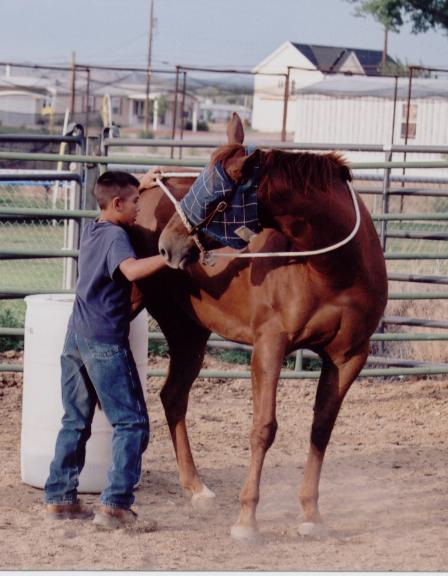
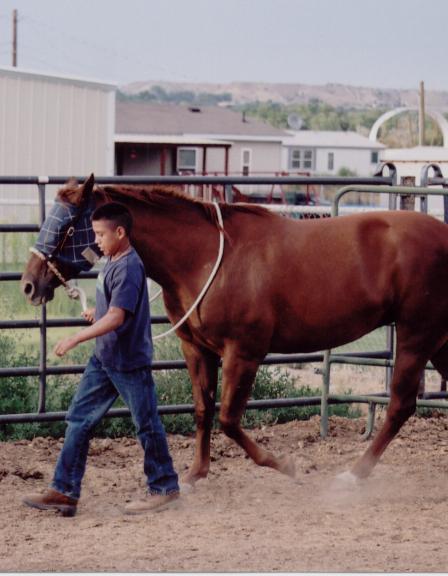
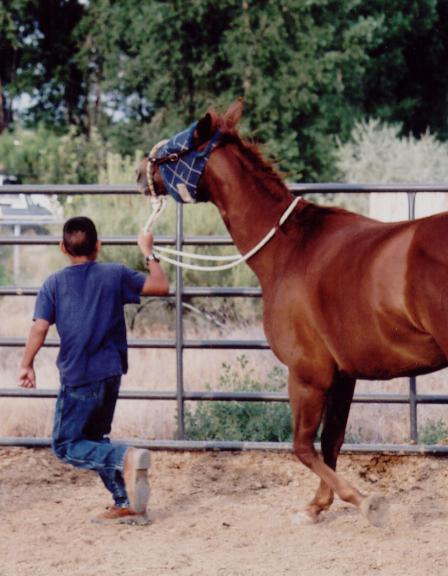
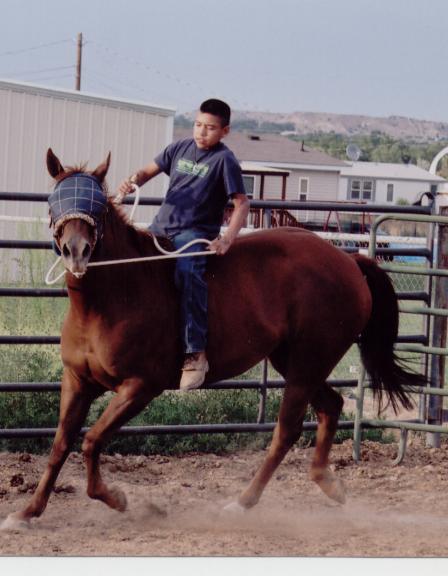
This little gal of 15 hands. Spoiled and spoiled some more. Yeah, cute when they are babies. And even more cuter when they don't want to listen and become mischievious. Trouble when they become big, and they sure ain't cute anymore. So, what happens to them? Well, they become a problem. They go through different trainers until one suits them. Sometimes, they end up in the auction line, or the meat plant if they are not lucky.
This gal here learned to back up, turn, and stop at a simple command. When I saw three men get out of the truck when she arrived I said "Is she that bad?" They all laughed. One was the recommender, the other was the owner, and the other he wanted to do the training. Unfortunately the owner and the brother knew how he trained horses and they didn't want him to do it. So, he came to check us out. My son and I. Of course, he sized us up and down and see how we would handle her. To me she was simple.
The first thing we do when we get the horse is have the owner do a run down on their horse. Then we figure out WHY they are they being a problem. The areas I check: Physical/Medical problem, Psychological issues, Simple miscommunications and confusions..and et cetra. Then we ask them where did they get the horse? Did they have it since they were a foal? Or were they bought through other owners? Where and how, if any applies to them, did they get their training. How was it? Then, we sit there and watch them for awhile and check them out. We do simple test runs on them to see how they react to certain things. A lot of times we go back to basic ground training so the horse would know what is expected out of them while they are with us. No, there is no harsh handling, I really don't believe in hitting the horse until they respond. One of the things I learned when you do that is, the horse becomes aggressive one way or another. First the horse will do anything to avoid the pressure, if it is kept being used the horse will try to escape (Their first response to uncomfortable situation), then fear sets in, when that happens. The horse becomes dangerous. So, it's always best to "HELP THE HORSE", rather than become overly pushy with them. Also, training should only be limited to 20 min. per lesson, two or three times a day. Like they say "Always leave on good terms." and "Stop when progress is made, even if it is just a tiny bit of progress." If you really think about it, we teach our children the same way, the same way we learned.. If it worked on us, why not them?
You also, have to remember. When the foal's mother or herd is disciplining the foal..it is much harsher. They bite, nip, kick, charge..just to name a few. With us, it's not so bad, but they learn when not push buttons. Quickly, you have only less than 3 seconds to react to their naughtiness. But when the three seconds is up, you just have to wait for that to happen again, and be consistent. This is VERY IMPORTANT. You can't discipline them any later than that, because they don't understand why you would act that way. It's like I see you do something wrong, ten minutes later I slap your hand, you will be like "Why'd you do that???"
I am running out of space, so I hope this helped some. Now, I know you probably thinking... Why is the kid the only one working? Well, someone has to take the photos. Besides, I might scare you. ha ha ha Even so, break the camera.
Take care, if you have any questions, email me. |