Jorge Conesa's Didjeridoo Page
Welcome Bellingham Mystical Didjeridoos Figures 1 and 2 Figures 3 and 5
Figure 4 Ordering Information Other Didjeridoo Sites

Welcome to this site! I'd like to share my enthusiam of playing and building didjeridoos with beginners and experts. The arts of playing and making didjeridoos are intimately connected. Since the instrument is relatively easy to make and shape a lot of good playersmake their own instruments. This insures that a specific and personalized signature sound is maintained.
An authentic sounding didj, derives its sounds qualities both from the ability of the player and the uniqueness of the design and materials. Tradinional Australian aborigene's didjs begin to be "crafted" (hollowed out) in nature by "white ants" ot termites. However, the selection and finishing of the (typically an eucalyptus) branch into the finished instrument is/was at the discretion of individual player. For me, playing and making didjs began after a trip to Australia. At the time I was too poor to purchase and "authentic" gum tree (eucalyptus) didj. That did not prevent me from inspecting several dozen top-of-the-line instruments, taking dimensions and making notes on their construction.
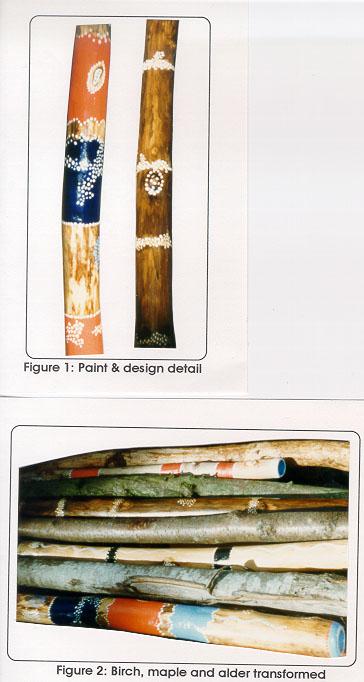
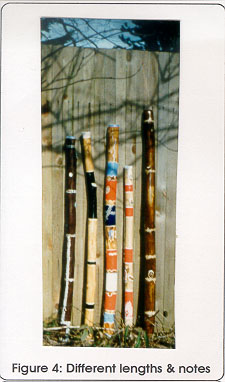
After much trial and error and exploring several variables while using native and eucalytpus wood (maple, birch and alder) -minus-the termites- I isolated several acoustic constraints whcih give rise to an "authentic" didjeridoo tone and voice.
In its basic form, a didjeridoo
is a tube about four to six (or longer) feet in length and 1 to 2 inches
in inside diameter. This descriptions allows for the utilization
of multiple materials to produce good quality sounding instruments from
plastic PVC to glass pipes, from agave atalks to carbon composite tubing.
Yet there is something about the feeling of real, carfted wood that makes
the sound and the playing of didjeridoos a unique experience. It
is this experience that I want to share with other palyers, or anyone who
wishes to display functional art.
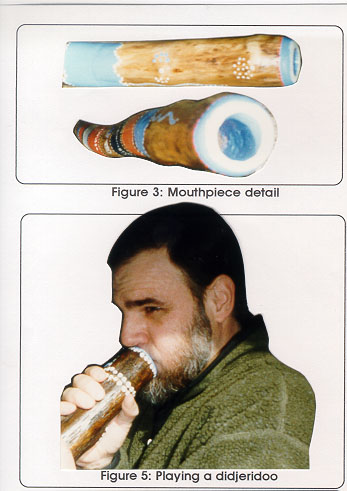
We carve the mouthpiece to fit an average lip size rather than form it out of beeswax. We believe that this change, in addition to being more hygenic, allows for easy maintanance of that section of the instruments wihtout having to reshape the coil of wax. Figures 3 and 5 show details of the mouth piece and how its fits into a player's lips.
Other Didjeridoo
Sites
Aboriginal
Myth
About the Origins of the Didjeridoo (Bew Bew The Giant)
Didjeridoo Music
Yothu
Yindi's Interactive Site
Didj Playing Tutorials (Yes!
Circular Breathing Too)
The
Most Complete Tutorial
Toot
and Hoot's Primitive Instruments Page
ARTculture
Australia
Making Didjs
Agave
Doos bt Michael Gilman
Cheap,
Quick and Dirty, (Dennis Havlena)
Seminars and Mystical
Sedona
Sacred Sounds
Northern
Sonoran Didjeridoo and Dreamtime Pipe Co.
Welcome
Bellingham Mystical Didjeridoos
Figures 1 and 2
Figures 3 and 5
Figure 4
Ordering Information
Other Didjeridoo Sites
Return to top of the page