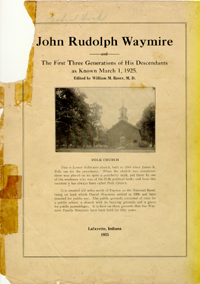
Excert
from "John Rudolph Waymire", edited by William M. Reser, M.D., Lafayette,
Indiana, 1925.1���� "John Rudolph Waymire was
born in Hanover, Germany about the year 1725. � He was tall, erect and of great
physical strength.� After having served his term of military service as required in
those days, he was retained by the king as an officer in his body guard.� Six feet
six inches in height and two hundred and twenty-five pounds in weight was the minimum
physical requirement to become a member of this unit.�
���� The king being impressed
by his executive ability and undaunted courage, soon made him governor of a province that
had recently been acquired through conquest. � Ere long, he aroused the displeasure
of the king by refusing to execute a mandate which he considered unjust.� For this
insubordination he was thrown into prison for thirty days.� Upon release he openly
voiced his displeasure of the punishment bestowed and vowed he would leave the
country.� The king hearing of this had him again placed in prison for a like period
of time.� This did not dispel his anger but taught him to be more cautious of his
speech.� So he quietly made his plans to go to America.
���� In the summer of 1753,
he, with his wife and two children, his father and mother and two sisters, took passage at
Hamburg on the ship Leathley.� After a long and perilous journey of several weeks,
during which the mother died and was buried at sea, the party landed at Philadelphia
� September 19, 1753.� In the Pennsylvanial archives is the Ship List of the
Leathley for this trip in which appears the name "Johan Ludolph Weymeyer" signed
by himself in a very legible hand.� The spelling of the name plainly shows that it
had not as yet been anglicized.� In the same list appears the name "Voltine
Weymeyer" signed by himself.� Probably this was the father, although tradition
has always stated his name was John.� He may have had a double name, John Valentine.
� The women and children on that boat were not listed; to us a very regrettable
omission, because if they had been we would have learned their given names.
���� Upon landing in
Philadelphia, the sisters were separated from the other members of the family and never
afterwards were seen or heard of.
���� John Rudolph with his
family, including the father settled somewhere in the rural districts of Pennsylvania, to
us not known, where the father died in 1857�.
� That same year the family moved to what is now Randolph County, North Carolina and
settled on the Uwarie river.� At that time Guilford County included, among other
lands, the territory within the present boundaries of Randolph County.� Here he
resided the remainder of his days; and it was here on one of the clay hills of the old
North State that his remains were laid to rest.
���� His death occurred in
1801�, some time between July 26th, and Nov. 1st.
� We thus fix the time by the fact that his will was written July 26, 1801 and
probated at the first of the November term of court the same year.
���� He was twice married.
� Unverified tradition states his first, or German wife's name was Lough.� She
bore him eight children; the fist one being a boy, all the others, girls.� His second
wife, according to tradition, was Miss Elizabeth Louck, but his will states "my
beloved wife Molly".� She may have been named Mary Elizabeth.� She bore him
seven children, all boys: making a total of fifteen children, all of whom grew to manhood
and womanhood, married and had families.
���� It is conservatively
estimated that up to the present time� Rudolph
Waymire has had more than thirty thousand descendants.
���� These people, mainly
farmers, were not altogether pleased with the agricultural conditions of North Carolina.
� The river valleys were very fertile, but narrow and subject to disastrous floods at
the time of freshets; the rest of the land was rock infested, clayey hills, mostly
impossible to cultivate and non productive.� Then again, this state permitted the
institution of slavery, and, as most of tese people were Quakers, it was galling to their
natures to constantly witness around them the workings of this iniquitous, barbarous
system.
���� Because of these
conditions and environments they had for sometime contemplated migrating to the new lands
in the northwest.� Immediately after the death of the father the children began the
exodus from the old North State and by 1808 had all migrated to Ohio, settling at first in
Warren, Montgomery, and Miami Counties.� Some remained herewhile others soon migrated
farther west and scattered in different directions until, today, his descendants are found
throughout all parts of the United States and Canada.
�
More to come soon. pkw