Each and every communication through TCP starts with a procedure
called three-way-handshake. Here I'm going to illustrate
the process for future reference --- for myself.
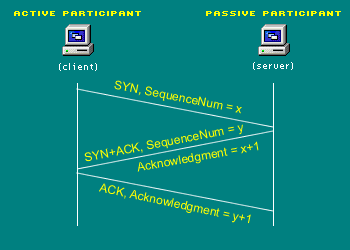
Here client is shown as active participant and server
is shown as passive participant because client initiates (active)
a connection to a server which waits (passive) for connetions on a particular port.
The three-way handshae is done in the following process:
- The client sends a SYN packet to the server indicating that it wants to
set a TCP connection. It also sends ISN (Initial Sequenc Number).
Here ISN is x.
- If the server is 'alive' and listening on the requested port and can
accept an incoming connection, it replies with its own SYN + ACK packet.
It sends its own ISN (Initial Sequence Number) (for this
connection, y ) and acknowledges the clients request by sending back
client's ISN + 1 sequence number (x + 1) .
- Finally, after receiving the server's SYN + ACK response, the client
sends back an ACK packet with a sequence number of server's ISN + 1
(y + 1) .
Now this is all theory! Let's see whether we can observer a real TCP connection
and whether we can identify the three-way-handshake process. We'll be using
tcpdump to observe the process. Commands used to capture the TCP
communication is:
tcpdump -n -S -t
    Here, -n don't convert addresses (i.e., host addresses, port numbers,
	    etc.) to names.
	 -S print absolute, rather than relative, TCP sequence numbers.
	 -t don't print timestamp.
    192.168.1.12.1051 > 192.168.1.11.23: S 4255483971:4255483971(0)
                              win 65535  (DF)
    192.168.1.11.23 > 192.168.1.12.1051: S 4279842714:4279842714(0)
	                           ack 4255483972 win 32120  (DF)
    192.168.1.12.1051 > 192.168.1.11.23: . ack 4279842715 win 65535 (DF)
-
First line: someone on client (192.168.1.12) is connecting
to port 23 (telnet) of server (192.168.1.11). We can see that
SYN flag is set (S), followed by:
4255483971:4255483971(0)
Here, 4255483971(=x) is the ISN (Initial Sequence Number)
and it apears twice separated by ':' because there's no payload
(0 in parentheses indicates this).
win 65535 indicates that the client has a buffer that
can hold 65535 bytes.
mss 1460 indicates that the network on which the client
exists can accept a maximum of 1460 bytes payload in a
single packet.
mss stands for maximum segment size .
<DF> requests that the packet shouldn't be
fragmented.
Interesting fact: though the client has a buffer that can
accept 65535 bytes of data, the network cannot accept more
than 1460 bytes of payload.
-
Second line: server replies with a SYN and ACK flagged
packet. It also sends its ISN (4279842714=y) and
acknowledge number (clinet's ISN + 1 = 4255483972).
Server's window size is 32120 and maximum segment size
is 1460.
-
Third line: client sends back acknowledgement packet
with a sequence number of 4279842715
(server's ISN + 1 = 4279842715).
Note that this packet has no flag set (`.' indicates
that no flags were set).
|
