 |
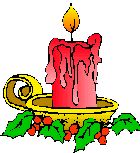
The Christmas Candle is an old tradition where a light is left burning in the window from Christmas Eve into Christmas morning. This burning candle signifies a welcome for our Lord, or for anyone traveling on the Eve of Christmas. Years ago, before the advent of window lights, an old turnip was scooped out and filled with a 2 lb. candle, lit and left burning into Christmas morning. |

|
There was a kindly nobleman whose wife had died of an illness leaving
the nobleman and his three daughters in despair. After losing all his money
in useless and bad inventions the family had to move into a peasant's
cottage, where the daughters did their own cooking, sewing and cleaning. When it came time for the daughters to marry, the father became even more depressed as his daughters could not marry without dowries, money and property given to the new husband's family. One night after the daughters had washed out their clothing they hung their stockings over the fireplace to dry. That night Saint Nicholas, knowing the despair of the father, stopped by the nobleman's house. Looking in the window Saint Nicholas saw that the family had gone to bed. He also noticed the daughters stockings. Inspiration struck Saint Nicholas and he took three small bags of gold from his pouch and threw them one by one down the chimney and they landed in the stockings. The next morning when the daughters awoke they found their stockings contained enough gold for them to get married. The nobleman was able to see his three daughters marry and he lived a long and happy life. |
 |
A holdover from pagan times, bells and other noisemakers were believed to frighten away evil spirits. As part of the midwinter solstice festivals, bell-ringing activities were very rowdy, mixing some fun in with the serious intent. Today, the peals of the church bells serve as unmistakable heralds of the arrival of the Christmas season. |
|
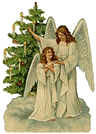
Christmas in Switzerland resounds with the ringing of the bells. The tinkling of the bell heralds the arrival of the white clad angel called the Christkindli, who comes along with presents. Three candles are lit when she comes and she hands the presents from the baskets held by her helpers. |
 |
The custom of gift giving on Christmas goes back to Roman festivals of Saturnalia and Kalends. The very first gifts were simple items such as twigs from a sacred grove as good luck emblems. Soon that escalated to food, small items jewelry, candles, and statues of gods. To the early Church, gift-giving at this time was a pagan holdover and therefore severely frowned upon. However, people would not part with it, and some justification was found in the original gift giving of the Magi, and from figures such as St. Nicholas. By the middle ages gift giving was accepted. Before then it was more common to exchange gifts on New Year's Day or Twelfth Night |
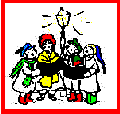 |
The custom of singing carols at Christmas is of English origin. During the middle ages, groups of serenaders would travel around from house to house singing ancient carols and spreading the holiday spirit. The word carol means "song of you." Most of the popular old carols we sing today were written in the nineteenth century. |
 |
According to legend, around the turn of the century a candy maker in Indiana invented a candy that was a witness to Christ. He used a hard candy because Christ is the rock of ages. He shaped the candy so that it would resemble either a "J" for Jesus or a shepherd's staff. The white represented the purity of Christ, while the red stripe represented the blood Christ shed for the sins of the world. Three thinner red stripes were added for the wounds he received when the Roman soldiers whipped him. Sometimes a green stripe is added as reminder that Jesus is a gift from God. The flavor of the cane is peppermint which is similar to hyssop. Hyssop is in the mint family and was used in the Old Testament for purification and sacrifice. |
 |
Holly was used to make Christ's crown of thorns. The berries were yellow, but they turned to red representing the blood shed by Christ for our salvation. The holly berries come in other colors too; one tradition says that white berries represent Jesus's purity, green berries the cross of wood, and black berries his death. |
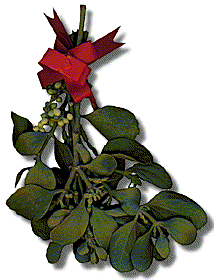 |
The ancient Druids felt trees were sacred and that mistletoe was magical and sacred. They thought this because mistletoe grew without roots in the ground, and they thought that it had been planted by the gods. During their winter festivals, they cut mistletoe from branches of an oak or apple tree with a curved golden knife and caught it in white cloths before it could touch the ground. They believed that the green leaves and waxy white berries brought love and good luck into their homes. Because of it's magical powers, anyone standing under mistletoe must be kissed or the mistletoe would lose it's powers, and the person would be unlucky in love during the coming year |
 |
According to legend, a poor Mexican girl and her brother were on their way to church on Christmas eve but they had nothing to give the Christ child. They gathered weeds and made them into a small bouquet. The other children made fun of their gift. When they laid the branches at the manger in the church, the weeds were miraculously transformed into bright red and white leaves of the poinsettia. The shape of the plant and the arrangement of it's leaves is seen as a symbol of the Star of Bethlehem. The red colored leaves symbolize the blood of Christ. The white leaves represent his purity. |
 |
The Christmas tree as we know it today appeared in Alsace, Germany (now part of France) in 1521. Both poor and rich families decorated fir trees with colored paper, fruits and sweets. Late in the Middle Ages evergreen trees were placed inside homes or just outside doors to show hope in the forthcoming spring. The retail Christmas tree lot dates back to those times when older women sold trees harvested from nearby forests. |
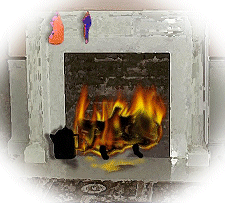 |
Most of our Yule log traditions derive from Scandanavia. The cold dark winters inspired the development of traditions concerned with warmth and light. Yuletide, meaning the turning of the sun or the winter solstice, has traditionally been a time of extreme importance in Scandinavia - a time when fortunes for the coming year were determined and when the dead were thought to walk the earth. For a long time, it was considered dangerous to sleep alone on Christmas Eve. The extended family, master and servant, alike would sleep together on a freshly spread bed of straw. The Yule log was originally an entire tree, carefully chosen, and brought into the house with great ceremony. The butt end would be placed into the hearth while the rest of the tree stuck out into the room. The tree would be slowly fed into the fire and the entire process was carefully timed to last the entire Yule season. |