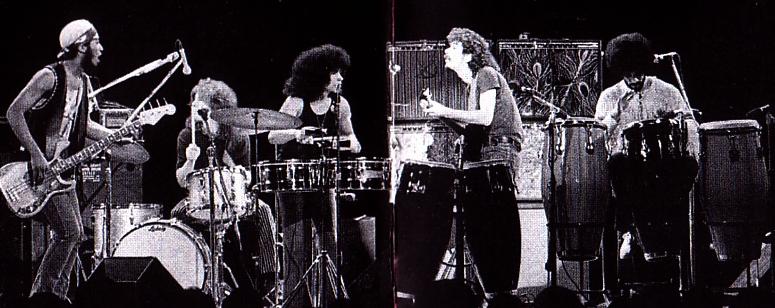
First Group
"Back in 1966 when we formed the Santana Blues BandBy 1966, he was playing in San Francisco, where groups like the GratefulDead and Jefferson Airplane were reinventing rock. The main collaborator in the band is keyboard player Greg Rollie. Carlos describes the relationship with Greg as two eyes. He gets the inspiration for certain parts and combines with Greg to help him finish them off. The other musicians are all great players in their own field:- David Brown on Bass, Mike Shriev on Drums, Jose Chepito Areas - on Timbales, and Mike Carabello on congas. The band loudly celebrated ethnic diversity at a time when much of America was still torn by racial tensions. Santana's combo featured two Latin percussionists, two white Americans on organ and drums, and a black bassist.
Carlos,"Back then I was just thinking of music as a means to give people joy. I knew a lot of people were not happy, and that music had a spirit to lift people out of that mire of frustration and depression. People have a hard time validating their own spiritual worth. People don't realize that with every breath you take, you have options and alternatives and choices...."
Bill Graham, an influential promoter,(who became a great personal friend and sometime manager)persuaded the organisers of the huge Woodstock festival to let the unknown Santana band play there. Their set, which included a sizzling rendition of their signature song,"Soul Sacrifice," stole the show. Their electric performance was one of the highest-energy highlights of the Woodstock documentary film and soundtrack album taking both audiences completely by surprise, captivating them and locking them in a 'semi-trance'. Clive Davis (the same one who signed him to Arista and helped plan and produce Supernatural)an executive at Columbia Records were so impressed with the band's Woodstock performance, which was in August 1969 (a pity that they still havent managed to release Santana's complete performance, which would be great if released back to back with another electric performance Woodstock 94!!), that they signed them and put out their self-titled debut recording that October.
The album,which featured the Top 40 "Evil Ways," was the best-selling album in the country by Christmas. It eventually sold 4 million, I can only wonder if that first album had been released today together with the documentary of the Festival, in todays expanded business world, it would surely sell close or more than Supernatural has done.
Carlos recounts,"All of a sudden you had a bunch of kids in their early twenties who, the next thing you know were going to New York and hanging out with Miles Davies and all these incredible musicians, coexisting with Jimi Hendrix, Janis Joplin, and The Who". There was pressure to top the first album. Those songs had been written over a three or four year period.A second album Abraxas,was recorded in the summer of 1970. With its extremely colourful and artistic cover (its one of the covers featured as backdrop to this site). The progression was evident, Carlos explains, "Musicaly, we did change rapidly because we had to: we had to learn fast to keep up." (quotes from Linear notes from Ben fong-Torres Abraxas album CD special colectors edition, highly recommended great photos plus 3 extra live tracks). The album kicks off with the mysterious instrumental 'Singing Beasts and Crying Winds'Carlos wrote a classic instrumental 'Samba Pa Ti' inspired by a scened from his hotel room, 'a drunken's sax player struggle in an alley with what to put in his mouth the instrument on the bottle. I think it went something like this through all of live we face choices. Jose Feliciano later wrote a different set of lyrics to sing this song. Other great tracks Tito Puentes 'Oye Como Va' (still played at live shows), Peter Green's Black Magic Woman/Gypsy Queen G. Szabo) and the 'jazzy' 'Incident at Neshbaur'. The band sounded entirely unique, like no other band on the planet. Carlos playing was much refined and sparkling and the overall sound was great. The album reached the no 1 spot and remained there for 6 weeks. It remained in the charts for a total of 88 weeks!!!
The young band as would be 'Normal' for anyone started having trouble handling fame, chemical dependencies, ego's, etc, etc and round the time of the 3 album they start to surface. New addition Chepito has health problems and is semi-replaced by Coke Escovedo and Carlos finds another guitar player 15/16 year old Neal Schon a hot guitarist from the bay area. Carlos continues to develop on guitar and the band keep on opening new fresh avenues to explore. The musicianship like always is on the up. Greg Rollie, "There is one unique ability in the band and that was to create music that there is no name for ... its such a jell of different material that there is no name for it and ther's no one that plays it like Santana." The band starts to disintegrate Greg and Neal have had enoughs of latin rhythmns. Everything starts to become more strenous and more tension and uneasiness starts to creep into the atmosphere. The album stays at no 1 for 5 weeks and remains in the charts for a total of 39 weeks. A great album, a must for the collection especially the remastered version with the 3 live tracks
Greg Rollie,"The way the band played, the sum of the parts was greater than any individual, even though there were people who stood out.....When you look at how big the world is, and think that we had the opportunity to do this and be heard at the exact right moment to have it become something bigger than we could have imagined-we were truely blessed."(sleeve notes Ben Fong-Torres.
|