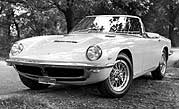
| The brand-new Maserati Spyder is a hymn to the glory of Italy - and turns our thoughts to earlier spyder models. Tony Dron investigates As any right-thinking Italian knows, gentlemen make motor cars to win races. The Maserati brothers, under Neptune's trident emblem to indicate Bolognese origins, began this noble task in 1926. Successful in such classic races as the Targa Florio and the French grand prix, Maserati cars also won the Indianapolis 500 in 1939 and 1940. Modern classic: a 1965 Mistral Spyder, powered by an engine descended from Maserati's famed 250F grand prix racer, winner of the 1957 F1 world championship By the 1950s, Maserati was located in Modena and owned by Adolfo Orsi: under his control, the company created one of the greatest-ever grand prix cars, the magnificent 250F in which Juan Manuel Fangio won his fifth world championship in 1957. But it was costing too much, and when his entire team of four big sports cars was written off racing in faraway Caracas, that was the last straw. Orsi pulled out of full-time racing in December 1957. Maserati was, however, ready for the road: a 3.5-litre GT had been shown in Turin. Yet at first it seemed perverse for Maserati to stoop to making cars for customers to use on the public road, as if the gods had decided to slum it with mere mortals. Production cars reached Britain in 1959, so, 33 years into Maserati history, we can begin to spot the more desirable classic Spyders. The snag is that just 242 of those early open-top models were built, only 10 per cent or so were right-hand drive and maybe five top-class examples survive; another handful remain in a seemingly permanent state of crisis restoration. Once in a blue moon, a 3500GT Spyder is offered for sale and today's value is �25,000-�50,000. What's it like, though, this classic you can't get? Quite a large 2+2, it had a race-bred, lightweight, straight-six, 220bhp engine. The 3500GT was pretty quick, up to 140mph. It had a relatively stiff chassis for those days, a hand-made steel body, good servo-assisted Girling brakes and a fine German ZF gearbox. All cars of that era will slide readily through corners, especially when shod with proper cross-ply tyres, but the Maserati 3500GT was renowned for its responsive handling and excellent, if somewhat heavy, steering. Many of the components, including clutch, propeller shaft, final drive and front suspension, came from British suppliers and there are specialists here today who can look after such gems as the 3500GT Spyder. Some say a major engine rebuild will cost a Commendatore's ransom - it will certainly take the thick end of �10,000. As you are unlikely to find one of these classics, how about a more modern Spyder - a Mistral from the late 1960s or a Ghibli from the early 1970s? Valued only slightly below the 3500GT, both are almost as rare. The two-seater Mistral Spyder was powered by Maserati's 3,692cc, fuel-injected straight-six, descended from the wonderful 250F GP engine and producing 245bhp in road-going form; it was later enlarged to four litres. The trouble was, with new Mistral Spyders costing about �5,000, the importer struggled against such rivals as Jaguar's �1,830 E-type. Only about 12 rhd Mistral Spyders were made, and it was the same story with the later open-topped Ghiblis. The Ghibli Spyder was an awesome, 4.7-litre, two-seater monster with performance in the 150mph region, fairly heavy controls, but most satisfying handling. It's an easy car to place precisely on dry roads. Although the four-cam V8 engine was steeped in racing heritage, based as it was on the company's big-banger sports racers of the late Fifties, Maserati had long since gone down the path of the "businessman's express". Grand tourers rather than sports cars, by that stage about half of them were ordered as automatics - less desirable than manual transmission now. A contemporary Lotus might run rings around a Ghibli, especially in the wet, when these big Maseratis can be something of a sideways handful if pressed. Maseratis still had heavy, leaf-sprung, live rear axles and were beginning to seem old-fashioned rather than charmingly traditional. However, the Ghibli's excellent, ventilated, servo-assisted disc brakes ought to keep a sane driver out of trouble. The driving position is not that great, but this is a truly splendid machine for a strong man, so long as about 12-15mpg suits his pocket. It's a good looker, too, and more practical to run than you might think. Just remember an engine rebuild will cost about �12,000. The ultimate classic Maserati Spyder is the bigger-engined Ghibli 4.9 SS of 1973, with manual gearbox. In the funny-money boom, the best of these commanded �250,000. Now they fetch a realistic �60,000, but the usual problem applies: there are probably only seven rhd examples in the world. Maserati subsequently struggled along under Citroen and later de Tomaso ownership, making coupes, so that's about it unless you include the later Biturbo Spyder as a classic. It was sold from 1986 until 1993, and in larger numbers than earlier Maseratis. About 250 rhd Biturbo Spyders came to Britain and perfect early 2.5-litre carburettor models are worth up to �8,000 now. Later 2.8 injection models fetch perhaps �18,000. All Biturbos can be a handful, particularly in the wet; they look rather ordinary and the interior is a curious mix of leather, polished wood and (beneath a bizarre clock in the middle of the facia) a ventilation control panel that looks like the cash till from a fast-food outlet. Beware poorly maintained Biturbos, as rectification is costly. Classic Maseratis tend not to rot in sinister inner places - the Biturbo had sills like a battleship to stop any scuttle shake - but they were so expensive when new that few ever graced British garages, and today's owners are reluctant to sell. If you want to add to the small pool of British-owned Maserati Spyders, you might be better advised to buy a new one, superbly built under Ferrari (ultimately Fiat) control. � Copyright of Telegraph Group Limited 2001 |
 |