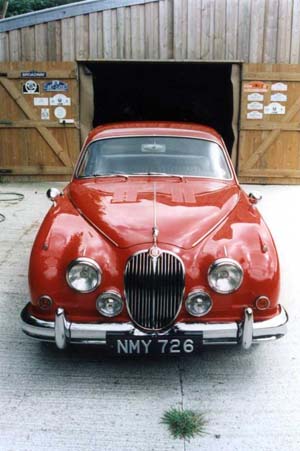
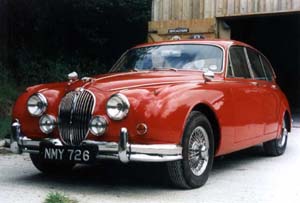
| NOT JUST ANY OLD MARK 2 - NIMROD'S STORY �Is it a Coombs?� is the often asked question, when someone sees the four neat rows of louvres in the bonnet (in many people�s eyes, the Coombs �trade mark�, despite the fact that most of the Coombs-modified cars did not have louvred bonnets anyway). �No,� I reply, �it�s better than that. It�s a Jaguar�. Few people seem to know that, if you had the right connections, you could get all of the things Coombs did to their Mark 2s done by Jaguar themselves, before your car left the factory. But I�m jumping ahead of myself. The story begins on a glorious sunny day in July 1997. Until then I had been the proud owner of a beautiful 1957 Bentley S1 Continental, a car in which I had covered many thousands of miles, including my honeymoon in 1993, but which I had driven no more than 200 miles since moving to Cornwall a year previously. In our part of the Duchy, as in the vast majority of it, the lanes are narrow, in large part single track, which militates strongly against ownership of an eighteen foot long, six foot wide leviathan, built for high speed travel on open highways. So, with great reluctance, I had put him on the market and now found myself at the M5 services just outside Exeter, handing him over in exchange for an unknown quantity in the form of a bright red Mark 2 Jaguar, which I had first driven only an hour before (and that was the one and only Mark 2 I had ever driven � and still is) and enough cash to buy my wife a BMW for her 40th birthday. First impressions were, indeed, favourable. The drive back to Cornwall confirmed that the 3.8 is a quicker car and a more nimble, taut-handling one than my old Bentley (itself no slouch), but that did not come as much of a surprise. In the light of what I discovered later, however, perhaps I would have been surprised by the performance of my new acquisition, had I driven a standard 3.8 before. All I knew about the car was that it had had only two owners, the second for most of its life, and that its mileage of just under 127,000 was genuine, because the second owner had documented the car�s history very thoroughly in a notebook which came with it. This also revealed just how carefully he had looked after it � not so much miles per oil change but oil changes per mile! A letter to the previous owner (I had bought it through a dealer) elicited the information that his name was �Nimrod� (the car, that is � the previous owner was called Louis Boschetti) and that there was a switch to cut out the petrol pump secreted beside the bonnet release knob, and easily turned off by mistake when opening the bonnet � a fact which I had discovered for myself a few weeks previously, after over an hour trying to find the �fault� which had so mysteriously prevented my new acquisition from starting! Boschetti, who had bought him in August 1963, told me that the first owner had been a well-known racing driver called Don Parker, very successful in the �50s in Formula 3, who sadly had died only two months before I bought his old car. Boschetti himself had driven Nimrod all over Europe, but, at the age of 85, and with only one arm (he had lost the other when he was blown up off Normandy during the war), had given him up in favour of something a little tamer � a 1.9 litre Peugeot 205 GTI! A call to Motor Sport produced a copy of Don Parker�s obituary, in which he was described as �the most successful Formula 3 driver in history�. He was British F3 champion in 1952, �53 and �59. He won 126 F3 races altogether and in 1953 alone started in 44, had podiums in 42 and won 30. Stirling Moss may have been a star in 1953, but he raced in F3 and Parker beat him more times than any other driver did, despite having never even seen a motor race until he was 40! Moss was not the only famous name Parker beat � a results sheet kindly sent to me by Parker�s widow, Dora (together with a splendid photo of Parker collecting Nimrod from Henlys in 1961) shows that at Brands Hatch on 3rd. May 1953, when Parker finished first in both his heat and the final, the �consolation race� was won by one Bernie Ecclestone. Also racing regularly against Parker in F3 in the �50s, was no less a luminary than Norman Dewis, but again I am jumping ahead of myself. When I bought Nimrod, it was not because I was looking for a Mark 2. I already had an E-type in my garage, and the object of the exercise had been to sell the Bentley, pure and simple, but I had taken Nimrod in part exchange, intending to resell him straight away. Eventually I did get around to advertising him in Jaguar Driver, but not until I had kept him for over a year. As a result of this advert, I had a �phone call from a gentleman by the name of Neville Orpin, who did not want to buy Nimrod, but to tell me a bit about him. Orpin had been working at the Clocktower Garage in Wembley in the �60s, when Parker brought Nimrod in to be sold. Apparently Parker had told him that Nimrod was a �special down the line� car, built for him on the express instructions of Lofty England, whom he had known well from his motor sport activities, and that it had been fitted with high-lift cams and uprated suspension and brakes. According to Orpin, his boss had reckoned it the fastest Mark 2 he had ever driven, showing 140 m.p.h. on the clock on the recently opened, but still unrestricted, M4. Within hours of going into the showroom with a price tag of �995 (book value for a standard car was then �860), he had been sold to Louis Boschetti, who named him �Nimrod� (the Great Hunter / Great Sportsman - see Genesis, 10:8-9). I now realised that I had rather a special car in my garage, so I did some more digging, but it was not until almost another year had passed that I got a call from Norman Dewis (thanks to the ever helpful Julia Simpson at JDHT), who was most forthcoming. He remembered Don Parker well, for he had started racing in F3 at about the same time as Parker did, and was able to confirm that, although Parker never had any professional connection with Jaguar, he did know Lofty England very well. Norman did not recognise the term �special down the line�, but confirmed that it was not uncommon for cars to be modified at the factory for customers with the right connections. He told me that these were usually done in the Competition Department, after the car had come off the production line, but that occasionally a car would be modified on the line, which could have been done on England�s instructions, although he could not recall whether or not this had been done for Parker. We discussed the sort of modifications which I thought had been done to my car and these all seemed to tally with him as typical of what would have been done at the time to provide a fast road car, or one for competition (the photo of Parker collecting the car from Henlys shows it wearing racing numbers, which may or may not be significant). So what are these modifications? They fall into three categories: done by Jaguar, for Parker; done by A.N. Other, for Parker; and done by A.N. Other 2 (probably D.K. Engineering, who seem to have done most of the work on Nimrod for him) for Boschetti. I mention the last category, because they are all carefully documented, so that anything non-standard which was not mentioned in Boschetti�s notebook, must have been done for Parker. Dealing with Boschettis�s modifications, the most useful ones are the fitting of a Jaguar all-synchromesh gearbox (as used on later Mark 2s) and a Kenlowe fan, both of which make the car a much more usable one. Turning to the mods almost certainly undertaken by Jaguar, I have not checked the cams (I wouldn�t know whether I was looking at the standard item, or a full-race D-type number), but one or two people who have driven the car and �know about these things�, seem to think that it is more than likely that they are �hotter� than standard, and it ties in with what Norman Dewis had to say. Even I can recognise 2� S.U.s when I see them (only because I own an E-type!), and these are not in Boschetti�s book. Nor is there anything in there about the brakes, but when my local garage overhauled them last year, the standard parts for a Mark 2 did not fit and, once they got hold of the parts that did, told me that the brakes worked better than on a normal Mark 2. As far as the suspension is concerned, Norman Dewis said that this probably amounted to fitting Koni shockers, which, of course, have long since been replaced (but the ubiquitous notebook confirms that this was with more Konis). The engine number confirms that the car left the factory with high-compression (9:1) pistons. The only remaining mystery is those louvres, which is where we came in. They aren�t there in the photo of Parker collecting the car, nor are they in Boschetti�s book, so one must assume that they were done for Parker after he bought the car, again hinting at possible competition use. They are unusual, in that they are not in two single rows, E-type style, but in two double rows, and very neatly executed. So what of Nimrod today? Well, there is still some more digging to do, to try to confirm beyond reasonable doubt who did what to him, when and why. In the meantime, he is in excellent, but used, and almost original condition, with almost forty years of patina, untouched by the restorer�s heavy hand, and a great car to own and drive. And no, he's not for sale any more - he's become part of the family.. |
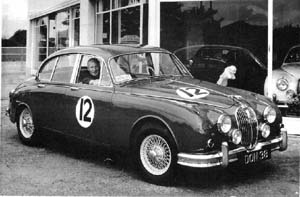
| The first owner, Don Parker, collecting Nimrod from Henleys - note the racing numbers. |
 |
 |
 |