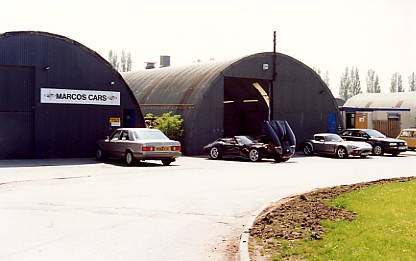
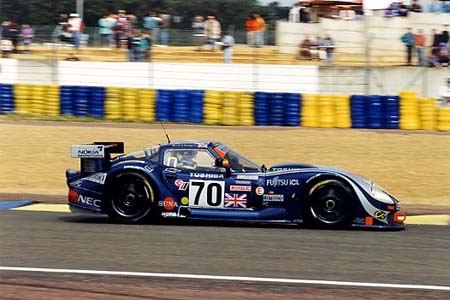
| Marcos, the Wiltshire Roadburner - from Kit-car to Supercar Today, the term "kit-car" covers a multitude of sins - in many cases, literally. What most have in common is a new body to which the customer adds second-hand mechanicals. The former is often in imitation of a well-known "classic", or "supercar" and the latter all too frequently from some very mundane "donor" vehicle. In other words, something which looks (a bit) like an expensive thoroughbred, but costs no more than a mass-produced family saloon - and retains all the essential character of the latter. Pastiche on wheels. There are, of course, some noble exceptions, but they are as common as chicken farmers at a meeting of the Edwina Currie Fan Club. In the swinging sixties, however, it meant something very different. What was delivered to the customer was everything that was needed to make a complete car. All the parts were new, the styling was original and, in many cases, performance and handling were at the leading edge of sports car design. This was not entirely surprising, given that many had their roots in motor racing. The best known of these is probably Lotus - even in 1960, one of the most respected names in Grand Prix circles and now a legend. Thus were born many of the famous names in the low-volume end of the British motor industry. By a curious quirk of fate, one of those - TVR - is now the largest remaining independent (i.e. not owned by a former Colony or one of the Axis Powers) British motor-car manufacturer. Another such is Marcos - named after its "parents", Jem MARsh and Frank COStin. They started building cars together in 1959. Most of these virtually bespoke cars, although designed for the road, were extensively raced by Marsh himself and by other drivers who later became household names, like three times world champion, Jackie Stewart (Marsh still has Stewart's car, which he races regularly). Costin left the company in 1961, before it moved to Bradford-on-Avon in 1963. Marcos remains Wiltshire's only car manufacturer. In 1963, when the first (some will argue still the best, possessed of the greatest design purity) serious production car to bear the Marcos name appeared in public, it still utilised a plywood chassis - a form of construction with which Costin was familiar from his work in the aircraft industry. This tradition continued until 1969 and Marcos owners became the butt of jokes about death-watch beetle and woodworm. The Marcos was clothed in a beautiful, very low (42" high), light and aerodynamically efficient fibreglass body, designed by Dennis Adams. The interior, too, was unusual, with a beautifully sculpted fascia, full of jet-age imagery, in contrast to most of its contemporaries' flat slabs. The sharply reclined seats were fixed. Uniquely until the advent of Maserati's Bora and Merak in the '70s, the pedals and steering wheel were adjustable instead. Initially, power came from an unlikely source - Sweden's best-known manufacturer of sturdy family estate cars, Volvo. I kid you not. In fact the engine had already achieved sporting status, for it was the four cylinder, 1,778 c.c. unit from Roger Moore / Simon Templar's transport in "The Saint". When Ford gained respectability on the rece-track in 1966, by winning the all-important Le Mans 24 hour race, Marcos switched to Ford power, but things came full-circle, however, five years later, when a Volvo engine was again installed. By now, however, it was a 3-litre unit. In all forms the Marcos was no sluggard. With the 3-litre engine, it was very quick, as contemporary magazines testify. One well-known journalist tells a story of how road test cars were selected. After suitable fettling, four cars (some belonging to customers) were taken onto a deserted stretch of the M4 at 4 a.m. and lined up across the carriageway. On the word "go", they shot off in a massed-start sprint. The winner was submitted to whichever journal had requested an example for testing. Unfortunately, Marsh insists that there is not a grain of truth in this tale! In the early '70s, only a decade after the company was formed, things started to go wrong. A major investment of money and effort put into trying to crack the potentially lucrative North American market, had come to naught, due to problems trying to comply with increasingly tough US emissions and safety regulations. At the same time, Marcos had made an ambitious and expensive move to new premises at Westbury. The company was broken by the financial strain and production ceased in 1972. There are two other Marcos road cars which deserve a mention before I close this chapter. The Mini-Marcos of 1965, was much more like today's idea of a kit-car: for as little as �199, you could buy an unpainted, untrimmed body / chassis unit, with no mechanicals. Onto this you bolted the front and rear sub-frames from a no longer required Mini, together with whichever of that car's many different engine options took your fancy. Despite these origins, however, it was strong enough to be the only British car to complete the gruelling Le Mans 24 hour race in 1966 - a distinction claimed by an Austin-Healey Sprite the following year, when the Marcos, with Marsh driving, retired hurt. The Mantis, introduced in 1969, was a much more civilised kettle of fish, with no racing pretensions. Again from the pen of Dennis Adams, but even more dramatic in appearance than the 1800 of 1963, its low, aerodynamic shape gave it stability at high speeds and the slipperiness necessary to attain them, while accommodating an entire family of four. The same 2.5-litre engine which could propel two people to barely 120 m.p.h. in a Triumph TR6, gave the Mantis a top speed of close to 140. After the crash, Marsh made a living servicing, buying and selling again the cars which he had sold when they were new. It seemed that the Wiltshire Roadburner was dead and buried - until, that is, the resurrection. Unlike with the Messiah, however, the second coming took a little longer than three days. It was not until 1976 that Marsh re-acquired the company and, after a few years selling Mini-Marcos kits, he put the 3-litre back into production in 1982. In 1987, this evolved into the Mantula, when Marsh switched to the more powerful Rover V-8 engine, an enlarged version of which is still in use. Today, the company is back in full production on the West Wilts Trading Estate at Westbury and, in Marsh's words,"riding the crest of a wave". Jem's son, Chris, is in charge now, as managing director. His father has retired, but no-one seems to have got around to convincing him of that fact yet! About two cars a week may not sound all that wonderful, when compared to what Ford or Vauxhall churn out in half an hour, but it certainly ensures exclusivity. The price tag is about 150 times more than the basic Mini-Marcos kit used to cost in the '60s, but you do get a completed vehicle these days - no car leaves the factory until it can do so on its own four wheels. Adams' original 1800 shape lives on in the company's current offerings, albeit in a bulging and be-spoilered form reminiscent of a course of steroid-enhanced muscle-building at the local gym. This design trend, apparently an effort to satisfy the appetite of the neutered '90s male for a mobile expression of his lost masculinity, is popular today among many who should know better - stand up Porsche and Aston Martin, to name but two. Marcos is in good company. They may have lost the subtle beauty of the original 1800, but the Mantara and LM 500, with a choice of 4- or 5-litre Rover-based V8 engines delivering between 190 and over 300 b.h.p., certainly live up to their new macho image. A ride with Jem Marsh in the LM 500 left me in no doubt that it is very fast indeed. It made the E-type Jaguar in which I had driven down to the factory, seem slow. The 0-60 m.p.h. sprint takes less than 5 seconds and, given a long enough piece of straight, gestapo-free, road, Marsh tells me that you can see over 160 on the clock. We didn't , however, put it to the test! The handling department is right up to date, too, with MacPherson struts at the front, double wishbones behind and wide, ultra-low-profile rubber on each foot (necessitating the use of power-assisted steering). Well able to stand comparison with rival TVR products, not only does it corner on rails, but it smooths out bumps which would have sent the owner of an 1800 straight off to his local spinal unit for emergency treatment. Inside there are all the modern creature comforts demanded by '90s motoring man, with air-conditioning and oodles of electric bits and bobs, but the 1800 owner would recognise its ancestry immediately he tried to adjust the seats - they still don't. He would also be impressed by the build quality - no, this is definitely no kit-car! The flagship of the fleet, however, and the car on which Marcos' hopes are pinned for their return to Le Mans this month, is the 6.1 litre Chevrolet engined LM 600, which, in racing trim, turns out a mighty 560 b.h.p., capable of propelling it to 200m.p.h. down the Mulsanne straight. Can the pride of Wiltshire conquer the best that the rest of the world can offer in motor racing's most important event of the year? You had better believe it! |
 |
 |