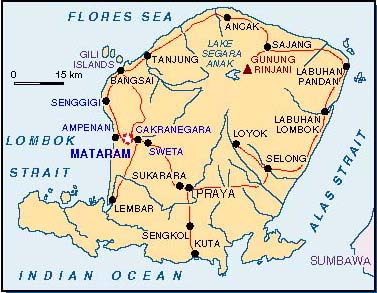
LOMBOK ISLAND
|
BACKGROUND
In the 18th century, Sir Alfred Wallace
postulated the so called Wallace Line which divides Asia and Australia
into two distinct area in terms of flora and fauna. The line coincides
with the strait between Bali and Lombok. Lombok's white sand beaches, historic
temples, and majestic volcano have attracted many tourists. Taking its
name from the spicy red chilli, Lombok has long been a melting pot of Indonesian
art, music, and tradition. Its current population is comprised of descendants
from several Indonesian civilizations, and the island's rich culture reflects
these colorful and varied influences. |
The Sasaks culture, mostly Muslim, represents
the majority of the islanders, but there are also large enclaves of Balinese
living in western Lombok who form an entirely distinct Hindu community.
The temples or pura in the western region provide some of the most fascinating
glimpses into the island's Balinese heritage, and their annual harvest
ceremonies are famous attractions. Lombok has always been primarily an
agrarian society.
The rains that run down from Mt. Rinjani have produced
one of the world's most fertile valleys, and the islanders grow acres of
rice, soy beans, coffee, cinnamon, vanilla,
and many other spices. |
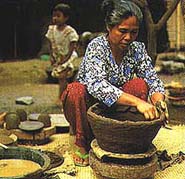 SUSAK POTTERY
The Sasaks are also known for their handcrafts including
the elegant ikat cloth, pottery, and a wide selection of baskets that are
woven from strips of ratan and banana leaves. Though the prime beach
SUSAK POTTERY
The Sasaks are also known for their handcrafts including
the elegant ikat cloth, pottery, and a wide selection of baskets that are
woven from strips of ratan and banana leaves. Though the prime beach |
and tourist areas of the island are dotted
with hotels, restaurants, clubs, and shopping centers, much of Lombok is
still rural and offers many pristine landscapes that remain untouched.Jeeps
are the preferred mode of transportation to traverse these more rugged
terrains, and experienced drivers are a necessity. Lombok provides a perfect
blend of modern amenities, traditional
Indonesian culture, and stark natural beauty.
Though the island has welcomed the influx of developers
and tourists from around the world, it also has thankfully protected much
of its land to preserve Lombok's splendor for all to enjoy. |
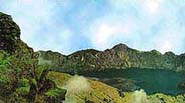 CRATER ATOP MT RINJANI
Mt. Rinjani The name Rinjani comes from an old Javanese word
for "All Great," and according to Sasak legend, the volcano serves as the
primary home of princess Anjani, the daughter of the islanders' Supreme
God.
CRATER ATOP MT RINJANI
Mt. Rinjani The name Rinjani comes from an old Javanese word
for "All Great," and according to Sasak legend, the volcano serves as the
primary home of princess Anjani, the daughter of the islanders' Supreme
God.
One glimpse from the volcano's 3,726 meter summit, and
the reason why the Supreme God's daughter would decide to live atop the
mountain becomes clear. |
The view at the top of Gunung Rinjani may
be the most extraordinary sight in all of Lombok, and even all of Indonesia.
Hikers who scale the great volcano are rewarded with
stunning vistas both of the lush countryside that surrounds the peak and
of cobalt blue Lake Segara Anak that rests inside the caldera.
The panorama is breathtaking and, on clear days, this
view extends all the way to neighboring Bali.
If visitors reach the peak and decide to make the three-hour
descent into the volcano itself, their weary muscles can be luxuriously
soothed by the many hot sulfurous springs that are scattered around the
caldera. |
The springs are warmed naturally by volcanic
vents, and some of the waters that pour out of Gua Susu, "the milk cave,"
are even believed to possess curative powers.Getting to the summit of Rinjani
(and back again) necessitates three days and some dependable camping gear.
Though the hiking is not particularly challenging, the trails are not all
clearly marked, so local guides are also a must. The trip takes some planning,
but is definitely worth the effort.
A trip to Lombok cannot truly be considered complete
until this great volcanic adventure has been had. Varied Influences Lombok's
native Sasak culture represents a complex tapestry of foreign influences. |
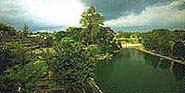 NARMADA
For the past millennium,
Lombok has the arts and the wisdom of both its guests and its invaders.
NARMADA
For the past millennium,
Lombok has the arts and the wisdom of both its guests and its invaders.
The neighboring Javanese
were an early influence on the island and |
were the
first to bring Islam, Hinduism, and poetry to Lombok. Later, during the
years of Balinese colonization, this Javanese influence was mixed with
the theater, dance, and music of BaliThe resulting cultural blend permeated
not only the adat or customs of Lombok but also the island's architecture
and agricultural practices. Another branch of Lombok culture can be traced
to the influence of the Middle East. |
Sumatra,
Malaysia, and the Arabworld all contributed a great deal to the music and
religious dances of the island.Though there are pockets of purely Balinese
and purely Islamic society, the fabric of the island's predominant Sasak
civilization has been woven from the threads of many different cultures.
Contemporary Lombok is a fascinating mixture that chronicles centuries
of cultural exchange. |
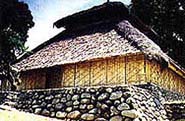 BAYAN
The birth place of the
Waktu Telu Bayan is still quite isolated from the rest of the island. It
is also one of the main starting points for the climb up Mount Rinjani.
BAYAN
The birth place of the
Waktu Telu Bayan is still quite isolated from the rest of the island. It
is also one of the main starting points for the climb up Mount Rinjani.
A very old mosque
can be found there. |
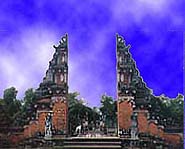 LINGSAR
Constructed in 1714, this
complex has a Hindu temple built next to a Kemaliq, a shrine devoted to
the Islamic Wektu Telu. An annual event of "Perang Topat", in which the
Balinese and Sasaks throw topat (steamed rice wrapped in coconut leaves)
at each other after a prayer, is held at this complex.
LINGSAR
Constructed in 1714, this
complex has a Hindu temple built next to a Kemaliq, a shrine devoted to
the Islamic Wektu Telu. An annual event of "Perang Topat", in which the
Balinese and Sasaks throw topat (steamed rice wrapped in coconut leaves)
at each other after a prayer, is held at this complex. |
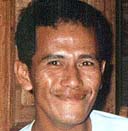 This is my friend Amang,
he will be happy to show you around Lombok. For bookings write to:
AMANG ALKAFFI,
This is my friend Amang,
he will be happy to show you around Lombok. For bookings write to:
AMANG ALKAFFI,
Gang Melur No:6,
Kampung Melayu,
Ampenan. Lombok. (NTB)
Allow 2-3 weeks for your letter to arrive. Ask Amang to take you for a
walking tour of Ampenan. It is customary to give a tip when you leave. |
SENGIGI BEACH
The first and the
most popular tourist resort in the region offering beautiful beach and
sea view and many tourist facilities.
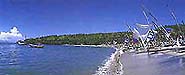 SENGIGI BEACH
The idyllic white sand
beaches and colorful coral reefs of Senggigi and the Gili Islands draw
thousands of tourists each year. Sengigi beach many international hotels
SENGIGI BEACH HOTEL, SHERATON, also there are many cheaper local hotels.
PONDOK SENGIGI and HOLIDAY INN.
SOUTHEAST
On Lombok's southeastern
peninsula, the weather is dependably gorgeous and the beaches are pristine.
On the land, coffee
farms, coconut groves, and red palm sugar plants make for interesting tours.
In the sea, divers can find rare species of giant clams, sharks, turtles,
manta rays, and blue spotted sting rays gracing the warm coastal waters.
AMPENAN
The original port
town of Lombok, until bombed by the Japanese
during WWII.
Years ago sailing
ships came to the port of Ampenan to buy chilli
and take it back to
Europe where it fetched a high price. |
The mandarin
speaking Chinese bought the chilli from the local farmers, dried it and
sold it to the trading ships. Their decendants still live in Ampenan today.
In the back lanes
of Ampenan you can still see some of the old
warehouses. The population
of Ampenan is very mixed, Chineses,
Balinees & Sussak
people all live together in harmony.
 MUM & ME AT
LOSMAN PABEAN
Losman Pabean on Jalan
Yos Sudarso 146 - run by a very friendly Chinese family. Managed by HAN
WEI and his sister CI IN. There are about 20 rooms. The cost includes a
small breakfast, Coffee, tea & boiled drinking water available all
day free.
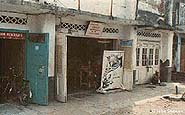 CIREBON CAFE
The Cirebon Cafe' serves
the best Chinese food in Lombok, or in all of Indonesia for that matter.
CIREBON CAFE
The Cirebon Cafe' serves
the best Chinese food in Lombok, or in all of Indonesia for that matter. |
The owner
AH HIN is always there and will look after you.Try the Asparagus &
crab soup
THE GILLI ISLANDS
The Gili Islands are
located just off the east coast of Lombok. These small, beach-circumferenced
islands provide an excellent vacation destination for adventure-hungry
tourists. The mostly young crowds spend their days on the beach and their
nights in the disco clubs. Because of the small number of hotels on the
islands, many visitors simply sleep on the beaches.
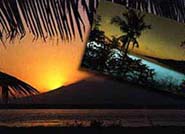 SUNSET AT GILI TRAWANGAN
At Gilli Trawangan there
are many bungalow type accomodation., complete with ensuite bathroom. Suggest
RUDI BUNGALOW, but there are many and all good. The night life is excellent.
SUNSET AT GILI TRAWANGAN
At Gilli Trawangan there
are many bungalow type accomodation., complete with ensuite bathroom. Suggest
RUDI BUNGALOW, but there are many and all good. The night life is excellent.
 Joko the manager of Rudi
Bar and Bungalows will look after you.
Joko the manager of Rudi
Bar and Bungalows will look after you. |
Copyright©The
Kerobokan Home Office 2001.
|