Chapter One
An overview of the research questions and their importance
Introduction
The emergence of the Internet as a new communication medium has spurred the development of new forms of advertising. In particular, the World Wide Web, a component of the Internet, has attracted an increasing number of advertisers over the course of its evolution. The Web offers a unique advertising environment that combines elements from print, television, outdoor/out-of-home and other media advertising. While research on traditional forms of advertising can inform some decisions made about Web advertising, new research is necessary to more fully understand its unique nature.
The World Wide Web offers a graphical user interface for Internet resources. Web pages are created using hypertext markup language (HTML) and can contain text, hyperlinks, photographs, images (e.g. photographs, illustrations, and graphic icons), videos, sounds and animations—making it a truly multimedia environment. As such, the Web provides a unique environment for advertising
Advertisers have been both captivated and challenged by the World Wide Web as an advertising vehicle. Captivated in so far as the Internet's interactive nature provides an ideal environment for customized and highly targeted advertising messages; challenged in so far as they have had to develop new skills and refine traditional advertising practices in order to take full advantage of this new medium. Regardless of their sentiments, advertisers have had to take notice of the Web as it has become an important media presence. In 2000, it is estimated that there are approximately 300 million users world-wide going online (NUA Internet Surveys, 2000). It is therefore understandable that advertisers constantly search for new ways to grab the attention, and ultimately money, of Web users. To be successful advertisers must better understand the process by which users come to pay attention to online ads in the first place.
The Evolution of this Research Project
The ability to draw users in and capture their attention is essential to advertisers attempting to cut through the clutter and information glut of the online world. By examining people's memory for Web-based advertising messages, I hope to gain a better understanding of what is necessary to draw the user in and ultimately make the decision to click on a banner advertisement to get more information about or buy a product.
Past research informs our understanding of the manner in which computer-mediated messages are processed. In a study conducted at the Institute for Communication Research at Indiana University, I found that presentation of news headlines written in plain black text presented on a white computer screen did not produce an orienting response in subjects (Borse et al, 1997). An orienting response, characterized by lower heart-rate and increased electrical conductivity of the skin, is the observable effect of a selection mechanism that helps determine what stimuli are further processed and encoded into working memory. The Borse et al study was inspired by a news headline study conducted by David (1996). He had found that people remembered imagistic and deviant news headlines better than non-imagistic and non-deviant headlines. The Borse et al study adopted the same headlines used by David, but created digital versions of the headlines to be presented via a computer. Although we replicated findings from David's study (i.e. there was better memory for deviant and imagistic headlines than for non-deviant and non-imagistic headlines), we did not find evidence to indicate that subjects had oriented to the headlines. These results led me to ask what was required to elicit an orienting response, and thus deliver all the advantages associated with orienting (e.g. greater attention and better memory). I was primarily interested in seeing what might be capable of eliciting an orienting response to Web banner advertisements, and subsequently capable of producing better recall and recognition of advertising stimuli.
This interest in Web advertising, commensurate with frequent personal use of the World Wide Web for research and entertainment purposes, drew my attention to the possible effects of animation. Based on my understanding of Information Processing theory, I believed that animated ads would be better at capturing Web users' attention and subsequently producing better memory traces than non-animated ads. I was also curious whether there would be better memory for animated ad as a whole or only for the objects that were animated, since the animated objects in Web ads are usually unrelated to the advertised product.
I also wanted to retest the stimuli presentation control variable from the Borse et al (1997) study. In that study, half of the news headlines were automatically presented at a pace controlled by the computer and the presentation of the other half was controlled by the subjects; we were interested in learning whether an interactive usage context would lead to better recognition of stimuli. We did not find any significant effects for what we called interactivity. Review of other research and theories related to interactivity led us to reassess the nature of our stimuli presentation control condition and determine that it was not truly an interactive condition. Subjects were indeed active, but they were unable to affect the order in which stimuli were presented. So, the nature of the question remains the same: What effect does taking a more active role in controlling the presentation of stimuli have on people's memory for the stimuli? In the case of Web advertising there is also interest in better understanding users' activity level, or amount of control, and the role it plays in determining their likelihood to click on banner advertisements.
Overview
Web advertising shares many features with its traditional media counterparts and Web advertisers have capitalized on some of the techniques used to improve attention and memory in other media. After illustrating some of the similarities and differences between Web advertising and other forms of advertising, I will review advertising industry research on Web banner advertisements and highlight the things that have been found to make them "tick,"—or perhaps more appropriately, given the nature of the Web, the things that make users "click."
Following the overview of the theory and practices applicable to advertising on the World Wide Web, I will present a study on Web advertising that seeks to answer the questions about memory and click-through tendencies raised above. I will then report and discuss findings from this experimental study of Web banner advertisements.
This research has apparent value to Web advertising practitioners as they strive to create more effective advertisements (i.e. those that have an impact on their desired audience). The research has additional value to media scholars hoping to better understand the way media messages are processed—for it is through our improved understanding of the ways media messages are processed that we become better able to predict the subsequent effects that those messages will have on audience members.
Chapter Two
Review of Web advertising and pertinent advertising and media research
The Internet as an advertising medium
Currently, online ads account for just 2% of all media spots, but the ease of creating Web advertisements and the ease with which they can be targeted at specific groups is causing Internet advertising to grow in popularity among advertisers (George, 2000). According to the Internet Advertising Bureau, online advertising expenditures in 1999 were $4.62 billion, more than a 141 percent increase from the amounts spent in 1998 (Internet Advertising Bureau, 2000).
There are several different forms of advertising on the Internet including direct email, listserv postings, and various forms of Web-based advertising. Perhaps the best known forms of Internet advertising are those found on the World Wide Web. The most prominent forms of Web advertising are company or product content sites, ad supported/sponsored sites and banner advertisements (or similar forms of advertising placed on popular entertainment and information content sites).
The earliest advertising on the Web consisted of isolated product or company Web sites. These sites contained information about a particular product or company and often included games or activities for users to engage in while perusing the advertising content. Because they were usually isolated sites, it was unlikely that Web users would simply stumble upon these sites. Advertisers soon learned that they needed to find ways to get their Web site addresses to users and/or find other ways to lure users to their sites.
Many advertisers began, and have continued, to include their Web sites' universal resource locators (URLs) in print, television, and radio advertisements. However, this method requires users to be motivated enough to write down or memorize the URL, then log onto the Internet and type in the sometimes rather long site address after launching a Web browser. Another way to get users to advertisers' Web sites is placement of banner advertisements on frequently visited Web sites (Thorson, Wells & Rogers, 1999). As one writer put it, advertisers must "drive traffic to their own Web sites by placing signposts on other sites frequented by desired targets," (p. 91 Naples, 1996).
Banner advertisements are graphic images placed on Web sites—often search engines or popular content sites—that provide a direct link to advertisers' Web sites when clicked. The first banner ad appeared on the Web in 1994 on Hotwired, an online counterpart to the popular technology magazine, Wired (Briggs & Hollis, 1997; Hyland, 1997). Web banner advertisements are typically 468 x 60 pixels. Generally they appear at or near the top of a Web page, but, as we'll discuss later, can appear other places within a Web site with varying results. Since their introduction, Web banner advertisements have proven to be both popular with advertisers and profitable for Web content providers. Approximately 80 percent of advertisers use banner advertisements in their online marketing campaigns and banner advertisements account for about 37 percent of all online advertising (AdRelevance, 2000).
The cost of Web advertising varies greatly. The actual cost of putting up a Web site with advertising content can be under $100; however, most advertisers spend thousands of dollars to create an online presence. Unfortunately, creating a Web site with advertising content is only half the battle. Efforts such as those mentioned above, to get users to the sites, often require additional money be spent, but generally speaking, the cost of advertising online has been low. The low cost of Web advertising has been both a blessing and a curse for online advertisers. The relative ease and inexpensive cost of creating a Web presence has helped contribute to congestion of commercial Web sites. According to a survey conducted in November, 2000, there are about 23,777,446 sites on the Web (Netcraft, 2000). Cutting through the clutter of competitors' sites is a daunting task for advertisers. "Its not just a matter of keeping attention—more so than ever before it's a matter of catching attention," (p. 32. Barrett, 1997).
Fortunately the Web offers many options for making ads more appealing and attention-grabbing. Because the World Wide Web is an environment capable of supporting rich multimedia resources, Web banner advertisements have been able to take advantage of these capabilities. Most Web banner ads are presented in color and most contain some sort of graphic image. Web banner advertising may also include elements of animation—usually moving images or text. GIF animation is the most prevalent Web ad enhancement. On average, GIF animation is used in approximately 19 of every 25 ads per company and amounts to 58 percent of total impressions (AdRelevance, 2000)
As Web programmers and ad designers become more sophisticated and technically savvy, and as new programming and design tools are developed, we are beginning to see ads with interactive elements (e.g. those allowing users to interact in some way within a banner ad without having to leave the content page on which the ad is presented). HotMedia, a product created by IBM, already allows advertisers to combine streaming audio and animated images to create Web banner advertisements that are more eye, not to mention ear, catching (Tedesco, 1999). Efforts to provide full motion and streamed video are also underway, and companies have kept the Internet supplied with a constant flow of new software and new products to enhance Internet and Web experiences.
It is logical for advertising in new media to both resemble advertising in traditional media and to evolve unique characteristics made possible by the new medium. To fully understand Web advertising, its structure, and ultimately its effects, we must consider the advertising formats that have preceded it.
Similarities to other media
The World Wide Web provides a presentation forum for a unique combination of traditional media. Web advertisements can contain textual content as in print ads, sound content as in radio ads, and content in the form of moving audio-visual images as in television ads (see Table 1). Additionally, this new medium provides opportunities for users to interact with advertising content in a way never before possible.
Comparative media studies are one way researchers have attempted to learn the relative strengths and weaknesses of different presentation media and their structural and content features. In a comparative media news recall study, DeFleur and his colleagues found that facts from news stories presented in print or on a computer screen were recalled at a significantly higher level than were facts from the same stories when presented via radio or television (DeFleur, Davenport, Cronin, & DeFleur, 1992). This, and other studies that have replicated the findings, have shown that the structural features of print media (e.g. headlines, and paragraph divisions) may contribute to greater recall of print compared to recall of radio or television stimuli (Furnham, Gunter & Green, 1990; Wicks& Drew, 1991; Wilson, 1974).
An additional advantage of print media messages over television and radio messages is the fact that viewers have more control over exposure to the content. A reader can choose to re-read or review material not completely understood the first time through (Garramone, 1983; Lang, 1989; Miyo, 1983). Readers of print media also have control over rate of presentation (i.e. how fast or slow they choose to read), and to some extent, order of presentation. This means that the reader has the opportunity to spend more time with the stimulus, therefore potentially confounding the effects of the reader's control over the exposure to the content with the length of the exposure. Radio and television viewers, to date, have had very little control over presentation rate or order, though the evolution of more interactive forms of television and radio may change this. Miyo (1983) found processing of television news to be less thorough than processing of newspaper news because it is presented at a constant and invariable rate. Web users can control the rate of message presentation as well as make decisions about the order in which they access content—two factors which increase the amount of effort expended to process a message.
Table 1: Media advertisements compared
|
|
Presentation (other content simultaneously present?) |
User Control (length of exposure) |
Mode |
|||
|
|
|
|
Picture |
Text |
Sound |
|
|
|
|
|
Static |
Animated |
|
|
|
Television |
No |
No |
Yes |
Yes |
Yes |
Yes |
|
Radio |
No |
No |
No |
No |
No |
Yes |
|
|
Yes |
Yes |
Yes |
No |
Yes |
No |
|
Outdoor |
Yes |
Yes |
Yes |
Yes* |
Yes |
Yes* |
|
Web (banner Ads) |
Yes |
Yes |
Yes |
Yes |
Yes |
Yes* |
*Possible but not common
Web banner advertising's earliest ancestor: Outdoor Advertising
Outdoor advertising is the term given to advertisements that appear outside on billboards or other out-of-home media such as buses or buildings. From the early Egyptians to the present day, people have found value in promoting information about products or services along highly traveled roads. "Posting 'bills' on wooden boards in the late 19th century led to the birth of the term 'billboard'" (Outdoor Advertising Association, 2000) As people's use of automobiles increased in the 40s and 50s, billboards became a successful mode of advertising.
When the interstate highway system was developed in the United States in the 1950's, people were both excited about the possibilities and somewhat skeptical about how it might change their way of life. Early protagonists and antagonists of the Internet were quick to see comparisons between the new computer-based communication medium and the transportation network that had come to be one of the most relied-on methods of travel in the United States. Analogies were drawn about the speed at which people could travel, the ability to travel to far away places more easily, the benefits in terms of bringing people together to communicate with one another, and the gap between those capable of traveling and those who were not. Those who travel the interstates are accustomed to the sight of billboard advertisements dotting the countryside and cityscapes, while seasoned Internet users have become accustomed to banner advertisements placed prominently on many Web pages.
In the 1990s when the World Wide Web emerged as a way to navigate the developing Internet landscape, advertisers became increasingly interested in finding ways to deliver advertising messages to online audiences. Today the "information highway" (however cliche the term might be) is one of the most traveled roads for information and entertainment.
Outdoor advertisers knew from the start that to be effective, their ads must first quickly attract the attention of drivers and passengers. Many subsequently came to rely on bold colors and images and catchy, but brief, phrases and slogans. Today the same structural themes are present in web banner advertisements. Beyond the structural similarities between outdoor and online advertising are additional similarities in the pricing, placement and production practices.
Similarities between Outdoor and Online Advertising
The similarities between traditional billboard advertising and modern Internet banner advertisements are numerous. The most prominent similarities are briefly discussed below.
Cost
Outdoor advertising remains a popular form of advertising even in our high-tech and highly mediated world, in part due to its ability to deliver advertising messages at a comparatively low cost. Because space online is abundant (and virtually limitless), advertisers have found that placing Web banner advertisements is a cost-effective means for getting a name, idea, or message out to an audience. The cost of advertising (and media messages in general) is often measured in CPM, or cost per thousand audience members to be exposed to the message. As seen in the shaded area of Table 2, the CPM for out-of-home advertising is much lower than for television, print, and radio.
Table 2: Comparison of CPM for major media
Source: Outdoor Advertising Association: "Basics"
Advertising Length/Size Location Lowest CPM
Spot TV 30-seconds Prime Time $18.00
Newspaper 1/4 page Black & White $10.80
Network TV 30-sec Prime Time $ 9.90
Magazine Full Page 4-Color $ 8.70
Radio 60-Second Spot Drive Time $ 5.30
Rotating 30 Days Bulletin $ 3.50
30-Sheet 30 Days Poster Panel $ 1.60
Just as outdoor advertisers pay a premium for high traffic areas or areas with particular demographics, online advertisers must be willing to pay higher prices for advertising on Web sites that receive the highest number of hits or target a particular demographic.
Overnight Exposure
Outdoor advertisements are prized for their ability to reach audiences quickly. New technologies have led to the ability to create billboards that can be installed literally overnight. This is an advantage for outdoor advertisers since it allows an advertiser to get a message out quickly. Online advertisers are at an even greater advantage, as the time to create and post an online advertisement is often as short as a few hours.
Differences between Outdoor and Online Advertising
While there are many similarities between outdoor and online advertising, there are also key differences.
Visibility
Outdoor advertisements are constantly present and visible—they can not be turned off or set aside. Online advertisements fall somewhere between their outdoor cousins and advertising on other electronic media such as television and radio. Some Web sites offer rotating banners, where a series of different ads appear as a user is visiting a Web page or Web site. Others offer a static advertisement where, like print advertising, a Web advertisement is present as long as a user decides to stay on a particular page.
Size
One advantage outdoor advertisements have over their online counterparts is size. Given the size of most billboards, it is difficult to avoid at least glancing at them while driving. Web banner advertisements are much smaller; therefore capturing and retaining users' attention while they are "surfing" by is a more difficult undertaking.
What makes banner advertisements "click"?
Many Web sites make their profit entirely from sales of Web banner ad space. It is therefore of great importance to Web advertisers and content providers to better understand what makes Web banner advertisements "click." This section will explore the pricing strategies for Web banner advertisements—largely driven by delivered and/or probable user clicks on ads and the features that encourage users to click.
Pricing for Web Advertising
From the start, pricing for banner advertisements was a tricky business. Unlike television and radio, which have their own ratings industry and systems for determining the reach of programs to audiences, there is some debate on how to determine the size of the audience reached by particular Web sites. Two main schools of thought regarding Web banner advertising effectiveness and reach have emerged—those who consider the overall number of impressions that an ad has and those who consider only the number of clicks that each ad receives.
What's in a click?
Click-through rate (CTR) is determined by how many Web users actually click on a Web banner advertisement and travel to that advertiser's Web site. The average click-through rate for Web banner advertisements is said to be anywhere from 1-2% (Marx, 1998). However, in situations where the banners are placed on highly appropriate pages or contain extremely compelling structural or content features, some banner advertisements have a click-through rate as high as a 50%. Click-through tends to be the preferred way for advertisers to gauge the effectiveness of their ad since it is based on observable and measurable user behaviors (Briggs & Hollis, 1997).
What was once an Internet-driven economy with no limits, is now tending toward more conservative marketing and promotional expenditures. Dot-com marketers are looking for more sound investments with proven impact and tangible outcomes. Click-through is an appealing measure to advertisers because it lets them know the specific number of people who were delivered to their Web sites.
The appeal of click-through based pricing has also been supported by various research findings suggesting that better memory and greater purchasing likelihood can be associated with click-through. Briggs and Hollis (1997) found that brand recall was linked to click-through, they also suggested that "people who remembered the ad and who said the product category was of interest to them were three times more likely than the average to claim to have clicked-through."
Proponents of click-through have also suggested that there is a greater likelihood of product purchase resulting from ads on which Internet users have clicked. Some marketing studies have shown that less than 10% of Internet users have purchased a product as a direct result of an online ad that they were simply exposed to (Diaz, 2000). This percentage is considerably higher for users who click on a products' ad. Generally speaking, an advertiser will have to pay anywhere from $200 to $800 per thousand click-throughs (Ellsworth & Ellsworth, 1998). Therefore, while the overall cost of a cost-per-click contract is greater than a CPM contract, the overall cost of acquiring new customers with a Cost-per-Click contract is less than 10% of the overall cost of acquiring new customers with an impression-based, or CPM contract (Gurley, 2000).
Research has warned of the potential negative effects from creating ads to optimize click-through. Of concern to Web advertisers is the fact that some strategies that have been found to improve the likelihood of click-through (e.g. unbranded ads) may reduce the overall potency of the ad. Thus, while paying for advertising based on click-through rates may be a more exact way for advertisers to get what they pay for, it may be an incomplete method of assessing the true worth of a Web banner advertisement.
Making an impression
The fact that ads can have a desirable impact even on audience members who do not click-through should not be overlooked by advertisers or media scholars. Even when Web users do not click on banner advertisements, they may retain brand and product information from the mere exposure to those advertisements. Those who prefer impression-based measures of advertising effectiveness consider the total number of users who view an ad, using hit data from the Web site on which the ad is posted. Overall effectiveness and pricing is then measured in Cost per Thousand (CPM, or the cost necessary to reach one thousand "viewers"), much the same way that television and radio ratings data are based on overall impressions made during particular time slots or programs. Advertisers will pay anywhere from $5 to $45 per thousand impressions (Halprin, 2000).
Impression-based pricing is popular on Web search sites. Advertisers enter into contracts to have their advertisements shown whenever certain search keywords are entered. For example, a jeweler may have a contract with a particular search engine that allows their ad to receive exclusive billing on the search result page whenever users search for information on key words such as: "diamonds," "jewelry," and "anniversary." Cost per Thousand (CPM) for Web banner advertisements attached to words on search engines averages around $100, and the search engines usually guarantee upwards of 10,000 impressions per month (Barrett, 1997). Advertisers are willing to pay more for this type of keyword-based exposure because they are reaching an audience likely to be interested in their product.
To click or not to click
With proponents on both sides of the click-through issue, the debate rages on and it continues to be greatly important for advertisers to better understand the nature of Web advertisements and the features that lead to better memory and making impressions and/or lead users to click on the advertisements. Factors that lead to click-through can be broken down into those that are audience-related and those that are ad-related. Audience-related factors include people's innate tendency to click on ads, the immediate relevance of the product to the audience, and the pre-existing appeal of the brand or company. The ad-related factors include the immediate relevance of the message to the audience and the involvement or intrigue created by the ad (Briggs & Hollis, 1997). These features can be further broken down into three categories: structure, content, and context.
Structure
Various structural features have long been associated with successful advertising. For print advertising, "the major factors in noting and recall are the size, color and amount of illustration," (p. 49, Lucas & Britt, 1985). Similar elements have been found to be beneficial in television ads. Color and motion are structural features that are used to make broadcast ads interesting, dramatic and compelling (Lucas & Britt, 1985). For Web advertising, "movement is in" and "bigger is better" (Marx, 1998).
Size matters
Traditional advertising media have imposed limits on the size and length of commercial messages. An audience member has a limited amount of time to view or listen to an advertisement on broadcast media. Audience members have more control over how long they spend reading or looking at an advertisement in print media, but advertisers have limited space in which to present their advertising message—here the constraints on space are essentially the same as the constraints on time experienced by advertisers in traditional broadcast media. The World Wide Web provides an environment where there are essentially no limits on time or space. Advertisers might embrace the concept of endless advertising space, but getting users to devote time to exploring this space remains a challenge.
Conventions have emerged regarding the size for ads placed on content sites, but there are few rigid parameters constraining these size limits (unlike magazine and newspaper advertising which are constrained by the physical size of the page). While the traditional size of Web banner advertisements has been 468 x 60 pixels, researchers have found that slightly larger banners draw higher click-through rates (Marx, 1998; White Palm, 1998), and there is nothing stopping a Web advertiser from entering into negotiation with a content provider to obtain a larger or different type of ad space. In general, "the larger an item is, the greater its perceived visual importance and likelihood of attracting attention" (Detweiler & Omanson, 1996).
Size also matters in terms of storage memory in bytes and the subsequent length of time it takes for the advertisement to load on a Web page. If an advertisement is too large in terms of memory size and takes too long to load, the user may move on to more easily accessible material before they have had a chance to see the advertisement.
Exposure time is controlled with television and radio advertising, with advertising messages usually restricted to 15 or 30 second spots. Print-based advertisements, on the other hand, give users control over the amount of time they spend reading or looking at advertisements. In this respect, Web advertising is similar to print advertising. However, having the opportunity to spend extended periods of time looking at an advertisement does not mean readers do so. Studies of magazine advertising indicate readers spend an average of four seconds looking at a page of advertising. Research suggests comparable amounts of time are spent looking at advertisements in newspapers and other print media (Percy, 1983). The challenge to Web advertisers is to get users who are accustomed to passively looking at advertising messages, to become more active in seeking out those messages. With the World Wide Web, "the audience isn't captive anymore, and marketers are going to have to work harder to entice them," (p. 168 Keeler, 1995).
Color
Much of what we know about color as a structural feature of Web advertisements corresponds to what we know of the use of color in other advertising media. Generally speaking, bright colors are better able to capture people's attention and it is best to avoid drab colors that blend into the background (Lucas & Britt, 1985). Advertisers have long known that certain colors work best for certain types of messages, while other colors are to be avoided. For example, an ad for a somber topic should not contain a great deal of bright reds, yellows and oranges.
Illusion of Interactivity
As computer technology advances, Web advertisers have been able to offer interactive elements within their banner advertisements (e.g. items that animate when a user moves the mouse over them or pull down menus that allow users to jump directly to items of interest on an advertiser's Web site). Even when advertisers are not able to offer real opportunities for users to interact with banner advertisements, simply giving the illusion of interactivity is often enough to increase click-through rates (White Palm, 1998). For example, placing items on banner advertisements that look as though they can be clicked or adding fake radio buttons or pull down menus often elicits a click on the ad.
Lights, Camera, Action: the power of animation
According to Jim Savage of ZDNet, animated ads can generate click-through rates ranging from 15% higher to as much as 40% higher than static ads (Marx, 1998). In addition to its value as a feature that elicits higher click-through rates, animation tends to grab attention—leading to better memory for the ad even if the ad is not clicked.
Novelty
"Marketing and Psychology literature suggest that from a very early age humans are more attentive to novel messages," (King and Tinkham, 1990). Research has confirmed what seems like common sense—messages that are different or somehow stand out from other messages are most likely to capture people's attention. Distinctive stimuli are thought to create unique memory traces, which aids in people's ability to remember those stimuli. This is applicable to both structural and content elements that can cause an ad to stand out from others.
Content
There are a variety of content features that influence click-through rates. What advertisers say, and how they say it can have an impact on memory for the ad and users' likelihood of clicking on the ad. Advertisers have already begun to see benefits from certain types of ad content.
The Power of Suggestion: The case of "Click Here"
People don't necessarily do what you tell them to do, but it doesn't hurt to ask. "'Click here' may be the two most powerful words in cyberspace," according to one ad researcher, and "simply adding 'click here' to a banner ad can increase response rates twofold," (Marx, 1998). Other words that seem successful in their efforts to entice users to click-through are "press here" and "enter."
Urgency
White Palm, an Internet-based advertising consulting company, reports that elements that suggest a sense of urgency are likely to promote click-through rates. For example, "'last chance' or other time dependent phrases will prompt users to click now or forever hold their peace," (White Palm, 1998).
Money Talks
Sites that boast something for free or the chance to win money also receive slightly higher click-through rates than average. "Any promotional incentive that offers value or using words like 'free' will induce users to click on the banner," (White Palm, 1998). Harris (1983) suggests that advance organizers, or information that tells the users what's to come if they click on a banner advertisement (e.g. "Click here for a Free Sample," or "Find out how to win $ 10,000"), also produce advantages in terms of click-through rates.
Context
The context in which a Web banner ad appears is as important as the content of the ad. Two of the most critical elements of context in banner placement are: the Web site on which the banner is placed, and the location of the banner within the site (Barrett, 1997).
Site selection
Picking the right Web site to advertise on is an important first step for Web advertisers. Generally, it is worth the time and money required to locate a suitable Web site—one that attracts users likely to be interested in the particular product or service being advertised. This is one of the reasons search engines are effective places to advertise; banner exposure can be linked to appropriate search keywords (Barrett, 1997).
Placement within sites
The most common practice for Web banner advertising is to place banners across the top of content pages. However, this practice allows users to easily scroll down past the advertisement. Some Web sites give advertisers the opportunity to place advertisements within a frame. This allows the advertisement to remain visible as long as a user is on the page, even if they scroll up and down (Barrett, 1997). Ads have also been placed at various other locations within Web pages (e.g. at the bottom or along the side of a Web page).
Combating banner blindness
Different users have different reasons for using the World Wide Web. The two primary activities users are engaged in when they come across a banner advertisement are searching and browsing. Searching refers to a focused effort to find a particular piece of information, while browsing refers to a more general perusal for items of interest. Users who are actively searching for information are often blind to non-related content such as advertising (Benway & Lane, 1998; Norman, 1999). Thus, it is often harder to capture the attention of searchers than of browsers.
Avoiding banner burn-out
Researchers suggest that banner advertisements have a short life span. Industry practitioners suggest that "click-through rates can drop by one-half from the second to third time someone sees an ad" (Marx, 1998). To avoid banner burnout, experts suggest continually changing, updating, or rotating banner advertisements (Marx, 1988).
Personal preferences and interests
"Up to 80% of an ad's score on recall measures is a function of background variables such as whether or not people are interested in the product category" (Aaker, Batra & Meyers, 1992). Commensurate with other forms of advertising, what a consumer brings to a viewing experience is just as important as the conditions under which the viewing occurs.
Targeting audiences
Advertisers cannot read Web users' minds, but thanks to developing technology, they can at least ensure that their audience has a greater likelihood of thinking or acting certain ways. TrueMatch technology and its developers, MatchLogic, are working to deliver particular advertisements to users with particular demographics. "MatchLogic servers recognize demographic characteristics and geographic locations of PC users clicking onto Web sites through anonymous profile data about that user" (Tedesco, 1999). Appropriate ads are then selected based on each individual users' demographic profile.
In addition to the ability to more dynamically direct advertising messages to target audiences, advertisers can collect a more complete profile of their audience than ever before possible. Some advertising sites require users to create accounts in order to access the sites' more enjoyable interactive elements (e.g. games or contests). This is a win: win situation for advertisers. Not only are these advertisers able to collect demographic profiles of their users, but they are also able to provide customized messages for particular users on subsequent visits to the Web site—allowing for a more tailored sales pitch.
The targetability of ads (e.g. in response to keywords, user's search/surf histories, or user profiles) can be a pro or con for advertisers. It has positive outcomes in so far as it allows Web users to see ads pertaining directly to their personal interests. Eysenck (1993) suggests that people tend to better remember things that are meaningful. What better way to make something meaningful than to have it correspond to personal preferences or be appropriate in terms of reading level or knowledge level. However, many users feel their privacy has been violated when they receive a large amount of highly targeted advertising (Ducoffe, 1996). In fact, the FCC was so concerned about the possible threats to consumer privacy as a result of online demographic profiling, they convened a hearing in June of 1997 to look into the matter. The online advertising industry ultimately adopted a set of self-policing measures, which the FCC endorsed, as an effort to preempt government intervention (Hyland,1997).
User Activity
It has been suggested that the objective of television advertising is to keep viewers passive through commercial breaks (Barrett, 1997). In contrast, advertisers on the World Wide Web have had to shift their objective to finding ways to get users to be more active.
The majority of users who click a banner ad to visit an advertiser's Web site have generally done so because they are interested in seeing what is there. This is appealing to advertisers because it helps ensure they are attracting an ideal audience for their advertising messages. However, getting users to take an active interest if they are not already pre-disposed to doing so, is somewhat difficult.
Advertisers have to identify ways to attract users with marginal interest in their product so that they are not only preaching to the proverbial choir. Animated GIFS, electronic forms and Shockwave-enhanced games are proving themselves as successful ways to entice user activity (Cleland & Carmichael, 1997).
Once advertisers have succeeded in attracting users to their Web site they can provide a number of opportunities for the users to interact and navigate in a meaningful fashion through the advertising content. Interactive elements increase the amount of time a user spends on the advertiser's Web site and allow the user to get information that is particularly geared toward his/her personal interests, tastes, or needs.
Advertising Research and Theory
The study of advertising has historically addressed issues of attention, understanding, comprehension, processing, memory, and purchasing behaviors. When considering Web advertising, click-through rates are added to the list of variables. The study of advertising on the World Wide Web is supported and, to some extent, guided by research and findings on other types of media. The theories and findings by media scholars who studied traditional media are being tested and applied, where applicable, to studies on various aspects of Web stimuli. Scholars can turn to existing research on traditional media (e.g. radio, television and print media) to make educated hypothesis about the processes and effects of the Internet and World Wide Web as an advertising medium. I will begin my review of applicable theory with a discussion of findings from media comparison studies that examine the similarities and differences between traditional media and the Internet.
Media comparisons
Researchers have suggested that a message may be processed differently when presented in one media versus another. Studies show advantages for memory of messages presented in print media over memory for messages presented in online media. Sundar et al (1999) looked at medium as an independent variable. They compared outcomes from exposure to the same information presented in print and online formats and found that subjects remembered more print advertising content than online advertising content, despite the fact that memory for print and online news content remained consistent. This replicates the findings of DeFleur et al (1992) who specifically studied memory for news stories presented in print and on the computer. They found that the same amount of information was recalled for print and online news stories.
One explanation for the differences in memory for ads suggested that because ads are secondary to other content, involvement with the ads is somewhat lower than involvement with the news stories. It is important to note that in an effort to control for differences between the two media, online ads were made to closely resemble their print counterparts and therefore did not take advantage of the enhanced presentation capabilities of the World Wide Web. According to Sundar et al (1999):
In order for Web advertising to work, advertisers have to do more to attract readers than they would in the print medium. For example, animated ads as opposed to still ads might be needed to attract online users. To the extent advertisers use the new features of the online medium that are nonexistent in print (audio and video downloads, animated images, hyperlinks, site-maps, etc.), they are probably more likely to enhance user attention to advertising.
In conditions where similar media were used, (i.e. text-only or static images), there did not appear to be much advantage for memory of online messages over print messages. If the presence of text and static images is not enough to elicit orienting and other physiological responses that are indicative of the amount of attention being paid and ultimately contribute to the formation of better memories for the stimuli, the question remains: What is necessary?
One of the crucial differences between online and print media is the ability of online ads to offer animation, video, and audio content. The most common enhancement to Web advertisements is the use of animation. As compression technology improves and Internet bandwidth increases, online ads with more video and audio components are likely. Streaming and other forms of "rich" media are likely to become more prevalent in online advertising, but according to one source, they already account for 20% of online advertisements (Meland, 2000).
The Web advertising industry has already begun to see effects from advertisements that employ rich media elements. Rich-media banners "are proving much better at drawing the audience's attention and engaging consumers in some sort of communication with the advertiser," (Meland, 2000). Streaming ad campaigns, such as those tested by RealNetworks found that downloads of their products were five times higher than they had been prior to the use of ads that employed streamed components (AdRelevance, 2000).
Information Processing Theory
Clearly, it is important for Web banner advertisements to gain users' attention in order to be effective. Researchers have studied many of the components of traditional advertising that capture the attention of media audiences. This body of research includes the use of images in advertising, the use of moving images, and the use of sound. Researchers on advertising and media content have frequently turned to information processing theory for better understanding of the way in which viewers' attention can be captured and memory can subsequently be enhanced.
The Information Processing Theory asserts that environmental stimuli are processed by a series of processing systems. These systems act on the information in different ways. Paying attention to a message, making sense of a message's meaning and processing a message for storage in memory are all tasks which require mental resources. Information Processing theorists suggest that these resources are limited, therefore causing predictable outcomes in the ways messages are processed under certain conditions.
Humans are subject to processing capacity limits that ultimately determine how much processing can be done. Attending to and processing every stimulus in the world around us is an impossible task. The human brain and nervous system sift through the large number of stimuli encountered, enabling our limited processing capacity to focus on the most important or personally relevant stimuli (Lang, Bradley, & Cuthbert, 1997). Gestault psychologists learned that some stimuli had characteristics that made them stand out more than others and were therefore better at capturing peoples' limited attentional resources. Animation is a characteristic that makes Web advertising stand out. In fact, some Web users have complained that animated Web advertisements are so successful in capturing attention and diverting the user away from Web page content, that they are an annoyance.
Attention
Human attention results from the information processing procedures that lead to selection and evaluation of motivationally relevant input (Lang, Bradley, & Cuthbert, 1997). Since people have limited resources to allocate, they must make selections about what they pay attention to (Basil 1994; Kahneman, 1973), "Attention is a process of resource allocation" (Basil, 1994). In situations where many sources are competing for attention, people must selectively focus their attention. In some cases attention is deliberately or consciously focused. In other cases, attention is automatically diverted to certain stimuli without conscious awareness.
Orienting responses are the observable effects of a selection mechanism that helps to determine what information gets selected and encoded into working memory. As such, they can be used as indicators of attention. Orienting causes people to focus their attention on the stimuli which caused the orienting response, and when orienting occurs, there is a momentary increase in capacity allocated to encoding the message or stimuli (Lang, 1996). An orienting response is characterized by lowered heart rate and increased electrical conductivity of the skin as well as other physiological responses discussed by Lynn (1966). These physiological measures were gathered as a part of the study discussed in the following chapter but will not be analyzed or discussed in this paper. For more information about orienting responses to media stimuli, particularly findings from studies of orienting responses to Web advertising stimuli, see Borse and Lang (2000).
As discussed above, research on orienting to online stimuli has already begun. Borse et al (1997) found that the appearance of black text on a white screen was not sufficient to elicit orienting in users. Orienting responses usually occur in reaction to things that move or somehow catch the eye, as it is evolutionarily advantageous to be able to respond to things that may be life threatening. Over time people learn to respond quickly to warning signs or signals, but these are learned responses and are physically different from those that are innate responses to potentially life threatening stimuli. The Borse et al (1997) study tested a "hardwired for news" hypothesis proposed by Shoemaker (1996) that suggested people were innately predisposed to respond to certain types of news headlines. The findings from the Borse et al (1997) study cast doubt on the notion that humans are hardwired to respond to news stimuli in the same way they are hardwired to respond to other more salient stimuli in the environment. These findings beg the question, what, if anything, will elicit orienting responses from users exposed to stimuli online (or simply on a computer screen)?
Orienting is also an indicator of other processing advantages likely to take place for media messages. Certain structural features of messages compel an orienting response and, subsequently, users' attention. Since a greater amount of processing capacity is allocated to messages with these structural features, attention to and memory for messages that people orient to should be higher. One must therefore ask; What is necessary in terms of structural features to cause computer users to orient to online stimuli and experience the subsequent gains in memory for those stimuli?
Memory
Many researchers have claimed that attention is a prerequisite for further processing of a message but that its does not guarantee further processing. Just paying attention to something does not mean the information attended to will be stored. Further more, storing information does not mean the information will be recalled.
The ability to recall or recognize information is, in part, a result of the manner in which a message is processed. Subsequently, tests of recognition and recall tell us different things about the manner in which a particular message or type of message was processed. Recognition memory tests the strength with which a message was encoded. Free recall indicates whether or not information has been stored where it can easily be retrieved.
Research on the differences between recall and recognition suggests that one out of every three people able to recognize a print ad will be able to recall it. Thus, recognition data indicates "how many saw the ad" while recall figures indicate "how many of them become sufficiently interested to actually look and often read what the advertiser tries to tell them" (Stapel, 1998).
The resources available for processing messages at any one point in time is finite. Structural features of the stimuli help determine what will be attended to, but an overload of structural features demanding our encoding resources can be detrimental to processing that message completely, and subsequently detrimental to resulting memory for that message.
Ultimately, the cognitive resources available to process a message is, in part, a function of a viewer's interest, skill, experience, and knowledge about a topic and cannot be fully controlled by advertisers. Advertisers cannot control the amount of effort a viewer will expend on processing an advertising message, but they can control the extent to which an ad compels a user's attention and the amount of cognitive capacity available for further message processing based on the structural features of the ad.
Interactivity, user activity level and user control of stimuli presentation
The ability to manipulate and control presentation of the content on the Web is one of the features that distinguish the Web from traditional media. The opportunities for interaction that the Web provides are an obvious subject for research. Traditional media require little user activity and offer few opportunities for users to manipulate content. When watching television or listening to the radio, viewers remain relatively passive while content is delivered. Aside from making channel selections, there is very little the viewer can do to alter or have an impact on the presentation of information and messages.
Use of the World Wide Web involves in the active selection of paths and information. The mere act of clicking on the computer screen to advance to the next ad does not indicate a high level of involvement but it does suggest greater activity than simply sitting in front of a computer screen and watching a series of ads whose presentation is controlled by the computer. Whereas traditional advertising is delivered to relatively inactive audiences, Web advertising is experienced by users in a more active context.
Borse et al (1997) tested a variable called interactivity. To test this variable, subjects were exposed to two levels of interactivity—a moderate level of interactivity where they controlled presentation of the stimuli and a low level of interactivity where the computer controlled the presentation of the stimuli. In the self-controlled presentation condition subjects were actively in control of the presentation pace of each stimuli, however, the outcome of each click to advance to the next headline was pre-determined and programmed into the computer and ultimately not under the control of the subject. A more realistic form of interactivity would involve subject or user control of the stimuli—such that subjects not only control the presentation pace, but also control the presentation order. This scenario would provide an interesting study of the effects of interactivity.
Whether users' actions are truly interactive or not, there is arguably an increased amount of user activity when using the Web and a greater opportunity to control various aspects of the experience. The ability to experimentally manipulate the extent to which a user has control over the rate of stimuli presentation offers a unique way to discern relative effects of moderate and slightly lower levels of user control or activity.
Hypotheses
Research suggests that response to things that move is an innate characteristic among human beings. For this reason, animated messages tend to be more captivating than static messages, generally speaking. By capturing attention, there is a greater chance that a message will be encoded and later recalled or recognized, as long as the stimuli does not exceed the user’s processing capacity. The more resources allocated to the response of structural features, the less resources remain to think about and store the message, particularly if it is complex (Lang, 1996).
Free recall indicates whether or not information has been stored and whether or not it has been stored in a manner allowing easy retrieval. The ability to recall something therefore depends on the resources available to store the message and the amount of elaboration during the encoding stage. Research suggests that animated stimuli, because they are novel and attention-grabbing, will compel greater allocations of processing resources. Thus, I hypothesize that:
H1: Recall will be better for animated advertisements than for non-animated advertisements.
Animation may indeed attract viewer attention to banner ads and therefore boost memory for the advertisement in general, however, in many cases the animation on Web banner advertisements is not directly related to brand or product names. Advertisers may be drawing viewers’ attention to the ads, but once their eyes are on the advertisement, viewers may be directed toward the animated object and away from the brand or product name and information. Thus, I propose the following research questions:
RQ1: Does animation damage recall for product or brand name information?
Furthermore if animation causes greater attention to objects does it also imply that objects in animated ads will be recalled better than objects in non-animated ads?
RQ2: Does the presence of animation in Web banner advertisements increase recall for animated images?
Ability to recognize media stimuli depends on the strength with which the message was encoded. Messages that capture users' attention are likely to be encoded more thoroughly than messages that do not capture users' attention. Again, research has suggested that animated stimuli will be better able to capture users' attention, and are therefore likely to show superior recognition compared to users' recognition of non-animated objects. Thus, I hypothesize that:
H2: Recognition memory will be better for animated banner advertisements than for non-animated banner advertisements.
Because click-through is an important industry standard for determining the effectiveness of Web banner advertisements, the impact of animation on users’ likelihood to click on banner advertisements will also be examined in this study. If structure (e.g. animation) compels click-through, then click-through patterns should be relatively consistent among subjects. Particularly, there should be a pattern of greater click-through rates for animated v. non-animated ads. However, if content (e.g. topics the subjects are interested in) is also important in determining the level at which users' attend to media stimuli such as advertisements, there should be a less pronounced pattern of click-through corresponding to structural features such as animation.
RQ3: Do animated Web banner advertisements produce higher click-through rates among users than non-animated Web banner ads?
The context in which a Web user encounters an advertisement is often much more active than the context of viewing advertisements in other media. It can be said that users also have a greater level of control when it comes to their use of the Web. Therefore, the role of control on recall, recognition and click-through rates for Web advertisements will also be examined.
Research suggests that memory for ads is higher in situations where there are moderate levels of user activity because of the benefits activity is said to have on arousal and subsequent attention. I therefore hypothesize that subjects will recall and recognize more from and about the ads that they view in the subject-controlled condition as compared to the computer-controlled condition of the experiment.
H3: Subjects will recall more advertising content from ads viewed when they have control over the presentation of the stimuli than ads viewed during the computer-controlled segment.
H4: Subjects will recognize more advertising content from ads viewed when they have control over the presentation of the stimuli than ads viewed during the computer-controlled segment.
Finally, advertisers are interested in learning more about what leads Web users to click on ads. If users are more active as they use the Web, are they more or less likely to click on ads they encounter?
RQ4: Do subjects report a greater likelihood to click on advertisements encountered when they have control over the presentation of the stimuli than ads viewed during the computer-controlled segment?
To test the hypotheses and search for answers to the research questions above, a study of Web based advertising was designed and run at the Indiana University Institute for Communications Research, in conjunction with the Department of Telecommunications. The following chapters discuss this study in greater detail.
Chapter Three
A study of Web advertising: Methods
Research Design
The study designed for the purpose of this thesis is an Animation (2) x Control (2) x Messages (7) x Order (4) mixed factorial design that uses actual Web banner ads to explore the effects of Animation stimulus Control n on recall, recognition, and subject-reported click-through. Animation, Control, and Messages are within subjects factors and Order is a between subjects factor.
Two levels of Animation were utilized: animated and non-animated. Subjects saw fourteen animated ads and fourteen non-animated ads. Seven animated ads and seven non-animated ads were shown in the computer-controlled segment and seven animated ads and seven non-animated ads were shown in the subject-controlled segment.
Two levels of Control over stimulus presentation were employed: computer-controlled and subject-controlled. In the computer-controlled condition the subject sat passively while the computer presented a series of ads. In the subject-controlled condition the subject was asked to click on a button to initiate the onset of each subsequent ad. Subjects saw fourteen ads (a mix of seven animated and seven non-animated ads) in the computer-controlled segment, and fourteen ads (again, a mix of seven animated and seven non-animated ads) in the subject-controlled segment.
Seven of each of the four types of messages were shown to each subject: seven computer-controlled presentation/animated, seven computer-controlled presentation/non-animated, seven subject-controlled presentation/animated, and seven subject-controlled presentation/non-animated.
Each of the four Orders presented seven computer-controlled presentation/animated, seven computer-controlled presentation/non-animated, seven subject-controlled presentation/animated, and seven subject-controlled presentation/non-animated. The orders balanced the presentation of each ad type such that across the four orders each individual ad stimuli would appear twice in each condition: twice as computer-controlled presentation/animated, twice as computer-controlled presentation/non-animated, twice as subject-controlled presentation/animated, and twice-as subject-controlled presentation/non-animated. Care was taken to distribute ad placement in each of the four orders to ensure that ads would not precede or follow ads they had preceded or followed in other orders.
Independent Variables
Animation
For the purposes of this study, animation is defined as repeated movement of any one or many object(s), or the appearance or disappearance of any number of objects on the banner advertisement.
Past research suggests that animated ads are preferable to non-animated ads largely because of their ability to capture people's attention and to stand out as novel or unique stimuli. In the rich multimedia environment of the Web, advertisers have had to up the ante on the techniques used to attract people's attention. Some Web advertisers create ads using all the possible bells and whistles, without giving much thought to the impact that use of those bells and whistles will have on users' abilities to comprehend and remember elements of the ad itself or information about the advertised brand or product.
It is of great benefit to Web banner advertisers to better understand the effects of animation on memory and the likelihood of click-through. By catching attention with animated objects, are the advertisers promoting better memory for those animated images or objects rather than the products and brands that are being advertised? If something is more visually compelling, does it also mean that people will have a greater tendency to click on the ad to see what the advertiser's Web page has to offer? Understanding the effects of animation in Web advertising is of a more general interest to media scholars who are currently seeking to better understand the various components of online media.
Control over stimuli presentation
One of the most unique aspects of the Internet and the World Wide Web as advertising media is their interactive nature. Users are able to actively manipulate and control presentation of content. In this study, control of stimulus presentation is tested as a second independent variable. Will people's memory be generally better in cases where they are more actively involved in controlling the presentation of Web stimuli, or will memory suffer as a result of the extra effort required to control the presentation of the stimuli? Will people be more likely to click on ads if they are more actively involved in the presentation of those ads?
The experimental nature of this study, and the subsequent need to control variables, prevents a truly interactive experience. However, the ability to control the onset of stimuli certainly indicates a greater level of user activity than does the passive watching of computer-controlled ad stimuli. In this study, user activity occurs when subjects are actively engaged in the control of stimuli presentation by pressing a button to advance to each subsequent advertisement. Conversely, subjects are considered to be relatively inactive during the computer-controlled presentation of the stimuli where ads are automatically presented at a constant and pre-determined rate.
Dependent Variables
Recall
Free recall indicates whether or not information has been stored in a manner to be easily retrieved. In this study, recall was measured by counting the number and type of items that subjects recall seeing for each advertisement. After participating in a second study which served as a distractor, subjects were given a sheet of paper with the following instructions: " Please list as many products, company names and items as you can, based on your memory of the ads that you saw earlier," (See Appendix A). They were given two minutes to complete this task. During the coding stage, each recalled item was identified according to the ad that it was recalled from and the type of item recalled. Item type was coded into four categories: brand name, product name, actual ad text, and images or objects that appear in the ad.
Composite scores were derived for brand recall, product recall, text recall, image recall, computer/animated recall, computer/non-animated recall, subject/animated recall, subject/non-animated recall, computer-controlled recall and subject-controlled recall. Comparisons were made across ad types (e.g. recall for computer-controlled presentation/animated ads vs. recall for computer-controlled presentation/non-animated ads vs. recall for subject-controlled presentation/animated ads vs. recall for subject-controlled presentation/non-animated ads) and across recall types (e.g. brand recall, product recall, text recall and image recall).
Recognition
Recognition memory tests the strength with which a message was encoded. Recognition was tested by counting the number of correct responses to a series of multiple choice questions about each advertisement (see Appendix A). One multiple-choice question was asked for each advertisement. One correct answer and three foils were given for each question. Subjects were asked to choose the correct answer. To prevent fatigue and order effects, four orders of the recognition test were created and administered.
Click-through
Self-reported click-through data is used in this study to explore the effect of Animation and Control on Web users' likelihood of clicking on banner advertisements. During the presentation of stimuli, subjects were asked whether or not each ad was one they would click on if they were browsing the Web on their own (e.g. in a non-experimental situation). The subjects were asked to record their answer on a sheet given to them prior to the start of the experiment (see Appendix B). Self-reported click-through for each ad, and ultimately each ad type, was measured by determining the percentage of subjects who indicated they would click on an ad.
Subjects
Subjects were recruited from undergraduate Telecommunications and Educational Technology Classes at a Midwestern University. Thirty-seven subjects participated in the study. While knowledge about the computer was not a pre-requisite for the study, all subjects had a basic understanding of the computer and use of peripheral devices (e.g. a mouse) and various applications (e.g. Web browsers).
Stimuli
The stimuli for this study consisted of thirty-two animated Web banner advertisements found on theWorld Wide Web, and thirty-two non-animated versions of the same ads creating by manipulated the original ads with Adobe Photoshop. Due to an oversight in the final stages of creating the orders, one order contained an extra animated ad in the self-paced section, and subsequently one less non-animated ad in the self-paced section. As a result, data from only seven ads in each of the four ad conditions (i.e. computer-controlled/Animated, computer-controlled/non-animated, subject controlled/animated, and subject-controlled/non-animated) was used to calculate results.
Each of the original thirty-two animated banner ads were found on commercial Web sites, including search engines, entertainment-oriented Web sites or news-oriented Web sites. Each original banner advertisement contained an animated graphic element of some sort and text that indicated a brand name and a product name. To create the non-animated versions of each ad the additional layers used to create animation effects in the animated versions of the ads found online were removed or collapsed into one non-animated layer. Brand and product name information were copied from the deleted layers and pasted into the non-animated version if they were not already present.
Four presentation orders were created. In each order, an even number of animated and non-animated ads were presented in each of the two control conditions (computer-controlled and self-controlled). In two orders the first 16 ads were computer-controlled (i.e. presented at a standard pace controlled by the computer), and the second 16 were subject-controlled (i.e. the subject controlled the presentation of each new stimuli). In each segment (subject-controlled/computer-controlled) eight advertisements were animated and eight were non-animated. Each ad was shown in its animated form in two of the orders, and in its non-animated form for the other two orders. Likewise each ad was evenly distributed across control conditions so that each ad appeared once in a subject-controlled segment in its animated form and once in a subject-controlled segment in its non-animated form; and each ad appeared once in a computer-controlled segment in its animated form and once in a computer-controlled segment in its non-animated form. Subjects were ultimately exposed to an even number of animated and non-animated ads, but saw only one version of each of the thirty-two ads.
Finally, ads were arranged so that an ad did not precede or follow an ad that it had preceded or followed in another order. This arrangement of ads in the four orders was done to ensure that memory effects would be the product of the ads themselves (and the ad's features) rather than the orders in which they were set to appear.
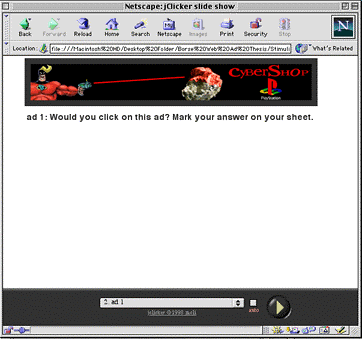
A javascript program called "JClicker" was adapted for use in the presentation of the four orders. JClicker was designed to show a collection of photographs as a slide show. Adaptation of the program allowed display of animated and non-animated Web banners ads. The built-in automatic presentation mode was used for the computer-controlled segment; this mode was preset to present a new slide/ad every five seconds. The built-in self-presentation mode was used for the self-paced segment of the study. Subjects were asked to click on an arrow button when they were ready to proceed to the next slide/ad. The "back" arrow was deleted to prevent subjects from being able to go back and look at ads they had already seen. This program enabled the stimuli to be presented via an actual Web browser, however all files were loaded locally on the computer used to present the stimuli. This was done to prevent presentation delays or differences in the amount of time necessary for each banner ad to load which may have occurred had the stimuli been stored remotely on a Web server and actually presented via the Internet.
Procedure
After signing release forms approved by the Human Subjects Committee and receiving instructions, subjects were randomly assigned to one of the four orders and were seated in an armchair approximately four feet from a 20 inch computer screen. A lap board was laid across the arms of the chair, and the mouse for the computer was placed on the board closest to the subject's dominant hand. Sensors were placed on the subject's non-dominant (i.e. non mouse-using) hand, collar bone, opposite ankle and the sole of their opposite foot. Before placing the sensors, each area of skin was washed and rinsed with distilled water to remove excess dead skin and help ensure a good connection. Sensors were also placed on the subject's corrugator and zygomatic facial muscles. These sensors collected skin conductance, heart rate, and facial EMG data during the presentation of each of the thirty-two banner ads. While these data will not be analyzed in this paper, they have been analyzed for subsequent conference presentations and other publications. (See the Borse & Lang, 2000, conference paper presented to the Information Systems Division of the International Communications Association and other forthcoming papers from the Institute for Communications Research for heart rate, skin conductance and facial EMG data).
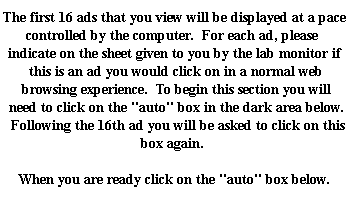
The experimenter launched a file in Netscape Navigator to start the JClicker program and present the predetermined stimulus order. The subject was asked to sit still while the experimenter went to the adjoining control room to calibrate data collection equipment. Once the equipment was calibrated and baseline data had been collected, the subjects were asked to use the forward arrow button on the JClicker interface to advance to the first set of instructions. The instructions preceding the computer-controlled segment stated:
After viewing the first sixteen ads, the second instruction screen appeared on the computer screen. The instructions preceding the subject-controlled segment stated:
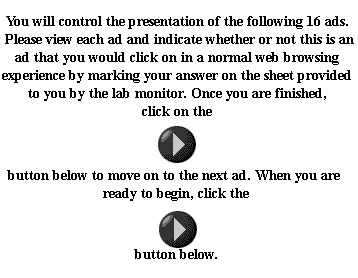
The experimenter was able to view the subject and the computer monitor through a one-way glass mirror and communicate with the subject, if necessary, over a two-way intercom. In order to segment the physiology data properly, the experimenter had to watch the subject and mark the onset of each new slide/ad (and simultaneously marking the offset of the previous ad) by pressing a key on the data collection computer. This was done for each ad so that a series of thirty-two data segments and two baseline segments were gathered for each subject. Trial runs of the experimental procedure indicated the experimenters were sufficiently skilled at monitoring the presentation of each ad and marking the onset of each ad to ensure the collection of useable data.
A reminder for subjects to mark their sheet as to whether or not they would click on the ad in a normal Web usage experience (e.g. if they were at home surfing the World Wide Web) was posted below each ad.
Figure 1: Screen capture illustrating the manner in which ads were presented
After viewing each of the thirty-two Web banner advertisements, subjects participated in an experiment on video games that served as a distracter for the Web advertisement study. The video game activity took approximately ten to twenty minutes to complete. Subjects were then asked to complete a free recall task for the Web advertisement study. They were asked to write down as many items from the advertisements as they could remember, with as much detail as possible; they were given two minutes to complete this task. After the free recall activity, subjects were given a paper-based recognition test. This was a multiple-choice test that presented one correct set of advertised product and brand names listed among three similar, but incorrect, sets of products and brand names (serving as foils) for each of the thirty-two ads. After completion of each of these tasks, sensors were removed and subjects were thanked for their participation.
Scoring
Free recall answers fell into one of four categories: product names, brand names, images (or animated objects) and specific ad text or offers. Subject's responses were coded such that each ad could have four possible recall points for each advertisement; one point for each category in which something was listed. The data was collapsed across ads in order to present a cumulative score for each ad type: animated ads in the subject-controlled segment, non-animated ads in the subject-controlled segment, all ads in the subject-controlled segment, animated ads in the computer-controlled segment, non-animated ads in the computer-controlled segment, all ads in the computer-controlled segment, all animated ads, and all non-animated ads.
Data from the recognition tests and click-through data were also collapsed across ads to present a cumulative scores for each of the ad types listed above. Results and findings are presented in the following chapter.
Chapter Four
Results from the study on Web advertising
The Effects of Animation and Control on Recall
H1: Recall will be better for animated advertisements than for non-animated advertisements.
H3: Subjects will recall more advertising content from ads viewed when they have control over the presentation of the stimuli than ads viewed during the computer-controlled segment.
The first hypothesis predicted that recall would be better for animated banner advertisements than non-animated banner advertisements. Recall scores for each type of recall (brand name, product name, ad text and images) were combined to produce a cumulative recall score for each ad. An anova was run on this data and a main effect was found only for control (F=4.14, p<.050).
A second cumulative recall score was created by totaling only recall for brand names, ad text and images. The patterns of recall for brand, text, and images were consistent but the recall pattern for product names was different. Therefore, the decision was made to re-analyze the cumulative recall data without the product recall scores. When an anova was run on the cumulative recall scores, including only brand, text and image recall, there were significant main effects for both for control (F=5.03, p<.032), shown in Figure 2, and animation (F=10.53 p<.003), Shown in Figure 3.
Five percent of animated ads were recalled, as compared to the 3.5% of non-animated ads that were recalled. Similarly, five percent of the computer-controlled ads were recalled as compared to the 3.5% of subject-controlled ads that were recalled.
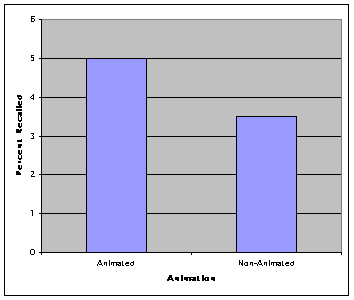 Figure 2: Effect of Animation on Recall
Figure 3: Effect of Control on Recall
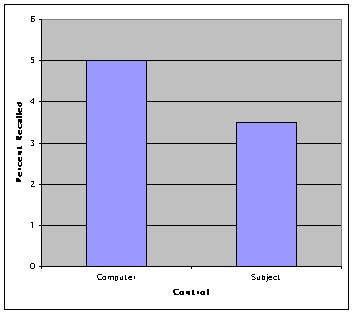
RQ1: Does animation damage recall for product or brand name information?
The first research question sought to determine if animation had a detrimental effect on recall specifically for brand and product names. There was no main effect for animation on recall of brand names and product names. However, there was an Order by Control main effect (F=19.49, p<.000) that seems to be due to better memory for a certain group of ads, irregardless of whether they were presented in the computer-controlled condition or subject-controlled condition and whether they were animated or non-animated.
RQ2: Does the presence of animation in Web banner advertisements increase recall for animated images?
The second research question sought to determine if the presence of animation had an impact on recall for images, specifically whether or not animated images would be recalled more than non-animated images. There was a main effect for animation on recall of images (F=7.2, p<.010). Seven percent of the images from animated ads were recalled, while only 3% of the images from non-animated ads were recalled. Means for percent of correct ad recognition are show below in Figure 4.
Figure 4: Percent of ads recalled
(Means for recall in decimal format)
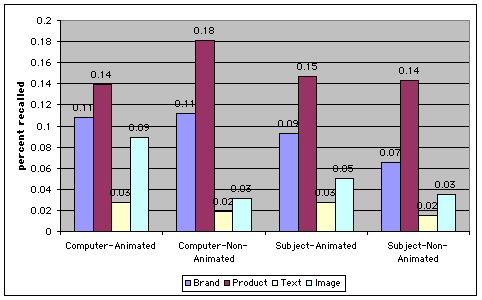
The Effects of Animation and Control on Recognition
H2: Recognition memory will be better for animated banner advertisements than for non-animated banner advertisements.
H4: Subjects will recognize more advertising content from ads viewed when they have control over the presentation of the stimuli than ads viewed during the computer-controlled segment.
There were two hypotheses put forward regarding recognition. The first predicted that subjects would make more correct responses on recognition test questions about animated ads than they would make for non-animated ads. The second predicted that subjects would make more correct responses on recognition test questions about ads viewed in the subject-controlled condition than ads viewed in the computer-controlled condition. There were no main effects for either Animation or Control where recognition data was concerned. However, there was a significant F=9.40, p<.004) Animation x Control interaction which is shown below in Figure 5. In the computer-controlled condition there appears to be little or not effect of animation. Fifty-nine percent of animated ads viewed in the computer-controlled condition were recognized, and 60% of non-animated ads were recognized. In the subject-controlled condition animation had an effect on recognition for ads such that animated ads were recognized better than non-animated ads, (61% and 51%, respectively).
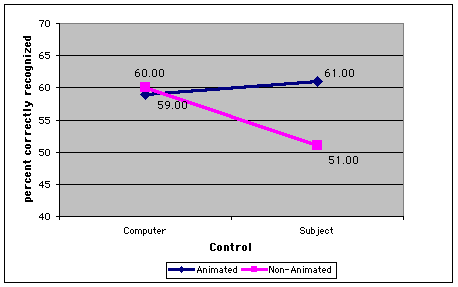 Figure 5: Effect of Animation and Control on Recognition
The Effects of Animation and Control on Click-Through
RQ3: Do animated Web banner advertisements produce higher click-through rates among users than non-animated Web banner ads?
RQ4: Do subjects report a greater likelihood to click on advertisements encountered when they have control over the presentation of the stimuli than ads viewed during the computer-controlled condition?
The final research questions sought to determine if there were effects for Animation and Control on subjects' self-reported likelihood of clicking on the ad. There were no main effects for Animation or Control but there was a significant Control x Animation interaction for click-through (F=44.58, p<.000). Results (shown in Figure 5) demonstrate that when subjects control stimulus presentation, the addition of animation increases the likelihood of click-through, but when the computer controls stimulus presentation there is less likelihood of the subject clicking on the ads.
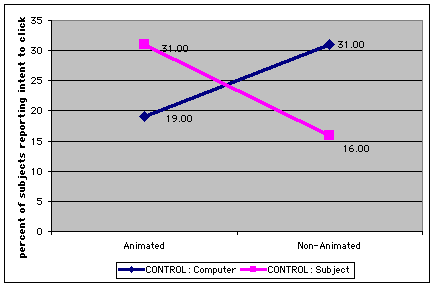 Figure 6: Effect of Animation and Control on subject-reported Click-Through
Chapter Five
A discussion of the findings from the Web advertising study
Research findings summarized and discussed
In this study of Web banner advertising I found main effects for Animation and Control on subjects' overall recall for Web banner advertisements. In terms of specific types of recall, my research findings suggest that animation did not have a detrimental effect on subjects' recall for brand and product name information. Furthermore, there appeared to be some benefit for recall of images that appeared within ads that are animated. For ads presented during the computer-controlled condition, ability to recognize ads seen was not different for animated ads and non-animated ads. However, when subjects controlled the rate of presentation and onset of ads, animated ads were correctly recognized more so than non-animated ads. Overall, animation seemed to have a positive effect on recall and recognition of Web banner advertisements. Finally, click-through data suggested that subjects were more likely to click on animated ads when they controlled the presentation of the ads, but more likely to click on non-animated ads when the computer controlled the onset of each new ad.
I had originally thought that memory for brand and product information would suffer if subjects' attention and processing resources were diverted toward animated objects in the ads. The fact that subjects' memory for brand and product information does not seem to be hindered by the presence of animation is good news for Web advertisers. While there is indeed evidence of better recall for animated ad objects and images, this does not appear to be at the expense of subjects' recall for brand name and product information.
The fact that there was better recall for ads in the computer-controlled condition as compared to ads presented in the subject-controlled condition seems at least partly attributable to a greater amount of time spent looking at, and possibly rehearsing, the content of ads during the computer-controlled segment. The recognition data also suggests the possible effects of ad exposure time in addition to animation's ability to capture attention. Each ad in the computer-controlled segment was present on the screen for five seconds, giving many subjects a much longer time to view each ad than was taken during the self-controlled segment of the study. As there was no other content present on the screen for subjects to devote their attention to, they might have taken advantage of the opportunity to study the ads presented by the computer in greater detail. Physiology data segments (heart rate, skin conductance, and facial EMG) collected during this study can provide some insight as to the length of time each subject spent viewing each ad. This data can perhaps be reanalyzed in order to shed some light on whether or not subjects did indeed spend less time viewing ads during the self-controlled segment. Additional research will need to be conducted in order to gain a better understanding of why this effect occurs—whether it is simply the result of a longer exposure to certain ad stimuli or the result of heightened attention being devoted to more compelling stimuli. None-the-less, this research suggests that there is an advantage for animated stimuli over non-animated stimuli, especially when subjects are in control of their browsing experience, which has more external validity as it is closer to the way that users interact with the Web in non-experimental situations.
The interaction between animation and user control over stimuli presentation for click-through likelihood also suggests a need for greater research and raises many interesting questions. Why do subjects prefer to click on non-animated ads in the computer-controlled condition, but animated ads in the self-controlled condition? Conversely, why do subjects show less interest in clicking on animated ads in the computer-controlled condition or non-animated ads in the self-controlled condition? The memory findings and patterns can possibly be explained by greater exposure time; is it also plausible to think that longer exposure to an ad would be enough to create a significantly higher likelihood of clicking on that ad?
Perhaps when stimuli are passively viewed, there is a slight state of annoyance with animated ads. Given the repetitious nature of animated advertising (i.e. animation cycles repeating over and over again), the ads may wear out their welcome among Web users, especially if they are intent upon rehearsing the content of an ad. The constant attention-drawing nature of animated elements in the ads might be consciously or subconsciously upsetting the subjects, thus the effects of animation may wear out over time if it repetitious, leading subjects to show less interest in clicking on ads with animation. However, if the subject is more actively (and more quickly) browsing through ads, animated ads might be an aid in capturing their attention—the first step in any eventual decision to click on an ad. These findings are likely to carry over into more real-world ad viewing conditions. Depending on the context in which an ad will ultimately be viewed (e.g. whether or not the user is more or less likely to be controlling the presentation of new stimuli), Web advertising creators may want to consider whether or not they include animation.
Clearly we have begun to see evidence that Web banner advertisements can have an effect on Web users even when they do not choose to click on the banner. This finding has clear implications for Web advertisers and those who determine pricing guidelines for Web advertising. Advertisers using a pay-per-click formula to place an ad on a Web site are likely to be getting more than what they are paying for, based on the likelihood of there being memory for that ad, and brand and product information contained therein, even among users that do not choose to click.
There is some evidence that animated ads work best when users are more actively involved and in control over their online experience. When users are active, their attention resources are divided among many tasks; perhaps in this situation animation is a sufficient feature to grab attention—getting users to look at the ad, remember the ad's content, and possibly click on the ad.
Limitations of this study
The main limitation to this study was that to gain experimental control, a true real-world Web usage situation was not possible. When people use the World Wide Web they are constantly engaged in decision-making efforts that determine the path they take. This effort is much greater (and likely to produce different effects) than the effort involved in the decision of when to push a button to advance to the next slide. Likewise, Web banner advertising in the real world appears among the content of Web sites. As discussed earlier, one of the biggest challenges to Web advertisers is capturing users' attention from they myriad of competing stimuli on a Web site. This study presented isolated Web banner advertisements. Therefore, the ability to make generalizations about the way ads are processed and remembered when they are in competition with other Web content is greatly limited.
The results indicate that the length of time a subject is exposed to an ad may have an impact on memory outcomes. Analysis of the length of subjects' exposure to each ad, available from the physiology data, will shed some light on this factor, however, even this data will have its limitations. The inability to create a direct link from the computer used to present stimuli to the computer used to collect physiology data was a limitation. Experimenters had to mark the onset and offset of each ad as it was presented, watching over the subject's shoulder from behind a one-way mirror. This resulted in a built-in margin of error based on the experimenter's response time to the onset of each new ad. Future studies need to consider the role of exposure time and find ways to more accurately gauge the actual amount of time spent viewing ads in a subject-controlled stimuli presentation context.
Directions for future research
As mentioned repeatedly, additional research is needed to further understanding of the role that exposure time plays in memory for Web banner advertisements. If time is not the cause of the interaction between Animation and Control, researchers must seek the real cause for this type of effect.
Future studies should continue to explore the differences between the ways people respond to other types of stimuli presented on the computer as compared to the ways they would respond to the same stimuli presented via other media. Furthermore, this study dealt specifically with advertising; other forms of content should also be examined. As research has shown, there can be differences in how advertising and other forms of content are processed (Sundar, Narayan, Obregon & Uppal, 1999). Additional research is also needed to inform our understanding of the role that exposure time plays in subjects' memory for stimuli presented online.
Conclusion
Additional research is clearly needed to fully understand the impact of Web advertising. This study contributes to the body of knowledge forming about banner advertisements, but much remains to be learned about other forms of advertising on the Web as well as non-advertising content. Web advertising is certainly not limited to banner ads, and new forms of Web advertising are constantly being developed by advertisers. New advertising formats such as "superstitials," which trigger a new window to pop up and present media-rich stimuli such as movie trailers, bear a stronger resemblance to television advertising. But the Internet remains a unique media, with unique media effects. As more is learned about the nature of peoples' responses to Web advertisements, advertisers can become more skilled at creating Web advertising messages that work.
Works Cited
Aaker, D.S., Batra, R. & Meyers, J.G. (1992). Advertising Management, 4th ed. Englewood Cliffs, NJ: Prentice Hall, 1992.
AdRelevance. (2000, December). AdRelevance Special Report. Retrieved December 7, 2000, from the World Wide Web: http://www.AdRelevance.com.
American Association of Advertising Agencies. Guide to out-of-home media. New York, NY.
Barrett, N. (1997). Advertising on the Internet: How to get your message across on the World Wide Web. London: Kogan Page Ltd.
Basil, M. (1994). Secondary reaction-time measures. In A. Lang (Ed.) Measuring psychological responses to media messages (pp. 85-98). Hillsdale, NJ: Lawrence Erlbaum.
Basil, M. (1994). Multiple resource theory I: Application to television viewing. Communication Research, 21, 177-207.
Benway, J. P. & Lane, D.M. (1998, December). Banner blindness: Web searchers often miss obvious links. Internetworking, 1.3. Retrieved March 23, 1999, from the World Wide Web: http://www.sandia.gov/itg/newsletter/dec98/banner_blindness.html.
Borse, J. et al (1997). Extra! Extra! Read all about it: Attention and memory for deviant and imagistic headlines. Paper presented to the Theory and Methodology Division of the Association for Education in Journalism and Mass Communication, Chicago, IL.
Briggs, R., & Hollis, N. (1997). Advertising on the Web: Is there response before click-through? Journal of Advertising Research, 37(2), 33-45.
Broadbent, D.E. (1958). Perception and Communication. London: Pergamon.
Cleand, K., & Carmichael, M. (1997). Banners that move make a big impression; Ads that say 'notice me' are the latest rage online. Retrieved December 7, 2000, from the World Wide Web: http://adage.com/interactive/articles/19970113/article3.html.
Craik, F., & Lockhart, R. (1972). Levels of processing: a framework for memory research. Journal of Verbal Learning and Verbal Behavior, 11, 671-684.
David, P. (1996). Role of imagery in recall of deviant news. Journalism Quarterly, 73 (4), 804-820.
DeFleur, M., Davenport, L., Cronin, M and DeFleur, M. (1992). Audience recall of news stories presented by newspaper, computer, television and radio. Journalism Quarterly, 69 (4), 1010-1022.
Detweiler, M.C., & Omanson, R.C. (1996). Ameritech Web Page User Interface and Design Guidelines (online).
Diaz, A.P. (2000). Consumers less likely to trust Web ads. Advertising Age, 71(12), p. 34.
Ducoffe, R. (1996). Advertising value and advertising on the web. Journal of Advertising Research, September/October, 21-35.
Ellsworth & Ellsworth. (1998). Marketing on the Internet.
Eysenck, M. W. (1993). Principles of cognitive psychology. Hillsdale, NJ: Lawrence Erlbaum Associates.
Garramone, G. (1983). TV news and adolescent political socialization. IN R. Bostrom (ed.) Communication Yearbook, 7, 651-671. Veverly Hills, CA: Sage.
Geiger, S. & Newhagen, J. (1993). Revealing the black box: Information Processing and media effects. Journal of Communication, 43, (4) 42-49.
George, T. (2000). Web ads add up fast. Informationweek, March 6, 2000, p 17.
Gurley, J. W. (2000). Why impressions don't matter. Fortune, 142 (3), 340.
Halprin, D.A. (2000, October 18) What is the real average CPM of Web Advertising? Retrieved December 7, 2000, from the World Wide Web: http://www.emarketer.com/etopics/articles/20001017_web_cpm.html?ref=dn.
Harris, R.J. (Ed.) (1983). Information Processing Research in Advertising. New Jersey: Lawrence Erlbaum Associates.
Harvey, B. (1996). Clickstream Measurement of Interactive Media. Getting started on interactive media measurement. Advertising Research Foundation (Eds.).
Hyland, T. (1997). Web Advertising; A year of growth. Retrived December 7, 2000 from the World Wide Web: http://www.iab.net/advertise/content/webgrowth.html.
Internet Advertising Bureau. (2000). Internet Ad Revenue Report. Retrieved December 7, 2000, from the World Wide Web: http://www.iab.net.
Kahneman, D. (1973). Attention and Effort. New York: Prentice Hall.
Keeler, L. (1995). Cybermarketing. New York: American Management Association.
King, K. W., & Tinkham, S. (1990). The learning and retention of outdoor advertising. Journal of advertising research, December/January, 47-52.
Lang, A. (1989). Effects of chronological presentation of information on processing and memory for broadcast news. Journal of Broadcasting and Electronic Media, 33 (4). 441-452.
Lang, A. (1992). A limited capacity theory of television viewing. Paper presented to the Information Systems Division of the International Communication Association.
Lang, A. (1996). The information processing of mediated and unmediated messages. Paper presented to the annual meeting of the International Communication Association, Chicago, IL.
Lang, P.J., Bradley, M.M., & Cuthbert, B.N. (1997). Motivated attention: Affect, activation and action. In P.J. Lang, R.F. Simons & M.T. Balaban (Eds.) Attention and Orienting: Sensory and Motivational Processes. Hillsdale, NJ: Lawrence Earlbaum Associates, Inc.
Lucas, D.B. & Britt S.H. (1985). Measuring Advertising Effectivenes. New York: Garland Publishing, Inc.
Lynn, R. (1966). Attention, arousal, and the orientation reaction. Oxford: Pergamon Press.
Marx, W. (1996, December). How to make Web ads more effective: Strong message, call to action are crucial, experts say. Retrieved November 4, 1998, from the World Wide Web: http://netb2b.com/cgi-bin/cgi_article/monthly/96/12/01/article.1.
Marx, W. (1996, November). Study shows big lifts from animated ads: Click rate jumps up to 40% higher than with static ads. Retrieved November 4, 1998, from the World Wide Web: http://netb2b.com/cig-bin/cgi_article/monthly/96/11/01/article.01.
Meland, M. (2000). Banner ads get sexy. Forbes. Retrieved December 7, 2000, from the World Wide Web: http://www.forbes.com/2000/02/18/mu1.html.
Miyo, Y. (1983). The knowledge-gap hypothesis and media dependency. In R. Bostrom (Ed.). Communication Yearbook, 7, 620-650. Beverly Hills, CA: Sage.
Naples, M. (1996). Introduction to ARF’s Interactive Research Day. Getting Started on interactive media measurement. Advertising Research Foundation (Eds.).
Norman, D. A. (1999, March). Commentary: Banner blindness, human cognition and web design. Internetworking, 2.1. Retrieved March 23, 1999 from the World Wide Web: http://www.sandia.gov/itg/newsletter/mar99/commentary.html.
NUA Internet Surveys, (2000, March). Retrieved December 7, 2000, from the World Wide Web: http://www.nua.ie/survesy/how_many_online/index.html.
Outdoor Advertising Association. (2000) Basics. Retrieved July 2000, from the World Wide Web: http://www.oaaa.org.
Percy, L. (1983). Advertising and Consumer Psychology. Lexington: Lexington Books.
Schumann, D.W. and Thorson, E. (Ed.) (1999). Advertising and the World Wide Web. Mahwah, New Jersey: Lawrence Erlbaum Associates.
Shoemaker, P.J. (1996). Hardwired for news: Using biological and cultural evolution to explain the surveillance function. Journal of Communication, 46 (3), 32-47.
Stapel, J. Recall and recognition: a very close relationship. Journal of Advertising Research, 38 (4), 41-45.
Sundar, S., Narayan, S., Obregon, R. and Uppal, C. (1999). Does web advertising work? Memory for Print vs. Online Media. Journalism and Mass Communication Quarterly, 75 (4), 822-835.
Tedesco, R. (1999). Web ads get glitsy, savvy. Broadcasting & Cable, 129 (46), 48.
Thorson, E., Wells, W.D., & Rogers, S. (1999). Web Advertising's Birth and Early Childhood as viewed in the pages of Advertising Age. In Advertising and the World Wide Web, Schuman, D.W., & Thorson, E. (Eds). Mahwah, NJ: Lawrence Erlbaum Associates.
White Palm (1998). Essential Banner Tips. Retrieved November 4, 1998 from the World Wide Web: http://www.whitepalm.com.
Wicks, R.H., & Drew, D.G. (1991). Learning from news: Effects of message consistency and medium on recall and inference making. Journalism Quarterly, 68, 155-164.
Wilson, C.E. (1974). The effect of medium on loss of information. Journalism Quarterly, 51, 111-115.
Zimmerman, J. & Mathiesen, M. (1998). Marketing on the Internet. Gulf Breeze, FL: Maximum Press.
Appendix A:
Recall and Recognition Test
1_Subject #____________
Please list as many products, company names and items as you can, based on your memory of the ads that you saw earlier.
Do not turn the page until instructed to do so by the lab monitor.
Please select the most appropriate answer to each of the following questions. Do not spend too long on any one question, as first impressions tend to be correct.
3. Which of the following did you see an ad for?
4. Which of the following did you see an ad for?
5. Which of the following did you see an ad for?
6. Which of the following did you see an ad for?
7. Which of the following did you see an ad for?
8. Which of the following did you see an ad for?
9. Which of the following did you see an ad for?
10. Which of the following did you see an ad for?
11. Which of the following did you see an ad for?
12. Which of the following did you see an ad for?
13. Which of the following did you see an ad for?
14. Which of the following did you see an ad for?
15. Which of the following did you see an ad for?
16. Which of the following did you see an ad for?
17. Which of the following did you see an ad for?
18. Which of the following did you see an ad for?
19. Which of the following did you see an ad for?
20. Which of the following did you see an ad for?
21. Which of the following did you see an ad for?
22. Which of the following did you see an ad for?
23. Which of the following did you see an ad for?
24. Which of the following did you see an ad for?
25. Which of the following did you see an ad for?
26. Which of the following did you see an ad for?
27. Which of the following did you see an ad for?
28. Which of the following did you see an ad for?
29 Which of the following did you see an ad for?
30. Which of the following did you see an ad for?
31. Which of the following did you see an ad for?
32. Which of the following did you see an ad for?
Appendix B
Banner Click-Through Information