
I. Introduction
Your peaceful life as the daughter fo an American diplomat has just been turned upside down. Without warning your father disappears and is presumed to be dead, leaving you orphaned -- lost in a world of strange people and strange times. You are invited to go and live with your aunt in Switzerland but a strange man who you meet at your father�s memorial service promises that he can provide information about your father if you can help him deliver a small package from London...
The times are tense and the one thing that you know is that you cannot stay in Germany. The faces of the people in you once bubbly and friendly neighborhood have grown cold and sullen and there is talk of another war brewing.
Whether you accept your aunt�s invitation or take the stranger up on his offer you cannot begin to imagine the adventures that are about to come your way.
II. Product Overview
This game is largely designed to be one that will attract the hard-to-reach young female segment of the market. As more and more familys jump on the multimedia-PC bandwagon more and more girls have access to computers but relatively small amounts of software that interests them. By capitalizing on a variety of features in other products that girls have taken interest in I believe that this game provides young girls with the right mix of adventure and drama. The game also has a educational component that will appeal to the parents of our targeted players.
Mission Statement:
It is my belief that there is a product formula that will attract young female users, and that if tapped, this market segment can prove to be profitable (especially given girls� habits of making repeat purchases for narrative series). More importantly than profitability however, it is my belief that the creation of a game/program that attracts a young female audience can help to foster their general interest in technology and development of computer-related skills.
The right blend of adventure and drama:
A recent survey (including my personal experiences as a summer camp counselor, babysitting, working with young people at the YMCA, as a middle school and elementary school substitute teacher and from my own experiences with adolescense) of the types of things our target audience currently enjoys uncovered the following examples:
While I by no-means am claiming to having created a fool-proof formula for targeting this market segment successfully, I do believe that my survey prepares me to make a more educated attempt at doing so. I believe that young girls are primarily interested in opportunities to interact with the world and the people that inhabit it. Narratives that involve an element o finterpersonal interaction and interpersonal relationships have been the long-standing favorites among this age group/for this gender. I therefore believe that this will be an important component of any game that attempts to target the young female market.
The educational twist:
In addition to being attractive to a young female audience this game is also educational in nature. The narrative element of the game will be largely based on historical fact -- including important events and people -- and the strategic elements of the game encourage the player�s use of problem solving skills.
Target platforms:
This game is designed for Macintosh and IBM compatible Pcs with CD ROM players. Due to the nature of the visual and sound components of this game I do not believe that it would be possible to aim for anything but CD ROM as an end medium for holding the game.
Number of players:
The narrative aspects of the game make it best suited for an individual player. This is not to say, however, that only one player can ever play the game. A save feature will allow multiple players to play and save individual versions of the game.
Character of the interactive experience:
There are many components of the interactive experience for this game. Most noteable is the interactive narrative fiction that will frame the remaining elements of the interactive experience. The game allows players to make selections throughout the narrative which will determine what actions/events will occur (similar to a choose-your-own adventure story).
In addition to the interactive narrative there will also be puzzles to manipulate, or simulated games (e.g. cards or checkers) against various opponents.
Finally, there will be real-time motion segements where you must either follow someone through a maze of streets and alleys or somehow evade being followed yourself.
III. Opening Sequence
The game begins at a crowded memorial service. As you move the mouse around you can hear bits and pieces of the conversations that are taking place among the other mourners that surround you. When you pass over the figure in the corner he informs you that: �Your father is not dead...you can help us find him!� The screen then goes fuzzy and the player is exposed to a multimedia collage of images and sound. Black and white pictures, like those below, will be laid on top of one another while the background for the story is being told. The entire while light music and ambiant sound will enhance the experience and draw the player into the story.
I remember that day so many years ago when father was working in his and he got the call offering him a position in Germany. My mother had died when I was born and since we had no other living relatives in the United States there really wasn�t much to the decision to move.
The first few years in Germany were incredible. I couldn�t remember father ever being so socially involved. There were times when I felt like a princess myself having met so many famous and royal people.
But things began to change. Father became very secretive and increasingly more protective of me. He also began to take long trips which would keep him away from home for great lengths of time.
...It was the spring of 1940, I wasn�t particullarly surprized when I began to hear talk of another war. The air had been filled with tension and everyone -- including my father -- had been seeming a little bit testy. One day a tall man with a handlebar mustache came to our door. He asked for my father and once I called for him I was hastily ushered away from the door. Immediately after the man left my father began packing his suitcase. As I peered in the door I couldn�t help but notice what appeared to be a tear rolling down my father�s cheek. While I had imagined that he must have cried when my mother died I had never expected to see him cry again.
I never got a chance to ask him what made him cry. He left quickly after leaving me with the usual amount of spending money and instructions to take care of myself. His departure seemed no different from any of the others...How was I to know that this time he wouldn�t be coming back.
It wasn�t until two weeks later that I was informed that my father had disappeared and was presumed to be dead. I realized for the first time in my life what it truly felt like to be alone.�
 Once this sequence has ended you find yourself once again at the memorial service. You can still overhear the conversations of the people in the crowd my moving the mouse over them. To exit this scene you must find someone who will offer you a ride back to your house.
IV. Graphics
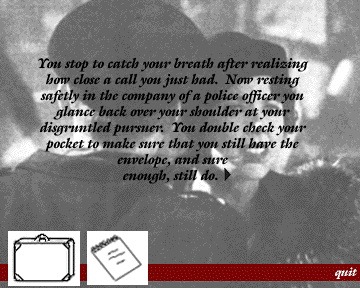
The visual component of the game is largely comprised of black and white photographic images. The narrative text is presented on top of a faded image which serves as a background.
There will, from time to time, be movie segments which will freeze at the end and become the background. These movies may be in color but even color is stylized to give it a historic look.
 There is a hazy quality to the whole thing giving it a somewhat mysterious or intriguing look while still retaining a somewhat romanticized feel.
The control bar is another distinctive graphic feature. The control bar is always present across the bottom of the screen. This bar includes a suitcase, allowing the player to carry around a variety of objects that he/she picks up along the way, and a notebook for jotting notes...or reading the supposedly self-generated mental notes that will appear in the notebook from time to time.
There will, from time to time, be movie segments which will freeze at the end and become the background. These movies may be in color but even color is stylized to give it a historic look.
V. Sound
The basic sound elements will never be overwhelming but more of a background effect that will draw the player into the world of the game. Whenever possible the game uses actual music from the 40�s to enhance the feeling of actually experiencing the time period as though you are there.
Sound also plays an important role for conveying important information to the player. Many clues and hints will be provided in short audio clips that the user can access by moving their mouse over the speaker whom they wish to speak with or eavesdrop on.
VI. Play-Action
To achieve victory the player must engage in a number of activities. There are many routes to victory and many routes to disaster. The path that the game takes is determined by the decisions that the player makes at the various points.
The player must first decide where to go and what to do. The first task is to pick up an envelope from a person in London and to deliver it to someone in Berlin.
There will often be telephones which the player can use to call numbers that they have been given to get more information. They can also call for a taxi which can take them either to their desired location (if they are in the appropriate city) or to the train station (if they need to travel from city to city).
Over-hearing the conversations of people is another important element of the game�s play-action (after all, it is a spy game...it wouldn�t be fair not to have to do any syping!) To overhear someone the player simply has to pass their mouse over them. A message will be displayed in cases where a person is too far away to be heard or for some other reason inaudible.
From time to time the player will encounter situations where they must solve on screen puzzles. In some cases these will quite literally be puzzles where the player must manipulate pieces in order to view a message, while other puzzles may be anagrams, riddles, or coded messages. There will also be times where the player must play a game of cards or strategy (e.g. pente or checkers) with an opponent.
The final type of play-action are doom-like sequences where the player must either evade someone who is following them or trail a character through a maze of streets and alleys.
VII. Play-Mechanics
The user�s most powerful tool is their mouse. The mouse will acitivate a variety of things by simply passing over a particular person or object.
At decision points the user will be asked to select from three or four options listed on screen (in some cases this is done graphically (e.g. selecting the appropriate train ticket from a set of three on the cashiers desk at the train station), while in others this is done with textual descriptions of the options (e.g. things are presented in a choose-your-own-adventure story). Paths are selected either by clicking on the object or clicking on the textual description.
For puzzles that the player must manipulate on screen they will once again use their mouse. Click and drag features are implemented. And the arrow keys on the keyboard allow the user to toggle or rotate the objects if necessary.
The play-mechanics for the game segments will be much the same as they are in most popular games of this nature, again, capitalizing on the mouse as a tool for manipulation.
The doom-like chasing/being chased segments will also use the mouse for most of their action. Examples of this type of play-action can be found in DOOM and Marathon. Moving the mouse forward will move the player forward. Moving the mouse backwards will move the player backwards. Moving the mouse to the side will allow the player to turn. Clicking will allow the player to open a door. Hitting the space bar will allow the player to pause the action temporarily. To resume action the player must simply hit the space bar again.
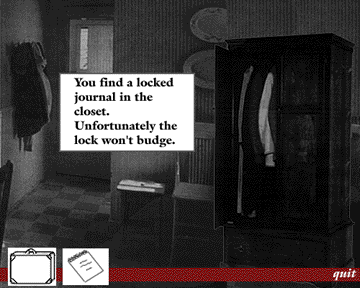
Finally, the player will always be able to manipulate the objects on the control bar at the bottom of the screen. As mentioned before there is a suitcase, a notebook and a control option that will allow the player to exit and save their game.
Clicking on the suitcase brings up an image of the suitcase and its contents (which will lay over whatever screen the user is at). Moving the mouse over each item will provide the user with a brief description of what it is. Clicking on an object will allow the player to have it �in hand� and ready for use.
Clicking on the notebook brings up an image of the notebook (which will lay over whatever screen the user is at) open to its most recent entry. Clicking at the bottom corners of the notebook will allow the player to review past notes or turn to a blank page to record more notes. To enter information in the notebook the player must use the keyboard. There are periodically entries that will appear in the notebook which the player does not have to enter. These entries will be added automatically following important events and can be used as a supplemental source of information for the player.
There are also special segments in the notebook for keeping addresses/phone numbers and important date/appointment information. These segments are separated by colored tabs. By clicking on one of these tabs the player can go directly to the appropriate section. To reduce the amount of hassle for the player the most recently seen number, address or date will automatically appear. It will be highlighted (following the Macintosh convention) and the player can either hit return or click away to accept what has been pasted or can type in their own information, automatically deleting what was written.
The quit button will allow the player to pause or exit the game. When the player selects this option by clicking on it an option screen will appear asking if the player would like to �resume game play�, �save the game�, or �exit the game�. To load a saved game once the game has been exited the player simply double clicks on icon that was created when the game was saved.
VII. Difficulty, Playability, and Play-Life
This game is designed primarily for a teenage audience. Therefore the difficulty will not be too advanced. The puzzles will be challenging (and will gradually become more challenging as the game goes on) but not so challenging that they will not be solveable.
Clues for the player will come from the conversations that they are able to hear. Secret messages will occassionally be sent to them and they will also be able to gather information from telephone messages or interviews with various people (including famous spys and other historical figures).
In cases of extreme desparation the player will be able to utilize a special help telephone number that is given to them in the game documentation as well as recorded in the phone number section of the notebook.
The play-life of this game is relatively limited. Theoretically a highly motivated player could complete at least one version of the game in a single weekend. More realistically however, a player might spend a month or two working through the puzzles and exploring a variety of paths. The game employs an update feature (which will be discussed in more detail in the next session) which provides a brief synopysis of what has happend and what the players current goals are each time the player resumes a saved game, thus allowing a more extended play-life.
More importantly than this single game, a framework is created on which future games could also be built. In addition to playing a game users are also learning about the main character and her history. (Sarah may accomplish her goals but she does not find her father in the first game). Following this game, users will hopefully be motivated to purchase subsequent adventures. Again, it is my hope as a designer that a well planned and efficient production process will allow for the production of a series of game titles based on the Sarah Lane story that is outlined in this game. Young girls like to read several quick-read books from a single series as opposed to mulling over one long and isolated novel -- I believe this characteristic will carry over onto their preferences for interactive computer games.
IX. Special Features
There are several special features of this game. As was mentioned before, its marketing slant towards young girls is a special feature in and of itself. By using historic examples of strong female characters (including spys) the game will not only be educational but also inspirational.
Also noteable is its unique combination of interactive fiction, traditional games and real-time, highly suspensful action segments. These segements make this game a one-stop shop for gaming enjoyment! They allow for a sampling of each type of game play without wearing out an interest in any one type.
The post-save/upon resume update feature (a brief synopsis of what has happenend and what your current goals are) is another important aspect of this game. This allows the game to retain its attraction over a longer period of time since the players do not have to worry about starting from scratch each time they resume play.
X. Market Perspective
As has been mentioned repeatedly in this proposal, the marketing prospective that this game takes is one which targets young girls.
Various detective/mystery games and educational games such as Where in the World is Carmen Sandiego? serve as popular examples of games which have been successful in attracting female as well as male players.
This game improves upon those similar games which have preceeded it because it combines a variety of different types of interactions. The player is not forced to rehash the same types of interactions over and over again each time they play.
XI. Summary
In sum, I believe that Sarah Lane�s Haphazard Adventures is a creative solution to the problem of creating software that is attractive to a female audience. It is an educational product that is also highly entertaining. It combines a variety of traditional game elements into a unique blend of interactive fiction, strategy and action/adventure. It allows a great amount of flexibility and interaction which will draw players in and hopefully keep them coming back for more.