
“Writing an informative yet compact thriller is a lot like making maple sugar candy. You have to tap hundreds of trees - boil vats and vats of raw sap - evaporate the water - and keep boiling until you've distilled a tiny nugget that encapsulates the essence.”
-Dan Brown

Links:
2) Book Reviews

3) Analysis of Each Novel
4) My paper
5) About Me
Dan Brown was born on June 22, 1964. in Exeter, New Hampshire and graduated from Phillips Exeter Academy where his father was employed as a math teacher. Brown actually attended local public schools until the ninth grade, though he nonetheless lived with his family on the Exeter campus and participated in a college related life that was also shaped by Christian values.
After leaving his home town, Brown attended Amherst College and graduated with a degree in English and Spanish in 1986, though he spent several years attempting to become a singer-songwriter and pianist with very little success.
Brown's first book was published in in 1995 and was called 187 Men to Avoid: A Guide for the Romantically Frustrated Woman. The following year Dan Brown became a full-time writer, when he published his first thriller, Digital Fortress, in 1998. He went on to write Angels and Demons and Deception Point. The Da Vinci Code was published in March 2003 and sold 6,000 copies on the first day - going to the top of the New York Times' Best Seller list in the first week of publication.
The sales figures for The Da Vinci Code kept on growing - to the extent that it became established as the fastest-selling adult novel ever with some 40 million copies sold that had reputedly earned Dan Brown around $140 million by early 2006.
Brown currently resides in New England with is wife, Blythe, who is an art historian and reportedly is a major influence in Brown's writings.

Hi, my name is David Jablonski, and I am an eleventh grader at Greece Athena High School in Rochester, NY. My favorite author is Dan Brown, and my favorite novels are Digital Fortress and The Da Vinci Code. I enjoy gym class and despise physics. In my free time I like to play basketball, go golfing, and hang out with friends. I also enjoy watching T.V. and playing on the computer. After high school I plan to attend college but I do not know where yet.
Dan Brown has written some of the most unique and interesting novels of all time. He was born in June 22, 1964, in Exeter, New Hampshire. Dan’s father, Richard G. Brown, taught high school mathematics at Phillips Exeter High School. He wrote the best-selling textbook Advanced Mathematics: Precalculus with Discrete Mathematics and Data Analysis. Richard was chosen by President George H.W. Bush to receive the “Presidential Award for Excellence in Science and Mathematics Teaching.” Dan attended public schools in Exeter until the 9th grade, at which time he enrolled in Phillips Exeter. After graduating in 1982, Brown attended Amherst College, where he graduated in 1986. After college, Brown became a songwriter, self-producing a children’s cassette and self-publishing many CD’s. To support himself, he taught Spanish classes at Beverly Hills Preparatory School. In Los Angeles, he joined the National Academy of Songwriters, where he met his future wife, Blythe Newlon. Later, he moved to New Hampshire and became an English teacher at Phillips Exeter. In 1996, he quit teaching to become a full-time writer. Since then, he has already written four best-selling novels. Two of these novels include Digital Fortress (1998) and The Da Vinci Code (2003), where Dan Brown uses many literary tools to write exciting and gripping story plots that keep readers coming back for more.
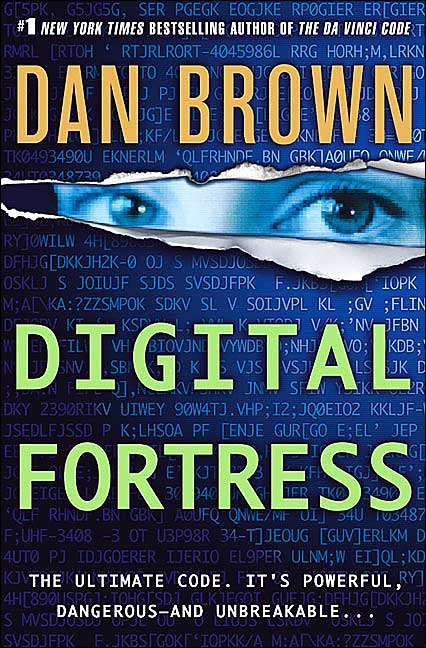
Dan Brown’s first novel, Digital Fortress, is nothing but exceptional. The story begins when the National security Agencies (NSA) top cryptographer, Susan Fletcher, gets an urgent call from her boss, Commander Strathmore, to come to work. She arrives to the shocking news that TRANSLTR, the NSA's incredibly fast and infallible code-breaking machine against which even the best computer encryption software is useless, has at long last come face to face with its nemesis. Codenamed the Digital Fortress, it is an unbreakable code created by an ex-NSA cryptographer, Ensei Tankado, who was fired from his job. As revenge, he had threatened to make it available for public use if the NSA didn’t make TRANSLTR’s existence known to the general public. As the repercussions of this comprise a deadly threat to the nation’s security, it sends shockwaves through the corridors of the NSA. Even as Susan scrambles to find Ensei’s secret partner, she is puzzled, angry and scared that Commander Strathmore has inexplicably sent her boyfriend David, an ordinary university professor, on a dangerous mission to Spain to retrieve this unbreakable code’s key. Does the key really exist, and if so, will David ever find it and live to bring it back? It’s a race against time as secrecy, deceit and lies escalate, and Susan finds herself smack dab in the middle of it all. Faced with betrayal and terror, this young woman has to fight for her love, her life and her country. This novel is full of twists and surprises.
Dan Brown uses a unique style of writing, which is shown in the novel Digital Fortress. Having been one of his fist novels, Digital Fortress is exceptionally well written. His use of many literary elements, such as the insane plot twists, the way he uses the chapters to jump to a different point of view at the climax of another chapter, the character selection, and setting are very noticeable. The book contains over 100 chapters, and each one is as compelling as the next. He ends each chapter with an idea that something interesting is going to happen. In addition, Brown’s use of figurative language is also evident in Digital Fortress. He describes the Digital Fortress code several times as being “tricky, deceitful, and devious.” These are good examples of personification, making readers believe that the code is superhuman. Brown also uses many metaphors and similes throughout the novel. A good example of a simile is in chapter 93, when Brown states, “Like a predator moving downwind, Hulohot moved to the back of the church.” This sentence allows readers to create images in their minds, thus making it easier for them to understand the novel. However, none of these literary elements compare to Dan Brown’s use of syntax in this story. His usage of different sentence varieties keeps the reader on the edge of their seats. Many of them are short and suspenseful, while others are long and detailed. This writing strategy keeps readers eager to read more and more. In the end of the book, they break Digital Fortress, but not after TRANSLTR gets destroyed in a fire.
Dan Brown’s latest novel, The Da Vinci Code, is by far Brown’s best-selling book. In The Da Vinci Code, art historian and religious symbologist Robert Langdon is summoned to the Louvre to help in investigating the murder of its curator. The dead man left a series of cryptic clues and symbols near his body before he died. With the help of cryptologist Sophie Neveu, whose father was the curator, Langdon discovers that some of the clues are hidden in Da Vinci's famous painting, “The Vitruvian Man.” He also learns that Da Vinci, along with Isaac Newton, Victor Hugo, and Botticelli, belonged to a secret society called the Priory of Sion. Also involved are other religious groups and secret societies who are out to stop Langdon and Neveu at any cost. This novel has stirred many harsh feeling in the Catholic Church, as well as many Christian believers.
Dan Brown’s writing style is very well developed, and this is shown in the novel The Da Vinci Code. Right from the beginning, Brown has readers on the edge of their seats. The book gets right into the action, and this is way so many readers can’t put it down. Throughout the novel, Brown’s word usage and its timing is nearly perfect. Since this novel also has more than 100 chapters, it moves very quickly. The way he put this book together is phenomenal. Brown’s most effective literary elements in this book are his symbolism and personification. The symbols that he portrays include red hair, blood, and cell phones. Sophie Neveu’s red hair, mentioned at the beginning of the text, foreshadows her divine blood. Mary Magdalene is depicted as having red hair, and this creates much curiosity for readers. Blood stands for truth and enlightenment in The Da Vinci Code. Whether it is on a person or it is on the floor, blood helps Robert Langdon solve the murder and other mysteries. The object of the cell phone in this book is to remind the reader that the novel takes place in modern times, where secrets are hard to keep. At the same time, the Langdon and Sophie are constantly worried if their cell phone calls are being traced, and this leads to a suspicion as to if they being followed. The most noticeable type of personification that Brown uses in this novel is allusion. In almost every chapter, there are references to history, including the Bible. Brown’s creative writing forces people to consider the existence of the secret society called the Priory of Sion, which protected ancient secrets and objects (including the Holy Grail). Likewise, he leads readers to believe that Leonardo Da Vinci left clues in his paintings to uncover these secrets. In this novel, Brown also uses vivid diction to explain different events. This is show when he says, "As someone who had spent his life exploring the hidden interconnectivity of disparate emblems and ideologies, Langdon viewed the world as a web of profoundly intertwined histories and events." There is excellent word usage in this quote, and it creates imagery in the mid of the reader. The Da Vinci Code is a great example of how Dan Brown is a master of diction. The ending of the novel was very ironic, concluding that Jesus Christ married Mary Magdalene, and that Sophie was a descendent of their bloodline. As a result, his book has become a very powerful and compelling novel to read.
Today, Dan Brown has become one of the most successful authors in the world. He has sold millions of copies of all four of his novels. His unique writing style, which is evident in two of his novels, Digital Fortress and The Da Vinci Code, keeps readers curious as to what he will write next. Throughout his novels, it is evident that there is a reoccurring theme: cryptology. It seems that Dan Brown likes to write novels where secrets or codes must be discovered or broken. His writing style goes hand-in-hand with this theme, which makes him a very effective writer. However, people have many different opinions on his novels. Some critics think that his writing is too bland, while others think it is too repetitive. On the other hand, other critics think his writing is excellent, and they can’t wait to read more of his books. All in all, Dan Brown is a very unique author who has written some of the most compelling novels of all time.
