Project 3

Introduction

For this project, we are continuing the investigation of percent body fat of males and density, weight, height, age, and upper body variables such as chest, neck, bicep, forearm, and wrist circumference.

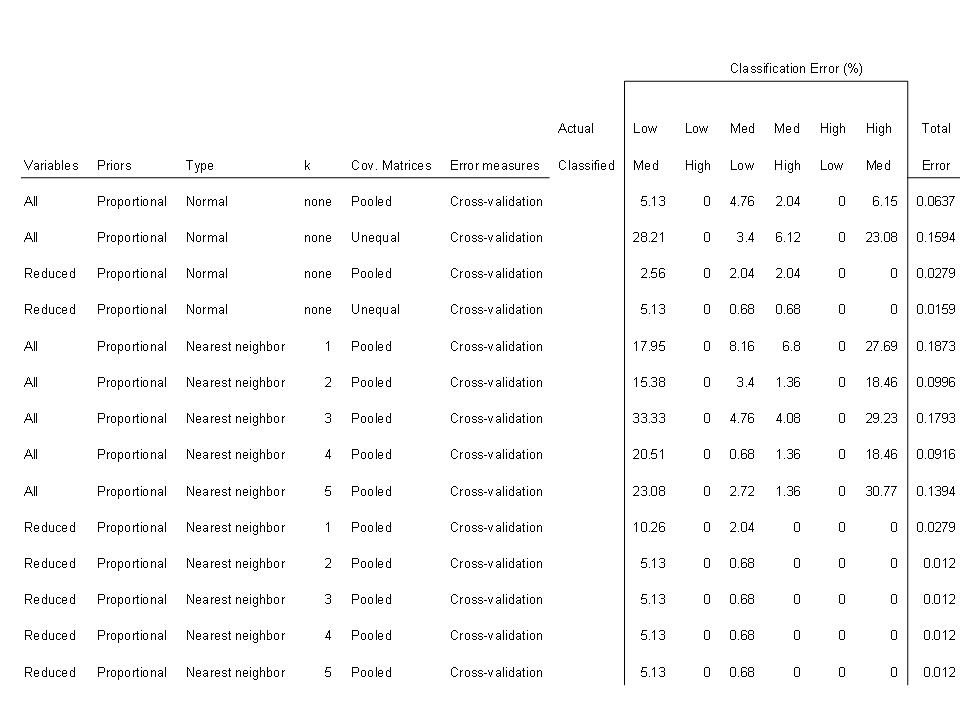
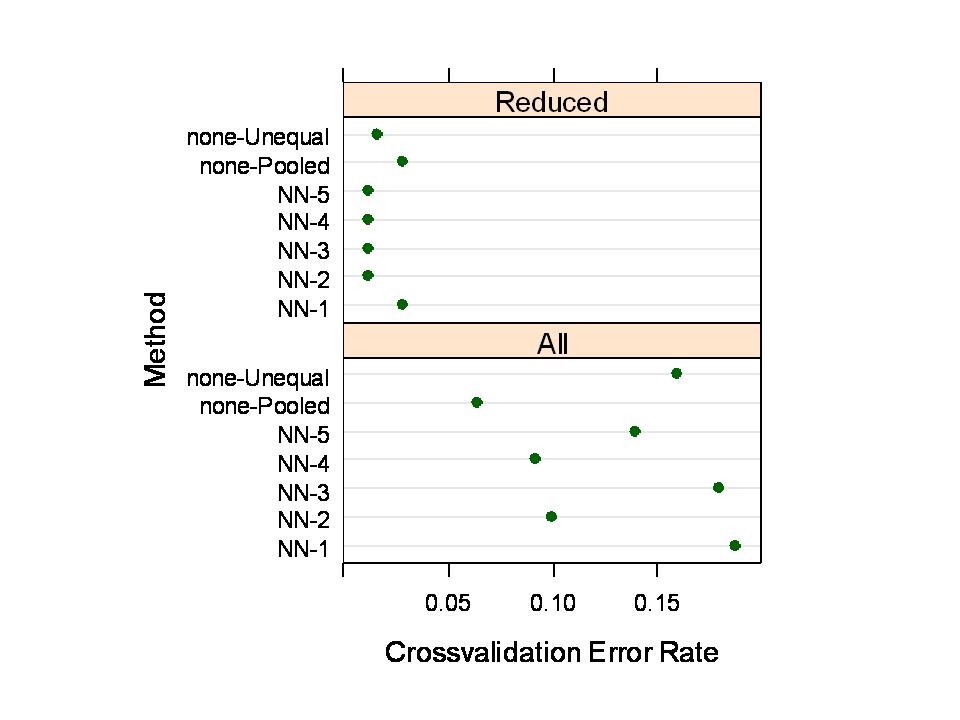
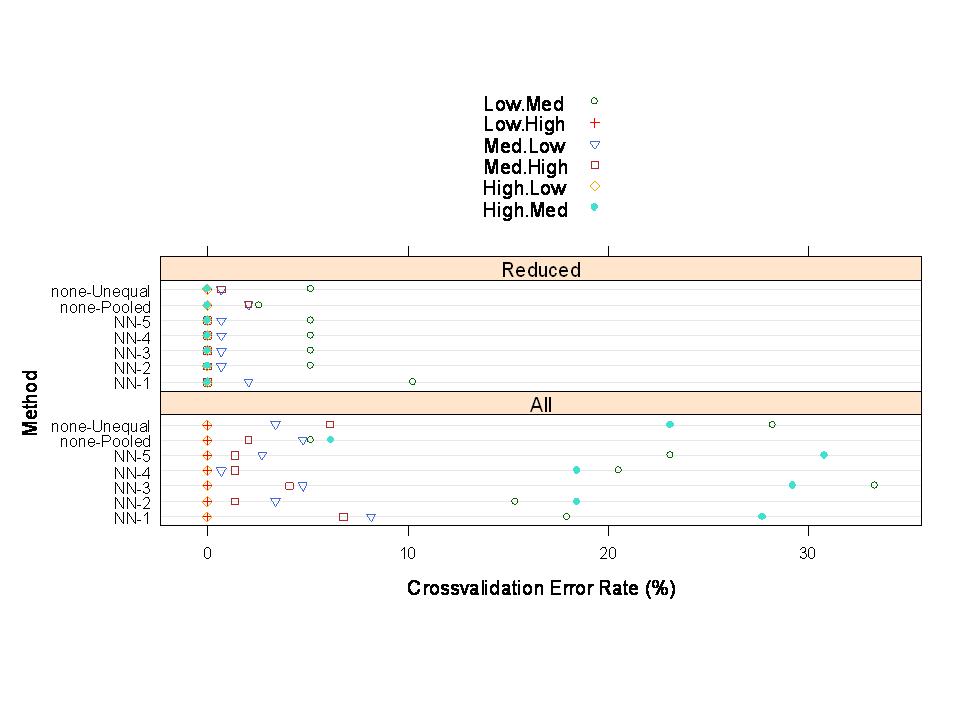
This project was designed to find a model that would best discriminate between low, medium, and high body fat bands. We defined low body fat as less than 10%, medium body fat as between 10% and 25%, and high body fat as above 25%. We are interested in finding a model that will give us low misclassification error rates as well as low overall error rates. We will test the normal method with both pooled and unpooled using priors proportional as well as the nearest neighbor method with k = 1 - 5. To conduct our analysis we will use the proc discrim function in SAS 9.1.

The data set can be found at percentbodyfat.html

**********************************************************************

Graphs

Methods and Errors

Crossvalidation Error Rate

Misclassification Error Rate
Summary of Discriminant Analysis Method
Conclusions

Back to Homepage homepage.html


Methods and Errors

Back to Top of Page


Crossvalidation Error Rate

Back to Top of Page


Misclassification Error Rate

Back to Top of Page


Summary of Discriminant Analysis Method

Back to Top of Page


Conclusions

After completing forward and backwards elimination in SAS we found a valid reduced model consisting of only the variable density. This reduced model had lower error rates than the full model.

Based on the "Methods and Errors" table, we chose to use the reduced model with the normal method and pooled variances. This method did not have the lowest error rates, however, the other methods did not seem to have error rates low enough to warrant the extra complexity.

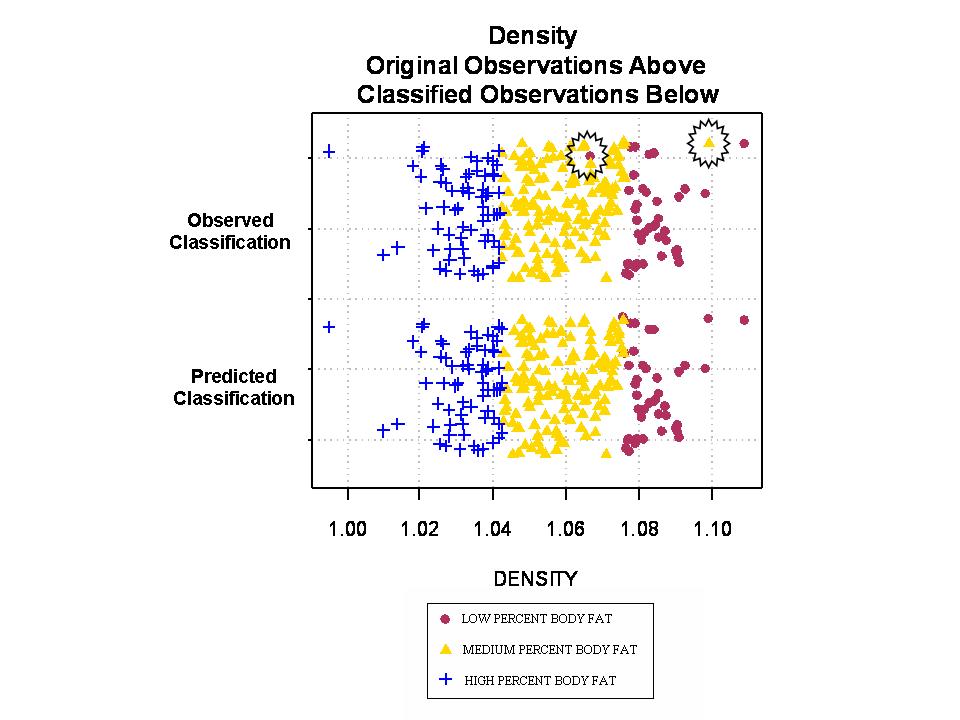
The "Summary of Discriminant Analysis Method" plot was created using the normal, pooled variances method. From this plot we can identify a couple of misclassified observations using our method. The boundaries between the percent body fat bands are where the majority of the misclassifications occur. For the most part this method does a good job in correctly classifying observations into the correct band.

Back to Top of Page

Back to Homepage homepage.html.
Hosted by www.Geocities.ws

1