Leaving Yangshuo on the morning of Oct. 16 was a piece of (chocolate!) cake: a short walk from our guesthouse on West Street to the bus terminal were we boarded a minibus to big-town Guilin, one hour over a nice asphalt road through the beautiful scenery so typical for the area. But since this bus wasn't a regular one, we were dropped off further away from where we wanted to be, so we had to take a taxi with our big bags and all to our next hotel. That one didn't take foreigners, but the one next-door had no problem.
Usually we negotiate the price of our rooms, especially in Chinese hotels (as opposed to guesthouses in villages), with good results. When you sign in you always have to show your passport and a lot of information is copied by the receptionist on a form that goes to the local police office (where sometimes this form is read, as the police may wake you up at night to double check!). You get a receipt that you show to the floor atten-dant who shows you to your room and gives you a thermos with hot water. There are always 2 beds in the room (sometimes clean sheets are needed) and the attached bathroom is usually OK (even when there's an Asian toilet, although I still prefer the sit-down
style...).
Our objective for that afternoon was to visit the famous Reed Flute Cave that Papa had really liked 15 years ago with Bertrand. It was easy to get there by local bus and after paying a relatively high entrance price of US$ 5, we were soon standing in line with many Chinese tourists to enter the cave. Then, like in a journey to the centre of the earth, I was amazed at the incredible underground scenery of all sorts of rock formations, mostly stalactites and stalagmites. There was a good pathway and coloured spotlights everywhere, giving it all a rather psychedelic atmosphere. Guides were telling small groups through megaphones what many of the formations looked like: centipede startled by a mirror, lion scaring off visitors, Christmas tree with snow, etc. And one "room" was so large that it could easily hold 1000 people! That evening we had a great buffet-style dinner in another hotel.
Since my tummy had been giving me some trouble the past couple of days (diarrhea), my folks decided to take me to the hospital affiliated with the Toronto-based AIMAT. A young doctor helped us getting through the system of registering and interpreting with the pediatrician. She prescribed a syrup and some powders for 3 days (US$ 2 for everything). Since I was feeling fine otherwise we decided to proceed with our travel plans and took an afternoon bus to Longsheng, 2 hours northwest of Guilin. From there another bus brought us to our destination for the next couple of days: Ping'an, in the middle of some very impressive rice terraces.
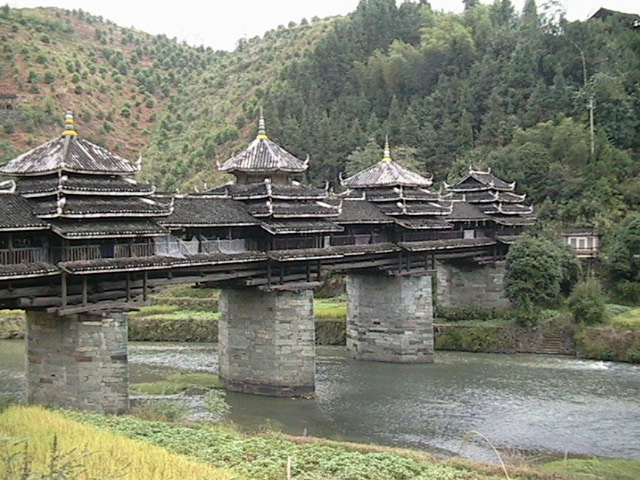
The arrival was quite special in itself: after going up the mountain via a steep zigzag road, the bus dropped us off at a gate, where quite a few porters wanted to carry our bags (and us on palanquins!) to the village. Passing a covered bridge we arrived to a place similar to Namche Bazaar in Nepal (or so I'm told): large dark wooden houses closely built together on the steep mountain, crossed by narrow, stone pathways. Soon
we were urged to come to several guesthouses where some other foreigners stayed as well. Mommy decided on the newest place in town, a clean room with bath and hot water. Thanks to the good road, Ping'an certainly has been discovered by some of the Yangshuo crowds, visible especially during the day when groups of mostly Chinese tourists come to see the rice terraces. By staying in the village a few days we got an opportunity to get a real good feel for the area and the people. They are of the Zhuang minority group and the women are dressed distinctly different from other Chinese farmers, mostly with coloured towels on their head. Some ladies there wore much more colourful ceremonial dresses, trying to sell embroidery or "silver" jewelry. And the scenery was of course stunning: rice terraces everywhere on the mountainsides around us, sometimes only a few feet wide (this place is often compared with Banaue in the Philippines). Unfortunately everything had recently been harvested otherwise they would have been golden yellow. Nevertheless it was nice to hike on very narrow paths right through the terraces, passing friendly farmers, who sometimes carried amazing loads of rice, wood or vegetables (always in two baskets balanced on a stick on the shoulder).