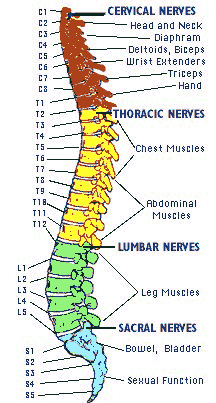
In order to understand what a spinal cord disability is, it is important to understand a few things about the nervous system. The nervous system is divided into two parts, the central nervous system and the peripheral nervous system. The central nervous system consists of the brain, the spinal cord, and the optic nerves. The spinal cord itself is a bundle of nerves and fibers, about the thickness of a little finger, that transmits messages to and from the brain. About 17 inches long, it extends from the brain to the lower back and is protected by the 33 vertebrae.
All other nerves in the body are part of the peripheral nervous system. These nerves can be either motor, sensory, or autonomic nerves. While motor nerves are involved in transmitting messages from the brain, sensory nerves are involved in transmitting messages to the brain. The autonomic nerves control the automatic functions of the body, such as breathing and digestion.
Both the central and peripheral systems work together to allow for the functions of life. While the peripheral nerves transmit messages in the form of electrical impulses between the body and the spinal cord, the spinal cord transmits messages between the peripheral nerves and the brain. For example if a person puts his hand near a flame, a sensory nerve, which is part of the peripheral system, transmits the "message" that the hand is very hot to the spinal cord. The spinal cord then transmits the message to the brain, where it is interpreted. The brain then sends a message down the spinal cord to the motor nerves at the place of the sensation so that the motor nerves can instruct the muscles to pull the hand away from the flame.
A spinal cord disability occurs when there is damage to the spinal cord, resulting in the loss of the ability to transmit messages to and from the brain. While some nerves and body parts have the ability to regenerate and repair themselves, the spinal cord can not. As a result, there can be a permanent loss of sensation and paralysis. All kinds of nerve impulses, autonomic, sensory, and motor, are affected by a spinal cord injury.
A spinal cord disability occurs when there is damage to the spinal cord, resulting in the loss of the ability to transmit messages to and from the brain. While some nerves and body parts have the ability to regenerate and repair themselves, the spinal cord can not. As a result, there can be a permanent loss of sensation and paralysis. All kinds of nerve impulses, autonomic, sensory, and motor, are affected by a spinal cord injury.
A wide variety of things may cause damage to the spinal cord. The three main causes of spinal cord damage are: traumatic injuries, birth abnormalities and disease processes.
When a person sustains a spinal cord disability, many functions can be affected. While bladder, bowel and sexual functions are affected in almost all spinal cord disabilities, the other effects depend on both the extent of the injury and the level of injury. Spinal cord disabilities can be either complete or incomplete. In a complete disability, the spinal cord loses all of its ability to transmit messages from below the place of injury. In an incomplete disability, at least one message can be transmitted from below the point of the injury, resulting in the retention of some sensation or movement, which may or may not be useful or functional. By level of injury, we mean the vertabra level of the spinal cord where the injury occurred. If an injury affected the cervical areas, say C5, then the person probably has quadriplegia and has lost sensation and experienced paralysis in both his arms and legs at the C5 level and below. If the injury affected the thoracic, sacral or lumbar region, the person probably has paraplegia and has lost sensation and experienced paralysis in his legs and lower body. Thus, an injury at the T8 vertebra level will result in loss of sensation and paralysis at the at level and below.
Since 1990, motor vehicle crashes were the leading cause of SCI injuries reported. The next largest
contributor were acts of violence (primarily gunshot wounds), followed by falls and recreational
sporting activities. The proportion of injuries due to motor vehicle crashes and sporting activities have
declined while the proportion of injuries from acts of violence has increased steadily since 1973.