U.S. House of Representatives
Washington, DC 20515
First I would like to congratulate you as our new Congresswoman. It has been a long time, in my opinion, since we have had a decent representative in the 8th district.
By way of introduction, I am currently living overseas but still vote using my old address in Tucson with zip code 85747 which is part of your congressional district. I lived in your district for almost 30 years, first in Sierra Vista and then later in Tucson. I arrived in Sierra Vista in 1972 when I was first stationed at Ft Huachuca. I retired from the Army with 20 years of honorable service in 1983 as a First Sergeant. I then worked for more than 21 years in civil service ending my career as a Health Systems Analyst at the VA Medical Center in Tucson.
I took an early retirement from civil service in order to join my wife and daughter in the Philippines. My hopes of bringing them to Arizona were dashed when, at her interview, the vice consul at the American embassy in Manila threw me out of the room before she screamed at my wife that they were denying her visa. When she asked if she could speak she was rudely told to shut up and leave. We were also denied our legal right to request a waiver and when I asked to speak to the vice consul about the denial she sent a local national out to tell me what she did was none of my business and to leave the embassy now. My attempts through Senator McCain to obtain another interview were rejected and his staff didn�t seem too interested in helping anyway. My letter to the ambassador, requesting the same consideration was ignored and I was later told by a vice consul at the embassy, when I was finally able to reach him on the phone, that I shouldn�t have sent the ambassador a letter as he was too stupid to know what to do with it and would just throw it away. They also explained to me that the American government recognizes no rights for non-citizens so there was no need to allow my wife to speak at her interview. In addition they told me that Filipinos were all liars anyway and could not be trusted so if she had said anything it would not have been believed. I was also told that all Filipinos are born with full knowledge of American visa law. They told me involving members of congress was a mistake because it would change nothing and only serve to piss them off. In addition I was informed by them that they considered themselves the silent army defending the U.S. against a massive invasion of Filipinos. I learned from an attorney that vice consuls are not required to follow the law and more often than not make decisions based on what they think the law should be, as was done in our case. I learned from him that since not even their own agency can require them to change a decision and their decisions cannot be challenged in court they routinely make decisions based on personal opinion and whim. So it became apparent to me that nobody could intervene with an embassy like that so about a year later, when I was able to retire, I sold, gave or threw away everything I owned and moved to the Philippines to join my wife and daughter. Leaving my country and my way of life was traumatic to say the least but the only other option was to abandon my wife and daughter. We have since built a house and I am learning to live in a new culture. It has been made easier by thousands of other military retirees that also live here with their wives and kids. I am now an active part of the local military retirement community and belong to Rotary where I can assist with local issues and disasters. I was appointed as the Army�s Retirement Services Officer Point of Contact for the Philippines and try to assist with issues involving all military retirees. I have seldom asked for assistance from my elected representatives and try to work things out myself so I hope you understand that I consider this to be a critical issue that needs your attention and is not something I or others like me can resolve ourselves.
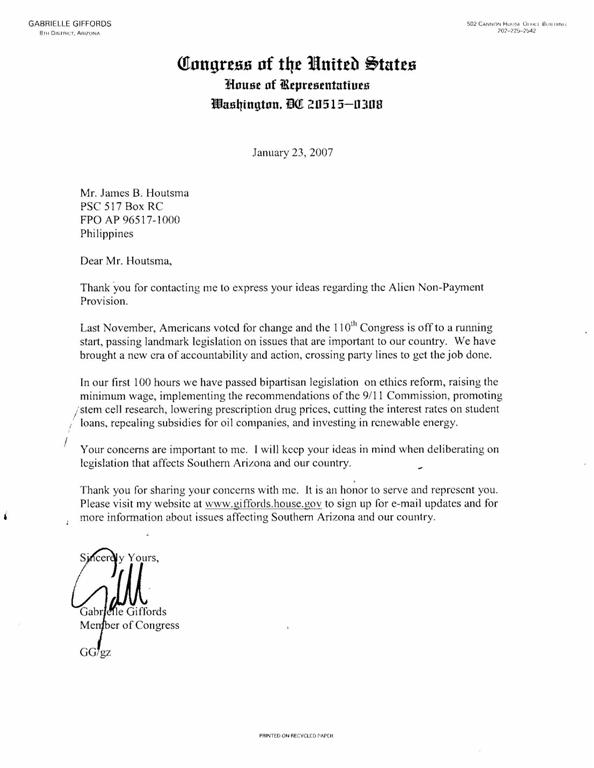
The issue, which affects many of us, is a Social Security Administration policy known as the Alien Non-Payment Provision (ANPP, SSR 83-8, Section 202.) This provision affects many foreign national widows and spouses living overseas who, though �eligible� for Social Security benefits, are not �entitled� to be paid those benefits because of this provision. For foreign national widows and spouses living in countries that the United States has an International Social Security ("Totalization") Agreement an exception is granted. However these agreements are limited to European countries, Japan, South Korea and Chile or essentially First World Countries. All countries in Africa, most of South America and Asia were never offered these agreements. A large percentage of military retires living overseas live in countries without �Totalization� agreements and are affected by the non-payment provision. When a foreign national spouse or widow of a retired military member reaches age 65 they must obtain Medicare Part B, if they are �eligible� for social security, in order to continue receiving medical care under TRICARE for Life (TFL). A benefit we spent the better part of our lives earning while in the Military. The foreign national spouses and widows who are �eligible� for Social Security benefits but not �entitled� to payment of those benefits cannot have their premiums deducted from their Social Security benefits to pay for the required Medicare Part B. So the sole option given to them by the Social Security Administration is to purchase Medicare Part B on their own if they desire to retain TRICARE benefits. Therefore the premiums must come from their already reduced Survivor Benefit Plan (SBP) benefits paid to widows or the husband�s retirement income for spouses. The effected spouses and widows in third world countries can only overcome these obstacles if they migrate to the United States. There are provisions that allow a foreign national widow to apply for a special widow�s visa, within two years of the death of the spouse, if they were married to their spouse for more than two years. However the widows may not want to apply or already have been, or may be, denied a visa. (The approval of visas has gotten extremely difficult since 9/11 and my case is only one of many examples of this.) Even if they could get a visa, in many cases these widows would have to leave their families to move to the United States where they have no family so they don�t apply. For many military retirees bringing their foreign national wives home to the states to overcome this issue is not an option either. Some, like me, have already had their wives denied a visa. Others find they are not able to demonstrate that they meet the minimum income requirements of immigration to support a wife in the states based on their military retirement pension so their applications would be denied. To deny these spouses and widows social security payments and to require them to purchase Medicare Part B from their meager funds to obtain TFL is inequitable and exclusionary when all other spouses and widows of military retirees are �entitled� to receive social security payments and have Medicare Part B premiums deducted from their payments. These are benefits that we earned by working and paying into the system for many years, in my case more than 40 years; even Social Security acknowledges we are �eligible� for these benefits. To have them arbitrarily denied simply because my wife is a citizen of a third world country by accident of birth when a wife in the same circumstances who is a citizen of a first world country is afforded these earned benefits is discriminatory. Currently there are a number of exceptions to the non-payment provision as outlined in SSA Publication No. 05-10137. These exceptions include widows of soldiers who died while in the U.S. military service or widows of veterans who died as a result of a service-connected disability. So the precedent of granting exceptions for the spouses of military and veterans has already been set. By simply amending the law to grant an exception to non-payment for spouses and widows of retired military members the inequity would be resolved. This would allow these spouses and widows to receive their Social Security payments which were earned and paid for by their spouses and have the cost of Medicare Part B deducted, as is the case with all other over 65 spouses and widows including foreign national spouses from first world countries.
I was successful in having this issue brought before the Army Retiree Council but it was not considered for two reasons. The first reason was that the Social Security Administration told them that the United States could not make monetary payments to citizens of other countries without the permission of the foreign government, which would require them to negotiate agreements with hundreds of countries if the exception was added. Of course this is hogwash as Social Security already pays some widows based on the above mentioned exceptions if they live in these same countries. In addition these same widows are entitled and paid military SBP in virtually every country in the world without any such agreements in place. The only issue is that unless there is a tax agreement with the country involved the United States will tax the SBP, which is the same that would happen with social security I presume. The second reason is that this issue only affects a few thousand spouses and widows of military retirees. But in my opinion, even if it only affects one hundred spouses and widows, we should do something about it. When I was in the Army we were taught that we never abandoned our comrades in combat and always took whatever measures necessary to insure they were not left behind. To me this is the same principle. We should not abandon these spouses and widows of military retirees just because there are only a few thousand of them.
This finally brings me to specifically why I am writing you. There are thousands of retirees living in the Philippines and more living in Thailand just to mention two counties where this can affect their wives as well as many widows currently facing this issue today. We would like to see an exception to the Alien Non-Payment Provision added to cover the spouses and widows of military retirees. As your constituent I am respectfully asking you to do this. In my opinion one of the reasons given for not considering it by the Army Retiree Council will work in our favor. That is that it only affects a few thousand spouses and widows. Because of this the cost, on a national level, would be minimal and have no noticeable effect on the Social Security budget, which should make it easier to add this provision to a bill going through Congress. But it would have a dramatic positive effect on the retired soldiers and sailors and their families that find themselves discriminated against. Anything you can do to effect this change will be greatly appreciated by the thousands of us living with the knowledge that benefits we were required to pay for will be denied our families even though they are �eligible� for them. If you have any questions please feel free to contact me by email or ordinary mail.
Sincerely Yours,