
Most people think they are too unrefined to appreciate jazz. That isn't true. Once you understand a few components of jazz tunes, you'll understand jazz as well as anybody. You will also find that what started in jazz applies to modern music, including the music of drop-dead gorgeous teenage phenomenons. So, for your listening pleasure, I'm using MP3 files of "Baby One More Time" and two select jazz songs to illustrate my points. (Author's Note: Click here to link to a page where you can listen to "Baby One More Time". Simply click on the B to the right of the window and find it.) Once you are done with this site, browse through your own CD collection and prepare to be amazed by how much influence jazz actually has on your favorite musicians.
INTRODUCTION
The introduction, as you might have guessed, is the introduction to the main piece of music. The jazz piece I'll be using to illustrate this is called "The Fox Hunt", a Maynard Furgeson piece. "The Fox Hunt" Has an introduction of 8 measures, or, for you people who aren't music buffs, eight groups of four counts. The intro ends after 8 seconds on the recording. "Baby One More Time" has a 4 measure intro. Of course, not all songs have an introduction.
THE FORM OF A PIECE
In jazz, as in pop, tunes almost always have a number of measures divisible by 4. Common measure counts for a jazz song include 12, 16, 32, or 64 bars measures. Usually, jazz groups will play the tune once, do their soloing, then play the tune again with a little ending. This is the case in Gerry Mulligan's version of "Yardbird Suite" and in most classic jazz you listen to. However, this rule isn't set in stone. Many big bands will break this form, and you may hear soloing instead of the tune to close the piece, as is what happens in "Yardbird Suite". A pop tune is like playing a jazz tune many times, to fill the void of soloing. "Baby One More Time" is made up of 3 sets of a 4-measure chord sequence for the verses (where the lyrics change). For the chorus (where the lyrics are always the same), the same chord progression in the verse is used once, followed by a different 4 measure set of chords. This is done twice, and is followed by a bridge and two more playings of the chorus. A bridge will be explained later. The form in "Baby One More Time" is similar to that of "The Fox Hunt". It has a 24 measure verse and an 8 measure chorus. The first verse is the tune itself, and the second and third verses are solos. After the last solo, the piece moves to a coda, or closing section.
And now, for those of you losing interest, here's another Britney pic!

Feeling better? Good! Let us continue:
SOLOING
Of course, Spears is a pop singer, and can't really improvise. I guess she could try to sing scat, but it wouldn't quite fit. However, the jazz players can improvise. The rhythm section of the group plays the backgrounds and lets the soloists run amok. You may have noticed some soloing without a rhythm section in "The Fox Hunt". This is called a break. When soloing rules are that you have to stay in key and to stay within the time allotted for your solo, and the first rule isn't even followed all the time either. Soloists use notes outside of the key they are in to create new feelings within the music.
You may be wondering at this point if soloing is even a challenge. The guy plays a bunch of notes. So what, you ask? I can play a bunch of notes just as well as anyone can. Hell, you may be saying, soloing is so easy, why doesn't the fabulous Britney add improvisation to her songs? And how can you tell a great solo from one that stinks?
My answer to the first question is that it's one of those things that looks easy but isn't. I know this because I'm a jazz musician myself (specifically, a bari player, like Gerry Mulligan). Soloing is, in fact, harder than something written out for you. The answer to the second question is that jazz is a matter of taste. Some people will think one solo is great, while others may say the same solo stinks. Why? Who knows? It's the same as some people liking Limp Bizkit and having others hate Limp Bizkit. It's merely a matter of taste.
TURNAROUND
An excellent example of how pop borrows from jazz. Listen to the end of the bridge on "Yardbird Suite". Hear how nicely it brings the ear to the third verse? That's because of the turnaround, or the transition chord. Now listen to the "hit me baby one more time" part of Baby One More Time. Very similar, isn't it? If this doesn't convince you of jazz's importance to pop, there ain't nothing that will.
MORE ON BRIDGES
The bridge in jazz is critical to the song's character. The bridge is usually in the middle of a jazz tune, and sounds noticeably different. It creates tension in the tune that is pleasing to the ears, and when it resolves itself, the musical effect is extremely pleasing to the ears. It's also a ramp for soloist, allowing them to catapult to great sounding musical phrases. Some songs, like "The Fox Hunt", have no bridge. "Yardbird Suite" has an excellent bridge. You can hear it for the first time at .17 seconds in the piece. After that, it should be easy to recognize where it is. A bridge in pop, like the one in "Baby One More Time" which takes place after the second playing of the chorus and ends when they start playing the chorus again, accomplishes the same task. It builds the listener up for a big finish and, to Miss Spears' credit, she gives a big finish.
How about another couple Britney photos before I finish up? OK, you say? Then let's go!
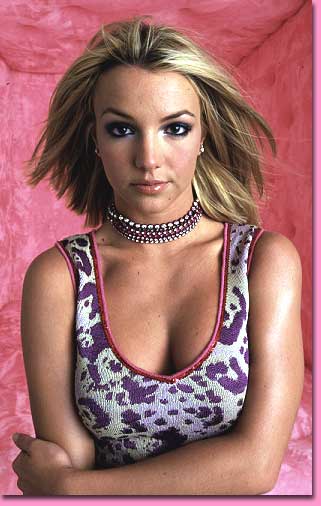

WOOOOOOHOOOOOOO!! All right you guys, you've had your fun, now let me finish.
While this overview covers a lot, there is still much for you to learn. And the only way to learn it is to listen to jazz. The "CD's for the Unhip" page will tell you what to buy to get started, and how to buy CD's later on.
However, don't feel pressured, like most beginners do, to attain a CD of everything when you are first starting out. Find artists and genres you like and buy them. Find a genre or an artist you are even vaguely interested in and just buy a random CD of whatever that thing is in the store. There doesn't have to be a rhyme or reason behind why you buy stuff, either. Just so long as YOU like it. Some people who like one artist will read about an artist they should like, and they end up hating it! Why? Who knows? It's why some people love *NSYNC and hate the Backstreet Boys, why they love Christina Aguilera and hate... Hey, wait a minute, EVERYONE loves Britney Spears for one reason or another! Right? So, to summerize, buy what you like, experiment with new stuff, and most of all HAVE FUN BECAUSE JAZZ IS COOL!!
Congratulations! You've completed the course!