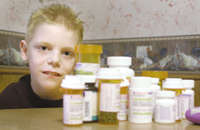
| St. Cloud resident Alex
Turnquist is much different from other 10-year-old boys. He never
has an appetite, is prone to suddenly falling ill for months at a
time and has to take 12 medicines each day.
One other thing: Alex doesn't know how long he will live.
Alex has Shwachman-Diamond Syndrome. It is a genetic disorder
that can be fatal and is characterized by a low blood count and
abnormal bone marrow. The syndrome is extremely rare, but medical
researchers have not found a way to establish a diagnosis of the
disorder. Therefore they can only estimate that it affects one in
every 50,000 births.
"It bothers me a lot that I have it," said Alex, who stands only
4-foot-1 and weighs 51 pounds. "It's hard to go through each day."
His mother, Laura, sees all this and is trying to do something
about it.
Support group
She has organized a national support group for the disease. She
and families from Ohio, Michigan and Virginia are raising money to
study Shwachman-Diamond Syndrome.
"We want people to know what it is," said Laura Turnquist. "A few
doctors have tried to do in-depth studies on it, but they ran out of
funding."
Laura, 31, and her husband Jay, 36, have two children together.
Drew is a stocky 6-year-old boy and Carlee is an active 4-year-old
girl. Alex is from Laura's previous marriage and he has no contact
with his biological father.
Learning that Alex had the syndrome didn't come through a
doctor's diagnosis. It happened when his parents noticed he wasn't
gaining weight as rapidly as a typical infant.
He weighed 11 pounds when he was 9 months and only 15 pounds when
he was 1.
"We thought he was healthy right away," said Laura. "But we kept
changing formulas and he wouldn't gain weight."
A bone marrow biopsy at the University of Minnesota revealed that
he had the disorder. It came after conflicting reports from doctors.
"Fifty percent of physicians don't even know what it is," said
Laura. "Some who do know about it have a hard time explaining it."
Frustration
When parents initially learn about a syndrome in their child, it
is common for them to find out everything they can about the
disorder.
"It's a very strong urge that parents get," said Dr. Fred
Goldman, who works at the University of Iowa Children's Hospital in
Iowa City, Iowa.
"The problem with Shwachman-Diamond Syndrome is that there is not
a test that is 100 percent definitive to tell if a person has it."
Goldman researches and cares for patients with Shwachman-Diamond
Syndrome. He developed a test that helps with the diagnosis of the
disorder. But there has never been an ample amount of information on
the disorder, which is hard for Alex's parents.
"It's frustrating and confusing," said Jay. "His life expectancy
is unknown. Doctors tell us they don't know a whole lot about it."
Laura and Jay's knowledge of the disorder comes from living with
Alex. His gaunt stature comes from never wanting to eat. He tires
easily, dehydrates regularly and is hospitalized often.
He was sick on and off for about 100 days this year. In February
he had an ear infection, followed by strep throat, followed by
bronchitis, followed by a stomach infection and then strep throat
again. It lasted until May.
Seven capped teeth line his gums because his body does not
produce a significant amount of neutrophils, the primary cellular
defense system against bacteria.
What does Alex think of all this? He doesn't say much. Most of
his answers are "I don't know."
Once in a while, though, he will offer a subtle perspective of
what it feels like to walk in his shoes.
"Every day feels like a cycle," says Alex, who is a fourth-grader
at Roosevelt Elementary School in St. Cloud. "I hate taking those
pills but I have to because I worry about dying."
Those fears fueled Laura's desire to start the national support
group named Shwachman-Diamond America. The oldest living person with
Shwachman-Diamond Syndrome is 40, said Laura.
"Our ultimate goal is to have a bone marrow failure institute set
up in 15 years," Laura said. "I realize we have a very long way to
go but I want Alex to live a full life."
Information about Shwachman-Diamond Syndrome
For more information on Shwachman-Diamond Syndrome, call Fred
Goldman at (319) 356-7360. If anyone would like to help with the
national support group, contact Laura Turnquist at 230-3383 or visit
www.shwachmandiamondamerica.org.

| 


 Local Menu
  Business