 |
|
|
|
|
|
|
|
|
|
|
|
|
|
|
|
|
|
|
|
|
|
|
|
|
|
|
|
|
|
|
|
|
|
|
|
|
|
Jay's Woo Woo Page: |
|
Attractions & Events: |
|
Home Page
|
|
|
|
|
|
|
|
|
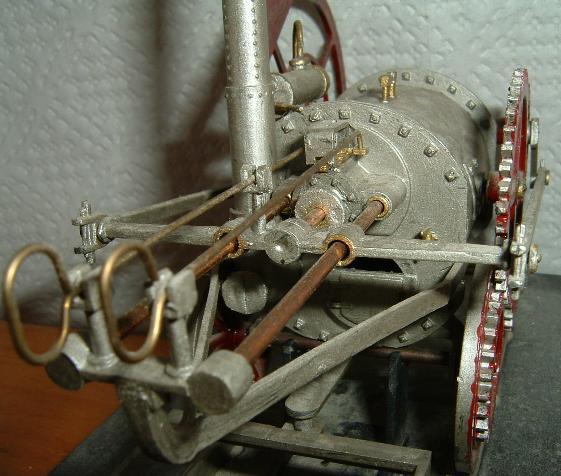
Earth's 200th Birthday for Railway Locomotives (February 21, 2004) |
|
|
|
 |
|
|
|
1/38th scale model of Richard Trevithick's Pen-y-darran locomotive (driver's view) |
|
|
|
Try these websites: |
|
|
|
www.trevithick2004.co.uk/ |
|
www.zawn.freeserve.co.uk/ |
|
|
|
|
|
 |
|
|
|
My Projects: |
|
|
|
Track Powered Toy Train Power Supply reaches for maximum realism: |
|
|
|
With modern digital command control and battery powered radio control, we can have very pleasing control of our toy trains. But what about all of our old classic toy trains, or inexpensive ones? They too can behave like the real ones! I have devised plans for more realistic operation of the Direct-Current type of electric toy train. Without modifying the trains, however, independent control of multiple engines on a single track would still not be possible. |
|
|
|
Operation: |
|
All conventional simple direct-current motors have a fixed number of �poles� or electro-magnets situated around the rotor shaft. There is a certain amount of energy required to move this rotor one step (from one magnetic alignment position to the next) which is directly related to the load imposed on the motor. With a voltage supply level set at a level for maximum practical efficiency, the amount of energy delivered would depend primarily upon the amount of time that the voltage was delivered to the motor (a small fraction of a second for one step). Voltage pulses too short to move or appreciably heat the motor could be used to sustain auxiliary train power, such as lighting, smoke and sound. |
|
|
|
|
|
Control: |
|
Using control variables based on the prototype (throttle, brake, etc.) an appropriate signal would be generated for more realistic locomotive operation. The user would be able to optimize the controller for operation of specific locomotives as well as easily recall this and other saved locomotive control profiles. A display screen would show control variables, monitor track power, show program variables and indicate modes, functions and alarms. |
|
|
|
|
|
Chugga chugga toy technology: |
|
|
|
�Chugga chugga� represents the characteristic steam locomotive sound while being true to the number of steam discharges per drive-wheel revolution, where �chug� is the noise from one of the cylinders and �ga� the noise from the other. �Choo choo� is an even more popular onomatopoeia, however only a few very early locomotives gave only two discharges per driver revolution. If we consider that each cylinder is imbalanced as one side of the piston must sacrifice surface area to the piston rod, then I might suggest �Chuchi guggi.� |
|
|
|
Growing up with many various toy trains, I was quite pleased with any that had smoke or sound, especially if it was in any way synchronized with the drive wheels. The best that ever came to me gave one chuff of smoke and sound per wheel revolution. Now that I�m no longer a child, this just won�t do! |
|
|
|
Often a locomotive can be modified to trigger a small switch the proper four times per revolution. This is usually all that is needed for correcting the sound. The mechanical smoke-pumps would require more substantial modifications if not a complete replacement with an appropriately cammed or geared pump unit. Still, the steady piston would result in a smooth and steady discharge. A real steam discharge is quite percussive. High pressure stored in a toy would not be welcome in all households nor be entrusted to all engineers. I have designed an electric pulse pump to answer these needs. Since it is electric, the same simple fix for synchronizing the sound also works for the smoke. |
|
|
|
More details to come. |
|