 |
|
|
|
|
|
|
|
|
|
|
|
|
|
|
|
|
|
|
|
|
|
|
|
|
|
|
|
|
|
|
|
|
|
|
|
|
|
|
|
200 YEARS AGO : |
|
|
|
(what they knew back then, in 1804) |
|
|
|
|
|
RAILWAY TECHNOLOGY: |
|
|
Roman rutways created before Christ can still be seen. German minors used wooden rails (troams) for transportation guidance over three hundred years ago. It's been almost two hundred years since Sir Francis Willoughby's railway connected the Wollaton coal mine to the River Trent. Fifteen years ago an Englishman, William Jessup, used wagons with flanged wheels for railway steering. Just four years ago, Benjamine Outram used stone props instead of timber to support his rails in Derbyshire and in America, an inclined railway was built in Massachusetts. |
|
|
|
LOCOMOTIVE TECHNOLOGY: |
|
|
Hero of Alexandria operated a rotating steam motor more than a century before Christ was born. Over a century ago, Sir Isaac Newton envisioned a steam locomotive and Denys Papin developed a boiler safety valve and a piston engine. It's been almost fifty years since America used a steam engine to pump water from a mine. Just four years ago, the American Oliver Evans was heralded 'the Father of High-Pressure Steam' with his non-condensing engines.
_______________________________________________________________________________________
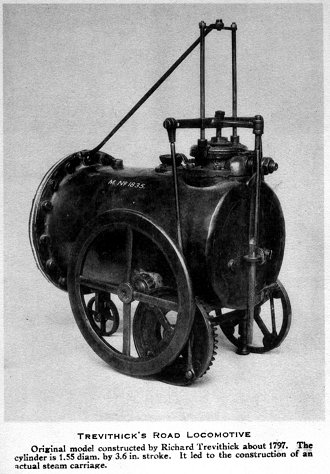
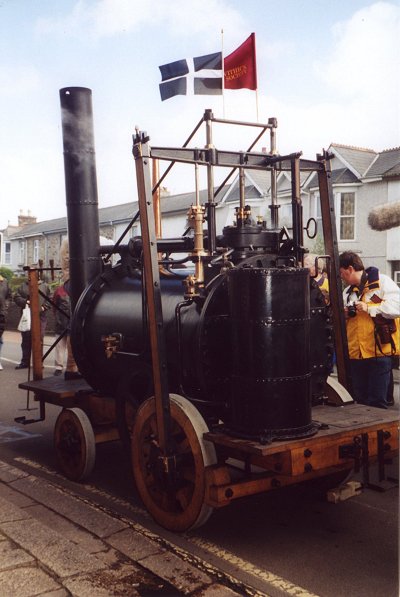
Even though engine powered transportation is a relatively recent event in human history, it relied on eyewitness records of its birth since photography wasn't even realized until 1825. It is well recorded that in 1769 at the Paris arsenal, Captain Nicholas Cugnot was able to move his three-wheeled cannon tractor under its own steam power. By 1797, Cornish engineer and inventor Richard Trevithick began public demonstrations of his street locomotive experiments using steam under pressure. After success with this miniature model, Trevithick built a full sized street locomotive that he ran up Camborne Hill on Christmas Eve of 1801. He found his "Puffing Devil," as the public called it, burned with the shed he parked it in after celebrating its success on another run with his friends. Later he built a handsome passenger steam carriage with steering, called the "Vivian," which ran 8 mph in London. The rough streets of the time severely limited the life of these fledgling machines. A few accounts tell of an attempt at a railway locomotive at England's Coalbrookdale iron works iron railway. However, there was a keen public interest when two businessmen of the Merthyr Tramroad cooperative wagered 500 guineas (over $350,000 in today's US currency) on the success of a locomotive in working their tracks. |
|
|
 |
|
 |
|
|
Left:
Replica of Trevithick's 1797
miniature street locomotive experiment |
|
|
|
Right:
Replica of
"Captain Dick's Puffer"
("the Puffing Devil") of 1801 |
|
|
|
|
|
|
|
courtesy of the "Trevithick Society" |
|
|
|
|
|
|
|
 |
|
|
|
|
|
 |
|
|
|
|
|
 |
|
|
|
|
|
courtesy of "Trevithick 2004" |
|
|
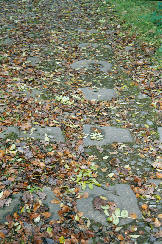
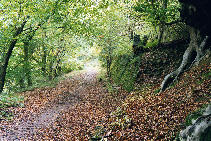
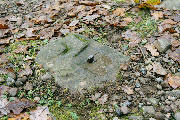
Tramroad right-of-way south of Pontygwaith (left) and original stone sleepers |
|
|
|
|
|
|
On February 13, 1804 Richard Trevithick tested his locomotive on the Merthyr Tramroad at Pen-y-darren. 'Its performance was without fault but the bet will have to wait until next week to be settled.' |
|
|
|
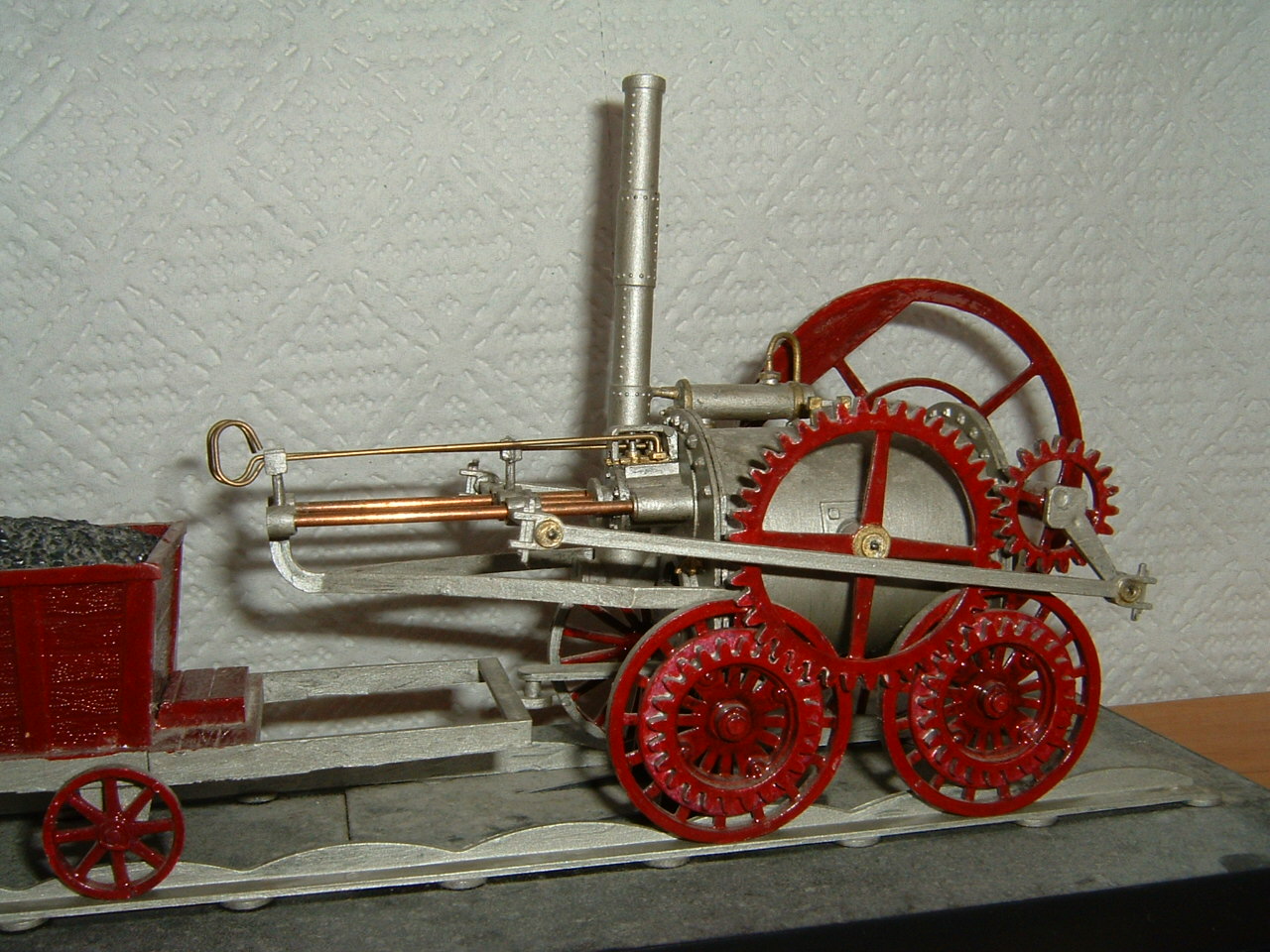
On February 21, 1804 'Caprain Dick' Trevithick prepared his improved locomotive with smooth wheels at the start of the Merthyr Tramroad. The tracks ran from Samuel Homfray's Pen-y-darren iron foundry to the Glamorganshire Canal at Navigation House, Abercynon. The train included the locomotive and five trans (4 wheeled rail wagons) carrying at least 10 tons of pig iron and around 70 men, including the owner of the Cyfarthfa Iron Works who bet against Mr. Homfray's success with Mr. Trevithick's locomotive. The apprehensive crowd was able to cheer as the train pulled out of sight . Stops were made to clear debris from the track and perhaps tend the fire. It was able to approach a speed of five miles per hour and completed the trip under its own power in little over four hours.
"Yesterday we proceeded on our journey with the engine; we carried 10 tons of iron, five wagons, and seventy men riding on them the whole journey . . . . The gentleman that bet 500 guineas against it rode the whole journey with us, and is satisfied that he has lost the bet." Richard Trevithick Feb. 22, 1804 |
|
|
|
 |
|
|
 |
|
|
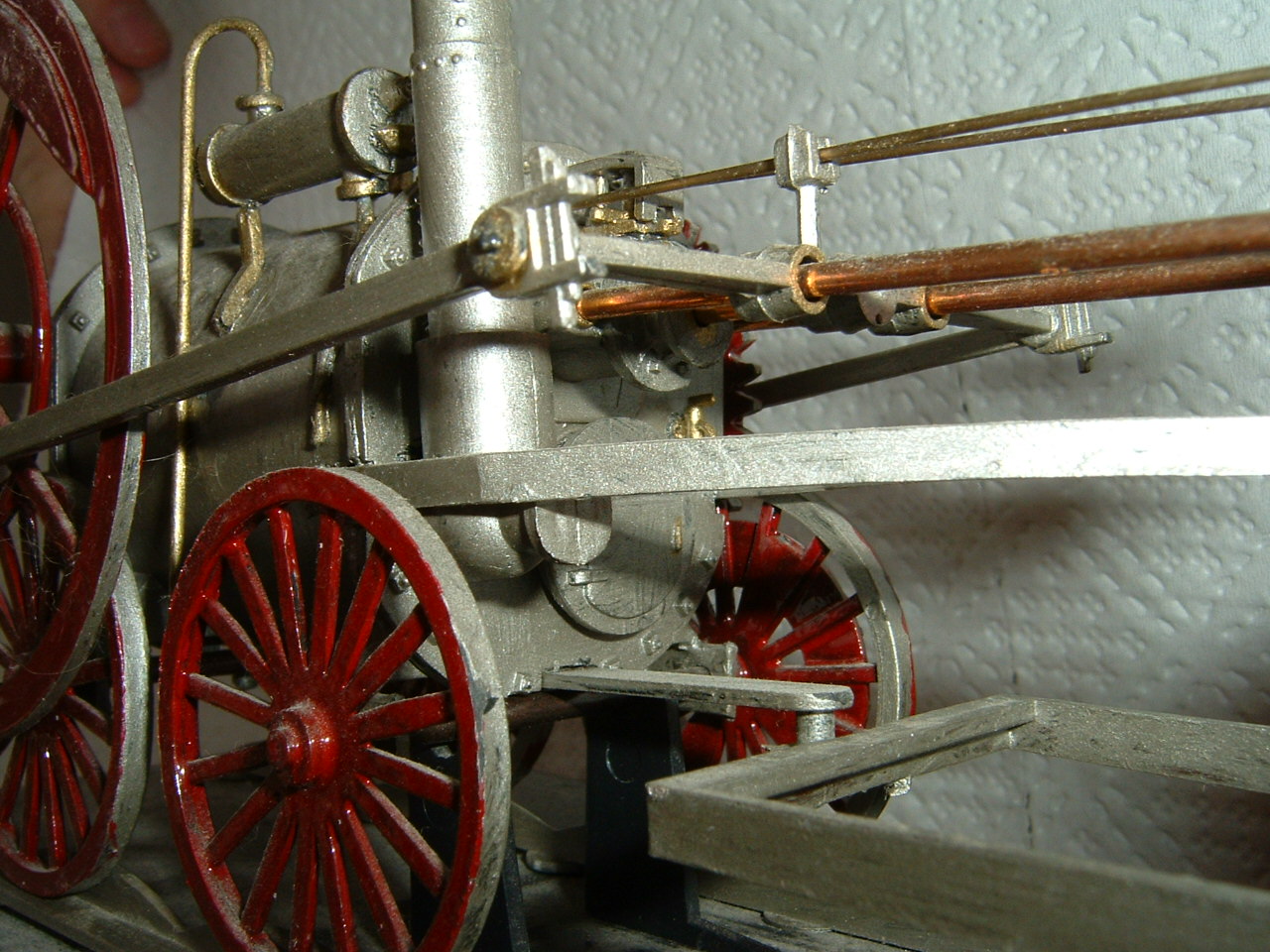
1/38th scale model of the Pen-y-darren locomotive on Merthyr Tramroad cast iron plate-way |
|
|
|
|
|
MORE |
|
|
|
click here to continue... |
|
|
|
|
RETURN |
|
|
|
|
|
|