| History of Blenheim |
 |
| By 1783, there were French settlers in Detroit and Windsor. There were also settlers in the Niagara and Kingston region, but no real settlers to speak of in the Kent County region. In 1790, Alexander McKee negotiated a treaty with Native Indians to acquire what is now Southwestern Ontario. With this area now being British owned, settlers began moving rapidly into this new land area, and eventually, the County of Kent, and Blenheim. Land began being surveyed in 1791 in Harwich township under the order of Lt.-Col. John Graves-Simcoe. Joining his crew was a man named Thomas Talbot who expressed great interest in this land, and Simcoe granted him any plot of land he so desired. He decided on a plot where present day Fingal resides. Being a man with great finances, he set out to begin road building in Southwestern Ontario in 1800. His main road was designed to go all the way to Detroit. It consequently ran directly along a ridge of high land, and on that ridge is where present day Blenheim stands. The great Talbot Project was put on-hold until the completion of the War of 1812-14. After the war, great settlers began arriving to this area to live peaceful lives after a violent war. Settlers also came via boats from England after a violent war there with France. After timber clearing, this land was ready for growth. Blenheim, itself was established in 1825-1850. It was amidst of 10 miles of dense forest, and its development lagged behind other close-by settlements. Albert Robertson purchased this land, and after trading hands over a few years, Harvey Halstead, Thomas Lynch, and George Hughson were the first three lot tenants who built homes. Blenheim's primary resource was of course, timber. Once the bush was cleared adequately in about 1900, farming took over as the key resource of Blenheim with its rich soil, and ideal climate. |
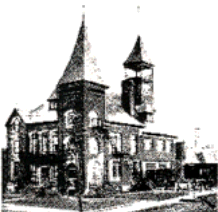
| By 1874, Blenheim had a full list of occupants varying in professions from dentistry to carpentry. In 1866, a town hall was built, fit for a village, ready to emerge as an important voice in Kent County. Blenheim became an official town in 1885. Pictured to the right is a picture of the town hall in 1896. |
 |
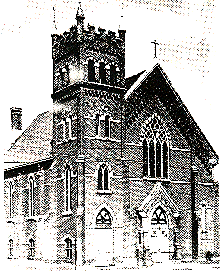
| In 1888, a magnificent church for the large Methodist population was built. It was the finest that could be found in the area. Pictured to the left is a 1907 picture of the church. The telephone was introduced to Blenheim in 1885 by Bell. Electricity came in 1888. A full-fledged fire department arrived in 1891. A railway arrived in 1894 and travelled through Blenheim to Windsor. The first high school was built in 1900. |
 |
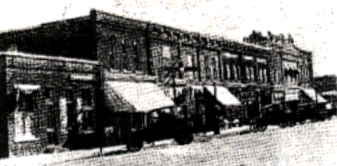
| As cars became more and more popular, Blenheim paved its first street in 1920, opening a period of enormous growth. Prohibition gave Blenheim a chance to grow as many men were involved in illegal rum running operation for larger centres. |
 |
| In 1924, W.G. Thompson opened a grain mill for local farmers and is still present today. |
| Blenheim proceeded to grow through the "Starving 30s", and the "War-Torn 40s". The period of 1950 to the present time has seen Blenheim mature into a town of 4 800, but no real evolution has taken place. You can still find streets like Talbot Trail, named after Thomas Talbot, the early Trinity Anglican Church, and other various landmarks unique to Blenheim and its foundings. |
 |
 |
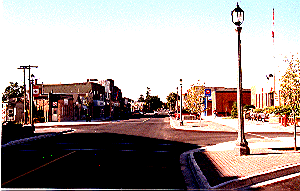 |
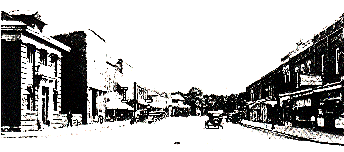
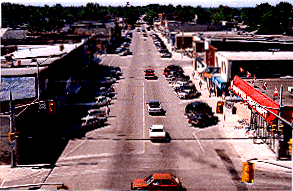
| Recently, Blenheim had its uptown sector reconstructed with new pavement, sidewalks,flowerbeds, and light fixtures. Even some stores refurbished their exteriors to suit the new look Main Street. |
| The picture on the left is an arial shot of Blenheim, looking west in 1992, the right picture is also looking west after the new construction was completed in 1998. |
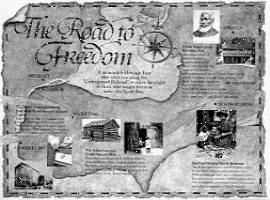 |
| AFRICAN-CANADIAN HERITAGE TOUR After the American Revolution in 1776, many British land owners left the new United States and fled for Upper Canada along with their slaves. In 1783, Lieutenant-Govenor Colonel John Graves Simcoe made law abolishing the ownership of slaves in Canada. In 1820, black slaves from the United States began fleeing for Canada on "The Underground Railroad". |
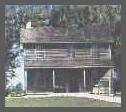
| This was in fact neither a railroad nor was it underground. It was a system of boats used to transport goods from the United States to Canada, all the while hiding black people on the boats and bringing them to this area of Canada to be free and live on Canadian soil. This area is strongly concentrated in the area surrounding the town of Blenheim. Uncle Tom's Cabin can still be seen today . For more information on Uncle Tom's cabin, you can go to http://www.uncletomscabin.org/history.htm |
 |
 |
| Uncle Tom's Cabin |
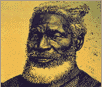
| Rev. Josiah Henson.. Uncle Tom |
 |
 |
| Back to Our Town |
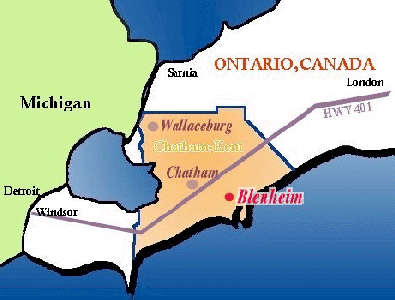
| Blenheim map |
|
|