
"HAROLD AND MAUDE"
A Review by Tiwanna Ellerbe
The opening scene: A young man (Bud Cort) locks a door and descends a staircase, entering into an immaculately decorated living room. He puts on a record, (Cat Stevens' "Don't Be Shy"), sits down at a desk, and writes out his name on a name tag. The young individual pins the tag on himself, and rises from the desk to light some candles. Then, stepping towards a rope that hangs from the ceiling, the young man, seen primarily from the waist down, steps onto, then off a footstool. The camera gives a long shot from the back of the young man, who dangles by the neck from the rope. With that, a woman (Vivian Pickles) enters into the room. At first she is stunned by the sight of the individual swinging from the rope, but then regaining her composure, chides him, "I suppose you think that's very funny, Harold." She dials her hairdresser, canceling her appointment for the afternoon. Harold tries to draw his mother's full attention to him and his prank, pointing upwards, choking and gagging from the rope. She gets up to leave the room, but before doing so, requests him not to be late for dinner, and to "try and be a little more vivacious" at her dinner party that evening.
With what is one of THE most memorable openings of a film, the viewer is introduced to one, Harold Chasen. A man-child of great privilege who lives in a mansion with his domineering, self-absorbed, socially conscious mother, Mrs. Chasen. His father, we find, has died, and like Harold, had his own peculiarities. His father was once arrested for testing out water wings in the Seine while floating in the nude, when he and Mrs. Chasen were on a trip to Paris.
Harold reacts to his loveless family life by shocking his mother with his morbid fondness of death and fake suicides. Apart from staging suicides, some of his other favorite things to do are attending funerals, watch building demolition, visiting scrap yards and working on cars. (What he does with a hearse and a Jaguar is priceless.) In an attempt to combat this, his mother employs the help of Harold's Uncle Victor, an Army general (Charles Tyner) as a father-figure for him, a psychiatrist, (G. Wood), and 3 computer dates (Judy Engles, Shari Summers and Ellen Geer). Harold scares each one of them away, but not before the last date (Geer), hilariously one-ups him.
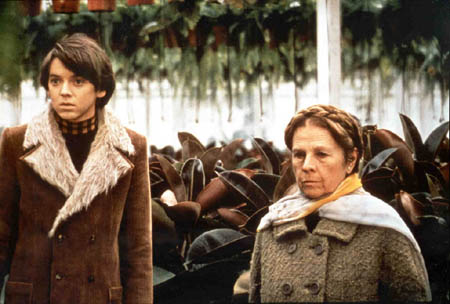
It is at a funeral in a cemetery where Harold first sees Maude (Ruth Gordon), sitting alone amongst some headstones, eating an apple as if she is watching a play. They meet again at a funeral in a church. There Maude strikes up a conversation with him shortly before She steals the priest's (Eric Christmas) blue Volkswagen beetle. At another funeral, Maude commandeers Harold's hearse, offering to take him home, until she finds out it's his car, which she then suggests his taking her home. A new chapter in Harold's life begins. Maude is a free-spirited septuagenarian; poor, but happy. Living life on her own terms; not being afraid of death, but seeing it as part of "the great circle of life". Thanks to Maude's guidance, the audience watches Harold evolve from an isolated and insulated young person loathing life, to one who becomes a person in love with life and living. Harold's metamorphosis is a beautiful thing to see. Part of his growth includes him falling in love for the very first time -- with Maude, who on the celebration of her 80th birthday, has some special plans of her own in store for him.
As for the performances, all of which are wonderful, Bud Cort's acting in the film is inspiring. He effortlessly uses his facial expressions, eyes and body so well to convey the essence and pathos of Harold, like some of the best silent-era comedians! His scenes with Vivian Pickles, are classic!
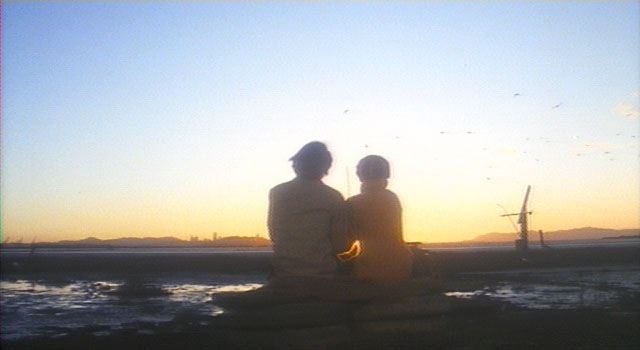
Maude lives up to her joie-de-vivre in Ruth Gordon's spirited performance. Her Maude is a survivor of life's ups and downs. At one point, while watching seagulls, Harold sees a tattoo on her arm, which showed she was once imprisoned for her beliefs. We find hilarity in her rebellious spirit, especially with such figures of authority as the police, whom She taunts and teases when she is stealing cars, for She does not even posses a driver's license. Religion too isn't safe from Maude's free-spirit, via the priest whose car she steals, and whose church she vandalizes (by painting the statue of a saint in the church). Throughout the film, Maude spouts words of wisdom to Harold, telling him "don't get attached to things," to sing and dance, to live, and to "go and love some more," when loves ends.
The script of the film was written by Colin Higgins, originally having started out as a half-hour master's thesis when the then-31-year old Higgins was attending UCLA. The movie, directed by Hal Ashby, was filmed in early 1970 and released to theaters in late 1971. The soundtrack featured the early music of Cat Stevens. It was based on 2 of his albums: "Mona Bone Jakon" and "Tea for the Tillerman". There were two original songs for the film, "Don't Be Shy" and "If You Want to Sing Out, Sing Out," later released on the album "Footsteps in the Dark". Although no official soundtrack was released, the closest to it is an album made for the Japanese market, which is hard to get and featured songs other than those heard in the film.
Upon its initial release, most critics panned Harold and Maude and it promptly flopped. However, one of the rare praises of the film came from the publication Film Quarterly, calling it "one of the best movies to come out of Hollywood in years. It is a love story, a sentimental black comedy, a ludicrous tear-jerker, a grisly social satire."In spite of the critical panning, the film began to gain a following at colleges and in theaters that catered to off-beat fare. It also gained followings in the UK and France, giving it an international cult status. For his role in the film, Cort earned a Crystal Star (the French equivalent of the Academy Award), as best actor. Later, teen fans of the film began to develop a fondness for cemetery-dwelling, which was dubbed "Harolding".
The film was re-released to theaters in 1979. Within a few years, it finally turned a profit and eventually was released on home video. Shortly after the film�s release, Colin Higgins turned "Harold and Maude" into a paperback book. In the 1980's there was a short-lived musical based on the film.
Sadly, many of the major players in the film have since passed away. Ruth Gordon, who played Maude, died in 1985. Three years later the film's director, Hal Ashby, and screenwriter, Colin Higgins also died, the latter from AIDS. Also deceased, are G. Wood and Eric Christmas. Bud Cort, however, is still very much alive. Once seen as one of the most promising young stars of the 1970's, he found himself typecast after the film�s success. He walked away from Hollywood for five years, mainly concentrating on building a repertoire in the theater. Later, when he returned to film, he continued to be typecast. In 1979, Bud was in a near-fatal car accident, followed by years of physical therapy and plastic surgery, all of which further stalled the growth of his career. Regarding some of the other cast members, Vivian Pickles, Charles Tyner, and Ellen Geer are living as well.
Today, "Harold and Maude" is finally getting recognition for the wonderful film that it is. The Library of Congress has it in its archives on American Culture, and the American Film Institute has included it in 2 of its listings. It's listed as one of the Funniest Films (#45) and the Most Romantic (#69) of all-time out of 100 films chosen.
Currently, the film is available on VHS and in a wide-screen DVD. However, the DVD is VERY short on the kind of features most fans expect from such a classic film, such as interviews with the remaining cast and crew, as well as many deleted scenes. The DVD only has 2 trailers, with some deleted segments in them, including a passionate kiss between Harold and Maude that had been cut from the film. There are captions in English and in French too.
These issues however, do not take away from a truly unique film-viewing experience; a masterpiece in film making. The themes of the film, and Maude's words of wisdom, are timeless.
If you're interested in sights geared to the film, you can seek out: HYPERLINK "http://www.geocities.com/RainForest/5862/harold.htm", which is the BEST fan site for the film on the Web; HYPERLINK"http://www.norcalmovies.con/HaroldAndMaude", which shows the filming locations for the film, and HYPERLINK "http://www.velvetmelody.com/haroldandmaude", a nice site by Eric Simpson, featuring a slide show of photos from the film.
Editor�s note: There is currently two Bud Cort fan sites on the web: "The Bud Cort Fan Club" and "The Official Unofficial Bud Cort Web Site". The former is Tiwanna Ellerbe�s own site dedicated to her favorite actor. There is enough Bud Cort information and photos to keep nitpickers busy for hours. Check out the links below for more information. You'll be surprised what you find. There's even a site dedicated to the herse used in the film!