
February 2005
Bhandara to Bhuleshwar
first appeared in different form in the Pune Times (Times
of India), April 29, 1999
by Jayant Deshpande
 |  |
click to view larger image
A Day's Journey
|
Most Puneites religiously make the trip to Singhagad,
the eminence that broods in the background with its Sphinx-like profile,
presiding over their city. But few seek out Bhandara Hill. Or Bhuleshwar. Both
almost as near, within a couple of hours' drive. Bhandara lies to the northwest near the village of Dehu, and
Bhuleshwar to the southeast near Yawat. Both rise above the surrounding plain;
both take us back in time. Dehu sits on the banks of the Indrayani River, and is
the birthplace of Tukaram, the great 17th century Marathi
saint-poet. A memorial to him stands atop Bhandara Hill a few kilometres away,
where varkaris, or devotees, come to recite and sing his verses. The day we took the winding road to the top was a day of
recitation and song. Vibrant, full-throated voices rang out in the deliciously
cool air of a January morning. The huge gathering of devotees, singing and
mingling, quickened my pulse. This hill is a sprawling island of rock made sacred
by the memory of Tukaram. Not only is the view scenic—on a clear day one can
even pick out Singhagad in the distance—but a feeling of unbridled joy washes
over even a casual visitor. I was eager to go to the cave in the side of the
hill (called Tukaram’s Kapaat), about half way down, where Tukaram would
sit for hours composing, reciting, meditating, looking out onto the scenery.
The climb down is worth the effort. For me, true solace can be found
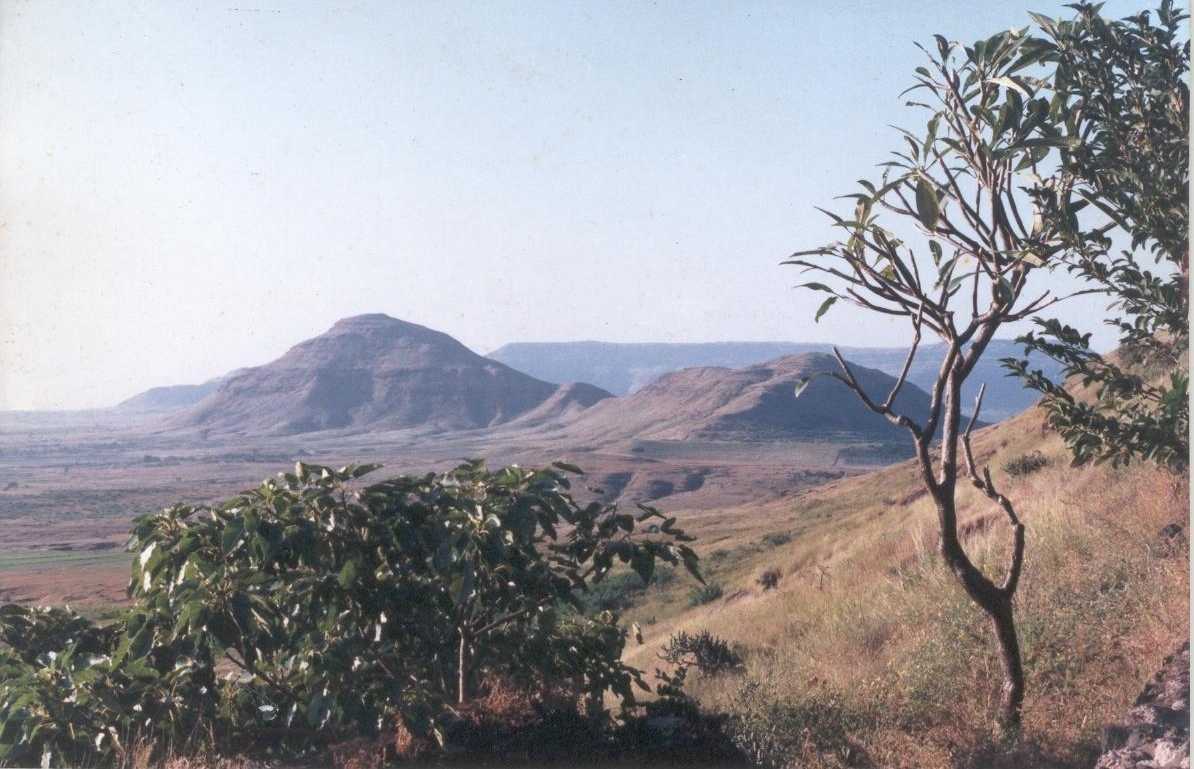
here. I took some photographs; stark landscapes always arrest me,
and where the Deccan plateau hugs the Western Ghats, the offering is a
feast. Brownish hills and ridges, odd-sized stone relics and
mounds, lie strewn across a sun-baked, semi-arid plain. One can see
checkered farms, scrubland, an occasional cluster of houses and sheds. An almost
primeval solitude prevails; one that envelops and engulfs the wonderful landforms
rising from the plain. Then we had a bite and moved on, taking the road to Chakan; from a
distance Bhandara looks like an elongated bubble of rock floating on the flat waving
fields. A short while later we passed through Alandi, the birthplace of that
other great Marathi saint-poet, Jnaneshwar. We got onto the Pune-Solapur highway, and just before Yawat, took the
narrow, deserted road that leads to Bhuleshwar. Soon, this road begins to wind its way up, looking out onto
almost moonlike terrain. Once you reach the top, the road levels out, and turns
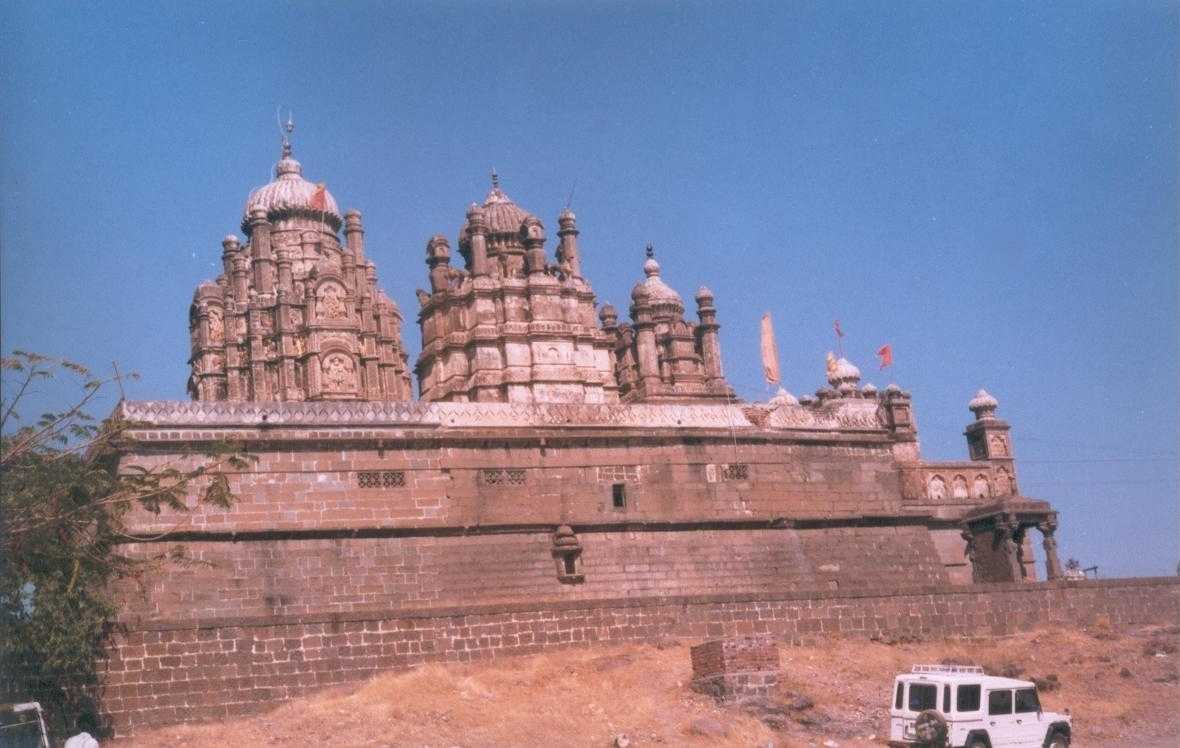
onto one last stretch up a gentle slope that leads to a magnificent Hindu
temple built with, hewed from, and
carved out of stone. Bhuleshwar dates from the Yadav
period (roughly 10th century AD). It sits high up on a hill beside
the village of Malshiras. A radio transmission tower stands to one side—the
only concession to the present. The temple honors
the deity, Mahadev. It has halls and chambers, pillars, sculptures and carvings
inside. A cool darkness greets you as you enter and walk into the Nandi (Bull) mandap, the entrance, the sabha
mandap, the meeting hall, the chauropi mandap, the square, and the
inner sanctum. Where there’s enough
natural light seeping through cracks and openings, one can feast one’s eyes on
male and female figures. There are dancing girls, women playing instruments,
males in disguise. But when the Moguls invaded the temple, many of them were
desecrated, their limbs or torsos cut off. What we see are remnants, but with
their beauty intact. The artisans’ work is breathtaking, awe-inspiring; one
wonders how they could have done such impressive work when all they had at
their disposal were crude tools. And
harsh conditions. Was it a labor of love? As natural as the food they ate? They unleashed their sensual energies
to celebrate life. It is a stupendous achievement that still stands with
pride after the ravages of a millenium. Not only is the space inside sacred,
but so is the silence that pervades the stark surroundings. It was Poornima (Full Moon), and
songs issued from speakers mounted outside. A verse composed in raga Bhairavi
especially tugged away at my emotions. Music and sculpture have a way of
heightening one’s senses. The harsh arid backdrop and the rough rocky terrain are
no impediment to joy of a certain kind.
My heart was gladdened by music on both hills, and the day would linger
on in my mind for days to come. We met a hardy shepherd outside,
quietly herding his goats. He was on his way down. A huge vat of the typically
Maharashtrian amti (curry) was
bubbling away nearby, promising a repast for some 400 devotees who would gather
on this occasion. We were warmly invited to join in, but had to forego the generous offer. Dusk would
soon fall, and we had to get back. |