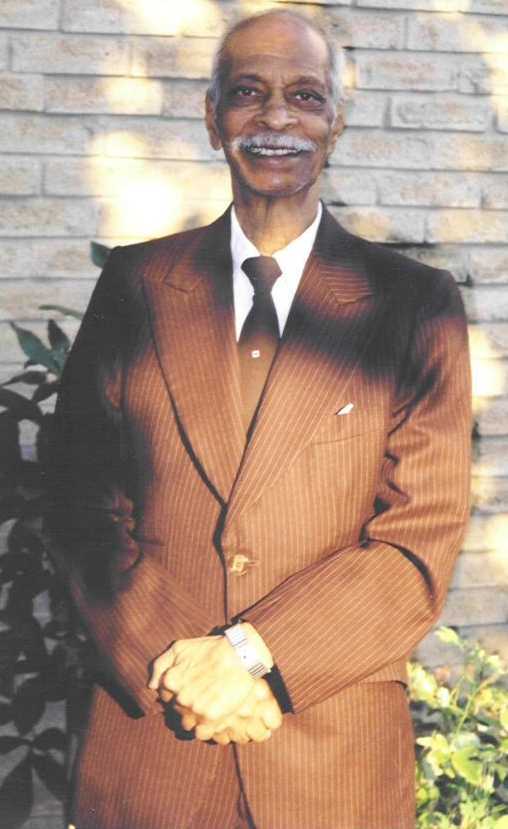
Jayant Deshpande
January 2003
Welcome

This site is dedicated to the memory of
my father, Dinkar B. Deshpande (1924—2001)
and
my mother, Shailaja Deshpande (1932—1987)
It was launched with a tribute (below) to my father on the occasion of his 79th birth anniversary on
January 17, 2003.
|
("Appa") Teacher and Traveler Born: Jan 17, 1924—Karad, Maharashtra, India Died: Dec 24, 2001—London, Ontario, Canada Reading Lives Lived (in Toronto’s Globe & Mail) these past few years, I wondered when the time would come to write my own father’s life story. Far too quickly the time did come. Yet, my father would probably have liked to see this obituary—it would have appealed to his sense of order and completeness. "There, that’s done," he would have said, "now I can go on." Born in the small town of Karad, about 200 miles from Bombay, he was called by his nickname, "Appa", from an early age. He arrived in Canada in 1961. For him, it was the last country on a tour of four continents starting in India, leading to East Africa, the UK and then the west coast of Canada. After graduating in 1945 from S.P. College in Pune, he taught for a few years at Tilak High School in Karad, and then at Ornella’s School in Pune. He left India for Uganda in 1953—a whole story in itself—and taught on and off in various schools there till 1961, when he embarked for Canada. His choice of Canada was equally improbable. Standing one day on a train platform in Uganda, he spotted a friend boarding a train. Appa asked where he was going and his friend shouted back, "A place called Canada—I know nothing about it, but I’ll be there next week!" The idea of teaching in Canada took hold in his mind, and anxious to escape the growing political unrest in Uganda, which was to culminate in the rise of Idi Amin, he researched Canada, province by province, applying to each province’s Ministry of Education (saying, "except Quebec, where I understood they spoke French, which I didn’t know.") He posted the letters and thought no more about it until one day, months later, a letter arrived from Prince Rupert, B.C., blandly informing him that he was appointed to the local high school, that he should report to the principal in three weeks’ time and that his immigration papers would be waiting in Vancouver. Always ready to travel, he sprang into action and arrived, by train, boat and plane, via Bombay, Tokyo and Vancouver, in Prince Rupert on a drizzly day in September, 1961 at Booth Memorial High School. He stayed for only a year, coming to Toronto at Easter the next year to find a job teaching in West Lorne, a small southwestern Ontario farming town where he taught for 22 years, commuting daily from London, Ontario. As a family our memories are mostly sedate ones from his settled life in London from 1965 onwards; that was our home no matter where we, his children—Mira, Santosh, Jayant and myself—lived. Looking back, I'm struck by the contradictions in his life: Born in India and trained in classical Sanskrit, his career for many years was teaching English literature, and he retained a lifelong love of Shakespeare and English drama; the man who loved travel, who had lived through Mahatma Gandhi’s struggles and the Independence of India in 1947, who had himself moved his family across oceans—not entirely through necessity—but who told me the happiest time of his life was living in a conservative suburb of London, Ontario; the spiritualist, whose readings and regular habits made him frugal and un-materialistic, who nonetheless spent two month’s salary on a Swiss Omega automatic watch during a trip to Zurich in 1958. A watch that he still had on his wrist when he passed away. And the final contradiction: a man that age had hardly touched, a lifelong practitioner of yoga whose life and habits were strictly regulated, struck down after a life of uninterrupted health by pancreatic cancer, one of the most unremitting of cancers. If there was one trait in his character that I admired the most, it was his ability to rise above the moment. He had a remarkable ability to live on a higher plane. This alienated some, who thought he was out of touch. Two months after his wife of some 40 years, and my mother, died in 1987, I remember him standing in the parking lot above Terminal 1 at Pearson International, just minutes after dropping off his eldest son, Jayant, knowing he was going back to an empty house for the first time in his life. There was a glorious sunset over the airfield and he stopped to point out its special beauty to me even though this must have been the saddest moment of his life. It would have been the last thing on my mind. After her premature death, he'd visit Jayant in India every winter, except his last one, with a stopover in England en route, to and fro. During the year 2000, he managed to visit India, England, Vancouver Island, San Francisco, the Yosemites in California, and New York City. Always on the move; seldom a dull moment, even as a widower. During his last few months of life, he met a new oncology resident at Sunnybrook Regional Cancer Centre. She made several oblique references to his cancer spreading, and what this meant. Finally, after a few minutes of listening to her beating around the bush, he interrupted to say quietly: "I have seen the country on the other shore. I know it will soon be time to leave this shore for that one. I am ready for the journey." I cannot offer a more fitting epitaph for a man who has left a gap in the lives of his friends and family, in our hearts, and especially in that space above us all where we look for direction, guidance and inspiration. Ravi Deshpande Toronto, Canada |