  |
|
| |
|
| |
|
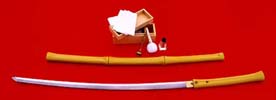
Bamboo
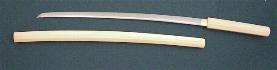
Shirasaya Samurai Sword (6.2"). Impessive
natural wood scabbard and wood handle. The sword
features a 440 stainless steel blade and blood
groove.
|
| |
|
The word
"Samurai" or warrior in the era of Japan -
China's feudalism (1192 - 1867) has its origin in the
10th century with the old humble Japanese verb
"samorou" or "saborou" meaning
"To serve, to guard imperial family or noblemen,
or to be ready anytime waiting for their order in the
spirit of loyalty. Samurais came to have strong
influence in the central political offices by the end
of the 11th century, taking the place of the noble
class. During the Japanese feudal era, the military
government was headed by the Shogun, the supreme
seigneur of Samurai. The Samurai's highest priority
was loyalty to the Daimyos who ruled under the
Shogun. In the late 16th century, it became common
for Samurais to carry two swords, one large and one
smaller. The large sword was used in battle while the
small sword was reserved for fights in narrow places
and for self-defense. Through the centuries, expert
sword craftsmen perfected the art of creating the
Samurai swords. Individualities developed in the
details of the swords to identify the maker. The
blade curve, style and decoration of the sheath,
sword and guard, method of metal refinement, as well
as other details, were varied according to the sword
smith. "
Won Hung
Lo Says "Swords must be displayed with EXTREME
caution around children!"
|
|
| |
|
| |
|
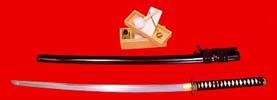
Deluxe Samurai Shoto (26
1/2") The unique styling of this sword is
recognized by The blood groove etched into the 440
stainless steel Blade that has been sharpened and
finished with a True-wave frosted edge. The black
wooden scabbard Has been modeled to perfectly fit
over the blade and Is complete with a Red
woven waist cord that Matches the tightly wrapped
handle.
|
|
| |
|
| |
|
|
|
| |
|
| |
|
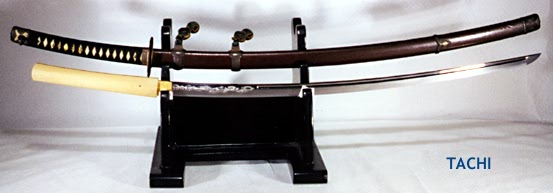
History of
Japanese swords goes back 2,000 years. The first
metal sward was discovered from a grave in Japan. The
oldest sward is called JO-KO-GATANA, which means
"the sward of an ancestor". The ones with
blades on both sides are known as KEN or TSURUGI.
Those with a single blade are generally called TACHI.
From the 3rd to
the 8th century, Chinese and Korean sword craftsmen
came over to Japan. Ken or the strait RYO-TO-KEN was
made during the 7th to the 8th period as can be seen
a t HO-BUTSU-DEN in Nara City. Tachi developed
into KATANA during the middle of the 10th century,
because the Japanese Calvary required weapons fit for
surprise attacks. During the year 1190 to 1337
(Katakura period), blacksmith techniques for sward
making reached its peak, and many of the swards
designated as national treasures were made during
this period. During the year 1337 to 1570 (Muromachi
period), long and heavy swards fit for one on one
fights were in demand by many samurai warriors. Those
sword s produced from the 14th century to Sengoku
period were heavy and some were longer than 3 ft. (90cm). At the end of Sengoku period, many Tachis
were cut shorter, and the concept of "tachi wearing" (TACHI KOSHIRAE) changed into
"katana wearing"(KATANA KOSH IRAE). This
caused the loss of many good swards with production
dates and signatures.
|
|
| |
|
| |
|
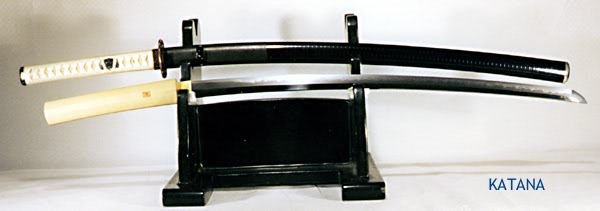
O-GATANA
(longer sward)
Length
2ft. 7.5 inches to 3ft. MACHINE MADE KATANA
|
|
SAMURAI
KATANA was a single bladed arm which samurai warriors
wore on their waist. To wear a katana was considered
to be one of the privileges that indicated one's
class. In 1614, after the early TOKUGAWA period, the
Tokugawa Shogunate regulated wearing of katanas, and
samurai warriors began carrying two swards of
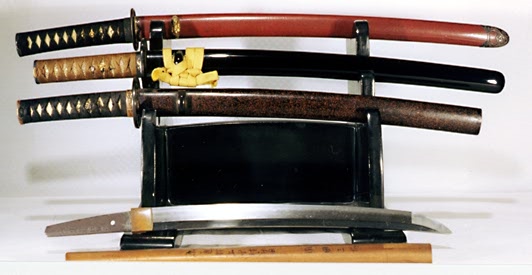
different size. O-GATANA (longer sward) and KOGATANA
(shorter sward) were limited in their length to less
than 2 ft. 7.5 inches (85cm) and 2 ft. 2.5 inches
(75cm) respectively. Katanas, which are curved,
medium in length, and bladed on single side, are the
ones that are under the most demand. Single bladed
kogatanas are also often considered as a gift item.
WAKI-SASHI and TAN-PEN that are also in demand are
the ones that appeared later on. They were used when
committing suicide by cutting one's own stomach
or in SEPPUKU. One of the most popular ones among
collectors in Japan is KAI-KENs. They were used for
decorative purposes, and the ones with pointed shape
was used with a ceremonial belt (women samurai's
belt) in a formal occasion.
The heart of a
real working katana is, of course, the blade.
Designed for Goza target cutting competition, these
blades ar e made of high carbon steel and clay
tempered, with an edge hardness of 59RC, and a body
hardness of 42RC. You will also notice slightly
huskier blade dimensions to aid in overall strength.
These blades also feature a revolutionary industry.
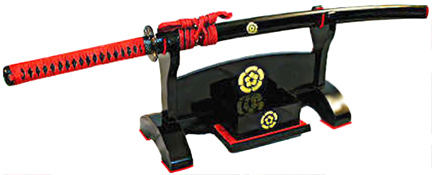
This katana is designed for Goza target cutting
competition. \par These numbered Limited Edition
Spirit of the Shogun katanas include a magnificent
high-gloss black furniture quality stand, a stand
unlike any you have ever seen. The katana, the stand,
and the maintenance kit are each embossed with a gold
crest of a partic ular Shogun or Daimyo, which that
katana commemorates. In this photograph one can just
begin to get an idea of the mirror finish on the
furniture quality stand, and see the protective
velvet padding in the arms for the katana, on the
shelf for the mainte n ance kit, and on the feet of
the stand. The padding color matches the color of the
katana wrapping. Engraved into the stand flanking
each side of the crest is the name of the Shogun or
Daimyo in Japanese characters.
|
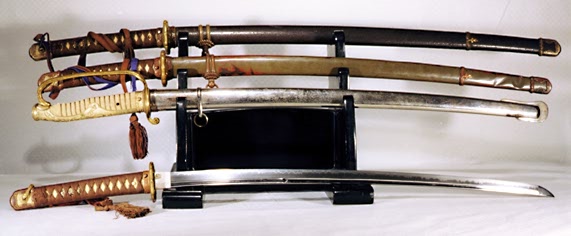
HAND MADE
SAMURAI WITH TWIN BLADE
|
|
| |
|
| |
|
|
|
| |
|
| |
|
| |
|
KOGATANA
(shorter sward)
Length 2
ft 2.5 inches
|
|
WORDS FOR
SAMURAI
|
|
| SAMURAI |
- - - A class of people
that e xisted in old Japan. Consisted of about 2
million or 3% of total - - - population.
|
| TACHI KOSHIRAE |
- - - Wearing method of
swords. The sword is hung from a belt with the
cutting edge facing - - - - - down. |
| KATANA KOSHIRAE |
- - - Wearing method of
swords. The sword is hung from a belt with the
cutting edge facing up. |
| |
|
| |
|
| |
|
|
| |
|
|
|
| |
|
| |
|
| |
|
| |
|
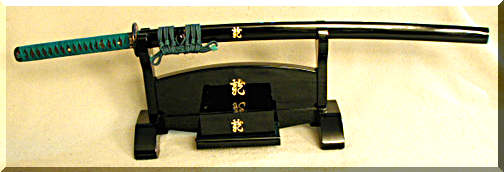
Specialty Black Samurai
Sword (27") Full tang construction! This unique
sword features a finely carved wooden handle and
guard. Marble lacquer finished scabbard is included.
440 stainless steel.
|
|
|
|
| |
|
Many Japanese swords were
brought to the United States during and after WW II
(some estimate over 1 million). The majority of these
swords were machine made military weapons made for
use in field; a few were older or well-made hand
forged swords. Type, style, condition, age, maker and
many other factors determine the value of a Japanese
sword. Many swords have characters on the tang that
gives information about the maker and year made. The
lack of informatio n on the tang does not mean the
sword is machine made, some older swords do not have
characters on the tang and many machines made swords
have a maker's name on the tang. If you own a
Japanese sword and are planning on selling it,
identifying what it is will help you establish an
appropriate value. Please see pictures of some
typical styles of swords. I have enjoyed an interest
in Japanese Swords for over 3 years; collecting their
photos n information has been my hobby the past 3
years. I would enjoy working with anyone interested
in exchanging the weapons information specially the
Japanese samurai and the Shotguns.
Epitomizing the art of the
Samurai sword maker, the Shinto Katana in shirsaya
form is hand crafted at the Dalian (China) forge of
ChenChao-po, the widely respected authority on the
art of oriental sword making. Displaying features
usually found only on original Samurai swords, these
pieces provide a unique opportunity to own a katana
of a quality usually found only in private
collections, museums or in the Orient.
|
|
| |
|
|
|
|