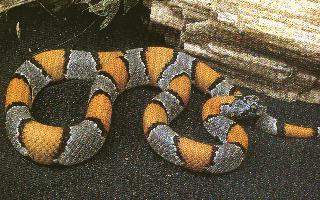
Common name : Gray-band Kingsnake
Scientific name : Lampropeltis alterna
Coloration : Gray-bands have a well defined head with large protuberant eyes. Color normally ranges from black tipped or speckled, to nearly black, or entirely gray. Ventral patterns are extremely variable ranging from no pattern, to almost black, to any possible combination imaginable.
Longevity : 10 - 15 years (average)
Distribution : As far south as Durango, Mexico and as far north as southern New Mexico. In Texas they range from Edwards County to El Paso. Rocky canyons, limestone ridges, and boulder piles are preferred. Many are collected from the wild by simply driving through their range and examining outcroppings of rocks and cliffs along the highway.
Size : Hatchlings are typically 7" - 12" while adults can reach 28" - 36" in length. The longest specimen on record is 57.75".
Growth : Can reach 3' in the first year. On average, about a foot per year after the first year.
Food : Rodents of the appropriate size should be offered to babies every 4 - 5 days. Adults should be fed every 7 - 10 days. The general rule of thumb is to feed the snake a prey item that is equal to or greater than the snakes' largest diameter. ( A small meal is better than a large one) Feeds primarily on rodents, but have been known to eat lizards, lizard eggs, and snake eggs in the wild. Scenting pinkie mice may be necessary to entice reluctant feeders to begin feeding.
Housing : Babies should be housed in a 10 gallon aquarium for their first year. Adults should be have the equivalent of 48" x 24" x 24".
Temperature and humidity : Daytime temperature should be in the 90 - 95 degree range, with a night drop to 70 -75 degrees. Access to a water bowl should provide adequate humidity.
Photo period : 12 -14 hours of daylight in the summer. Darkness in the winter.
Lighting : Full spectrum UVA/UVB lighting is not necessary.
Heating : Under the tank reptile heating pads will provide 24hr bottom surface heat, which is essential for proper digestion. Incandescent lights with a dome reflector situated above basking areas will provide the proper daytime heat gradient. Be sure to use a properly placed high temperature thermometer to ensure the temperature does not exceed 90 degrees.
Substrate : Newspaper or carpet type material is recommended for its ease of cleaning and removal. For a more natural looking vivaria, orchid bark (Repti-Bark), pea gravel, aspen shavings, or pine shavings can be used. If you use shavings or gravel, you must ensure that the substrate is not ingested during feeding as this can lead to impaction and/or death. NEVER USE CEDAR OR REDWOOD SHAVINGS AS THEY CAN BE HARMFUL OR FATAL !!!
Water : Water should be made available in a large sturdy water bowl at all times. Aside from the necessity of providing water, a water container will also raise the humidity and provide an area for soaking to aid in proper shedding.
Maintenance : A weekly maintenance schedule should be implemented with all snakes. Clean the enclosure to remove feces and replace areas of soiled substrate as needed. The water container should be removed, cleaned, and disinfected weekly (sooner if the snake defecates in the water bowl, which is common for the bull snake). Never allow the substrate to remain damp as this could lead to to skin and health problems.
Eggs and incubation : A brumation period is necessary prior to breeding. Temperatures should be lowered to 55 degrees for a period of 10 - 12 weeks. All feeding should cease approximately 2 weeks before brumation to ensure that the digestive tract is empty. 4 - 13 eggs in a typical clutch. the eggs should be placed in a vermiculate/water medium for 60 - 80 days at 80 - 85 degrees with a 90% humidity.
Notes : This species is very secretive and spend a lot of time hiding. It is important for the proper maintenance of this species to provide a hide shelter at both ends of the temperature gradient of the enclosure. Hides can be as simple as a clay flower pot, cardboard box, or a molded plastic box. Lampropeltis alterna are beautiful animals and are quite tamable. They make an outstanding addition to any collection and/or breeding project.
