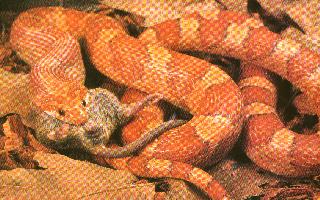
Common name : Corn Snake
Scientific name : Elaphe guttasta guttata
Longevity : 10 - 15 years (average)
Distribution : Central to Eastern United States
Size : 4' - 5' with some specimens reaching a maximum length of 5'-8'.
Growth : Can reach 3' in the first year. On average, about a foot per year after the first year. Grow quickly and usually are aggressive feeders.
Food : Rodents of the appropriate size should be offered to babies every 4 - 5 days. Adults should be fed every 7 - 10 days. The general rule of thumb is to feed the snake a prey item that is equal to or greater than the snakes' largest diameter. ( A small meal is better than a large one) Some variations of their diet can be made in the way of day old chicks or lizards to entice a reluctant feeder.
Housing : Babies should be housed in a 10 gallon aquarium for their first year. Adults should be have the equalivalent of 72" x 24" x 24".
Temperature and humidity : Daytime temperature should be in the 74 - 85 degree range, with a night drop to 65 - 70 degrees. Access to a water bowl should provide adequate humidity.
Photo period : 12 -14 hours of daylight in the summer. Reduce to 4 - 6 in the winter.
Lighting : Full spectrum UVA/UVB lighting is not neccessary.
Heating : Under the tank reptile heating pads will provide 24hr bottom surface heat, which is essential for proper digestion. Incandescent lights with a dome reflector situated above basking areas will provide the proper daytime heat gradient. Be sure to use a properly placed high temperature thermometer to ensure the temperature does not exceed 90 degrees.
Substrate : Newspaper or carpet type material is reccomended for its ease of cleaning and removal. For a more natural looking vivaria, orchid bark (Repti-Bark), pea gravel, aspen shavings, or pine shavings can be used. If you use shavings or gravel, you must ensure that the substrate is not ingested during feeding as this can lead to impaction and/or death. NEVER USE CEDAR OR REDWOOD SHAVINGS AS THEY CAN BE HARMFUL OR FATAL !!!
Water : Water should be made available in a large sturdy water bowl at all times. Aside from the necessity of providing water, a water container will also raise the humidity and provide an area for soaking to aid in proper shedding.
Maintenance : A weekly mainteance schedule should be implemented with all snakes. Clean the enclosure to remove feces and replace areas of soiled substrate as needed. Thw water container should be removed, cleaned, and disinfected weekly (sooner if the snake defecates in the water bowl, which is common for the bull snake). Never allow the substrate to remain damp as this could lead to to skin and health problems.
Eggs and incubation : A brumation period of 8 - 12 weeks should be maintained with a drop in light hours and a temperature of 50 - 50 degrees. Sexually mature at 1 - 3 years of age. Clutch normally consists of 6 - 20 eggs. Have been known to to double clutch. Incubate at 55 - 65 days at 82 - 85 degrees and 90% humidity.
Notes : One of the most popular snakes there is. The seemingly endless color variations and patterns make this one of the most interesting of snakes to keep and breed. They are one of the most frequently bred in the private sector. This is one species that you can never go wrong with if you want a hardy, tractable snake that tloerates handling well and is just a pleasure to watch and look at.
