The Endeavour Space Defense Platform
Although it is classified as an SDP by New Zealand and it's allies, Endeavour could
really be better called a space support facility. It's weapons arrays are
largely defensive, and it primary reason for existing is to support other
NZ space operations. Some strategists have (half jokingly) suggested that this fact could
be a better defense than anything else, because Endeavour will not be seen as a priority
target.
When New Zealand put up a tender for it's first space platform in 2065 a number of
widely different proposals were put foward. Hvide/Stjerne A/S put foward a customised
version of it's (then brand new) Avskermar SDP, whle both Nanodynamics and NUK
proposed broadly similar designs. Columbia Aerospace proposed a much simpler, less
sophisticated solution; a beehive asteroid base constructed in Earth orbit.
In the end Columbia Aerospace won largely on
economic grounds. The New Zealand government agreed to put up a small initial deposit
which would cover finding a suitable asteroid and moving it into an appropriate orbit,
and this allowed them to defer funding on the actual construction until later. As part of
cost reduction measures the asteroid's transfer orbit was a slow one, taking some
5 years to reach Earth orbit.
Completed (in it's current form) in 2072, the plans for Endeavour underwent a series
of reductions during the 5-years of it's transfer orbit. The original design had
room for a full wing of TCAVs, accomodations for a company of
infantry, and facilities to dock as vessel as large as a LSDV. These grandiose plans
inevitably eroded, leaving a platform more than sufficient for New Zealand's own forces,
but unable to offer much support to it's allies. But one of the advantages of
an asteroid hull is the relative ease of expansion, and improvements to Endeavour
are periodically proposed by various political parties and pressure groups. No major
expansions have yet been approved, but regular upgrades and refits keep the
stations existing facilities up to date.
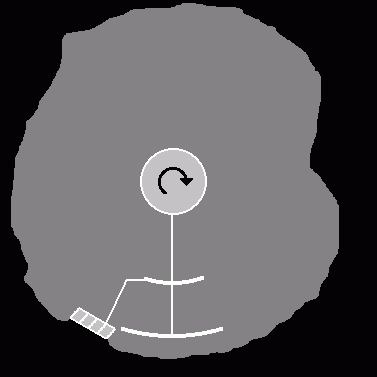 The image to the left shows a cutaway of Endeavour's habitable volumes, looking along the
axis of rotation. Near this axis are the fusion reactor and the spacedock, both
facilities which operate best in a microgravity enviroment. The spacedock forms a
cylindrical volume some 60 meters in diameter and 80 meters deep. Immediately
surrounding this cylinder are a variety of workshops and repair facilities. Roughly
40 meters deeper is the fusion reactor, near the center of the asteroid.
The image to the left shows a cutaway of Endeavour's habitable volumes, looking along the
axis of rotation. Near this axis are the fusion reactor and the spacedock, both
facilities which operate best in a microgravity enviroment. The spacedock forms a
cylindrical volume some 60 meters in diameter and 80 meters deep. Immediately
surrounding this cylinder are a variety of workshops and repair facilities. Roughly
40 meters deeper is the fusion reactor, near the center of the asteroid.
Moving away from the axis of rotation one finds the command levels buried roughly
halfway into the asteroid, under some 80 meters of rock. These command levels include
4 mainframes operating advisory LAIs, and 1 macroframe running an SAI that runs most of the
platform. The next level out is the crew accomodations, roughly 20 meters under the surface.
This level houses all cabins and common areas, as well as the vatfac and some
repair facilities that can be more easily operated in gravity enviroment.
Off to one side of the crew levels are the TCAV launch bays. These are not normally
pressurised, but can be if necessary to facilitate repairs or inspections. Similarly
most of the laser towers and sensor domes can be pressuried. Most of these are internally
accessable only by crawlspaces intended for cybershells, although they can (barely)
fit a human. Travelling several hundred meters through such a tunnel would not be
pleasant, so the rare human visits to these sites are usually done from outside.
An advantage of the asteroid hull is it's large size. Averaging over 180 meters
in radius, Endeavour can maintain a spin gravity of 0.6 G with no discomfort
to it's crew. Accomodations on Endeavour are rightly considered luxurious by military
standards, with each crew member having a 2,000 cf. cabin of their own, and
generous common areas. But even with these generous accomodations the occupied volume of
the asteroid is still negligable, and the total volume of all fuel tanks, spacedocks,
launch bays, and other facilities make up less than 1% of the asteroids volume.
As can be seen in the diagram most of these facilities are located in a single
30o× 15o
segment of the asteroid, although sensors and laser towers are scattered all over
it's surface.