| THE JASONVILLE STORY CONTINUED... |
| Chapter X The early schoolhouses were much like the early home in construction. All were built of logs with a huge fireplace, one window and one door. The floors were of split logs (puncheons) and the roof of clapboards. Splitting a slab from three to four inches thick and usually twelve to fourteen inches wide made the seats. These slabs were hewn smooth on top, and then holes were bored in the other side, into which were driven wooden pins for legs. The seats had no backs and often were so high that the feet of smaller children would not touch the floor. There were no desks on which to rest your arms or place books. Along one side of the room, made in the same manner as the seats, were desks to use in writing. Some of them were low with a seat placed in front for the writer, some purposely made higher so the scholar could stand while writing. The clapboard roofs did not shed all the snow, sleet and rain. There would often be much snow drifted in the loft, and when it began to thaw from the heat of the big fireplace, the dirty snow water would start trickling through the loose� loft floor onto the heads of teacher and scholars. There were no permanents to be ruined, as the hair was all done in long braids, but it made a sorry mess of Nellie�s new dress, she had worn that day to impress Abner who sat next to her on the bench. Prior to the early 1850�s all schools in the Jasonville neighborhood were subscription schools as they were elsewhere in the area. The term was about three months in the winter and each pupil was charged a fee of from one dollar to a dollar and one half per term. The older boys were assigned the task of cutting and getting in the wood for the huge fireplace. It is believed that the first school in the township was taught in 1823 or 1824 and that the teacher was either Rev. Alexander Poe or Rev. Richard Wright. This school was about one mile West of Meridian Street on the south side of the Shanklin Street road. The house was of round logs, was about 16 by 18 feet, and had been built by a settler for his residence, but was abandoned upon his removal to another location. It had a large fireplace and a square hole in the opposite end of the building, which was used as a window. Greased paper served as the windowpane. In all, about twenty scholars attended this school, some coming from Sullivan county, the county line being a little over a mile west of the school. Another early school was known as the Crabtree School, probably named after the family that donated the land. This was located near the center of section 17-8-7. This site would be two miles south of Main street on Meridian then one half mile west. The Crabtree church stood nearby. Elmer Warrick tells the writer that this was an old school when he was a small boy, 80 years ago. It is thought the church was abandoned upon the building of Embury. About 1859 Jasonville, as we know it today, had its first school within its borders. This was located in the Northwest corner of the intersection of Cook and Meridian Streets. There were probably short terms of school taught before this date within the boundaries, but this was the first schoolhouse built by the township in Jasonville under the free school law. It was a small frame building and was outgrown in a few years. It was then moved across to the south side of Cook Street and a larger building erected where it had stood. This building was used as a school as late at 1902. In l892abrick building was erected where the high school now stands but with the coming of the railroad and increased population it was soon over crowded and the frame building again placed in use. Churches and halls were also used as classrooms during the period, before a part of the present building could he completed. The frame building, finally abandoned after the 1902-03 term, was sold to the Grand Army of the Republic and used for a time as their meeting place. It was lastly used as a blacksmith shop by Steve Newby and Sons and was burned in the great fire of 1914. |
| Late in the 1840s and early 1850s Greene, with all the other counties of the state were called upon to vote on the question of having free schools. Before this time all schools in the county were �subscription� schools paid for by the patrons directly. As late as 1882 there was still 23 private schools in the county. It is interesting to note the rapid change of sentiment on the free school question, within a short period of time. 1848 Wright Township, For - 25, Against 75 1848 Whole county, For - 474, Against 1460 1850 Wright Township, For 40, Against 84 1850 Whole county, For � 974, Against 988 1851 Wright Township, For 61, Against 58 1851 Whole county, For 1278, Against 655 I find no results of the election of 1849, if one was held. Here we find the fine traditions of a progressive democracy at work. We see all the townships of the county casting a combined vote of three to one against this most important issue not one casting a favorable vote. Four years later practically the same voters, in the same voting units, cast a vote of almost two to one in favor of free schools, not one township showing a majority against. The entire revenue distributed to the townships of the county for schools in 1858, 100 years ago, was $6,043, an average of $400 per year for each school. We can�t be too proud of Wright�s record, but we did come from behind, a 3 to I underdog in 1848, to win by a scant margin in 1851. In the early days water channels were the great highways, which floated the products of commerce. Streams of all sizes were utilized-widened and deepened-and at last other means were sought to increase the number of waterways to meet the ever increasing demand for movement of products and produce. Artificial channels, canals, were constructed and filled with water, and furnished a much better means of shipping, due to their safety, that the natural streams whose currents and floods were at times dangerous. The State Internal Improvements Bill, enacted by Congress in the late thirties, provided for, among other stupendous projects, a system of canals. The government gave huge grants of land to encourage the building. Under such demand, and with such aid, the Wabash and Erie Canal was built. Most of the old abstracts for this section show that the Trustees of the Wabash and Erie Canal conveyed the land to some individual. The canal was to extend from Toledo, Ohio on Lake Erie to Evansville, Indiana on the Wabash River. The �cross cut� of the canal, as it was called, extended from Terre Haute, entering Lewis Township, Clay County near Old Hill, and following near Eel River on the west side, entered Smith Township of Greene County near the Northwest corner of Section 3, thence down to Worthington; thence along the west side of White River to Newberry, where the river was crossed by constructing a large chute or trough, technically a flume. This flume was above the river, and the boats traveled through it. Otherwise the water would have all drained from the canal into the river, when the river was at low water mark. The canal ran from Newberry in a southwesterly direction into Daviess County, thence on to Evansville. The work on this �cross cut� was started in 1846 or 1847 and completed so that regular traffic was established between Worthington and Terre Haute in 1850. The beginning of this schedule was observed by a grand excursion between the two towns. I give one location along the canal for the benefit of many of my younger readers and perhaps several of the older ones. Going North on state road 59 after crossing Muir�s Lake bridge a distance of 1 1/2 miles, and just a short distance before swinging East to Brunswick you cross the canal on a concrete bridge or culvert. Don�t look for the boat or the horses or mules that walked on the towpath and pulled them, for one hasn�t passed there for just about 100 years. No machinery of any kind was used in the construction of this mammoth venture. The work was done entirely with spade, shovel, pick, wheelbarrow and an occasional one horse cart and scraper. The reservoir near Lewis was built for a reserve water supply for the canal or �Feeder� as it was called, and covered about 4,000 acres of land, running to a depth of 15 to 18 feet. Dams were built along the river to raise the water level and thus feed the canal. The settlers who had ever been plagued with ague, chills and malaria saw in this newly flooded land additional threat to their health and life. On the night of June 22, 1854 the bank of the Birch Creek reservoir was cut and the water let out. The canal officials called a meeting with the residents of the locality but reached no agreement. The company repaired the dam, placed guards along the canal, and again filled the reservoir and resumed traffic. About a year later a group, said to be one hundred strong, of disguised and armed men, drove away the guards and again cut the embankment. Canal officials complained to Governor Wright who ordered two companies of militia from Evansville, under the command of John W. Dodd, to the scene of the trouble. Most of them were young, single men and received $1.00 per day from date of enlistment. About 15 were stationed at Spluge Creek reservoir and about 50 assigned to duty at Birch Creek. After about ten days the militia departed for Evansville and a short time later the Spluge Creek reservoir was cut and this spelled doom of this section of the Wabash and Erie Canal, but the southern section continued operation. The canal served a useful purpose at the time just before the coming of the railroads. Iron ore found east of Bloomfield led to building blast furnaces in the eastern part of the county, and the products of these furnaces were shipped by canal to Evansville, as was much milling products and grain from Worthington and other points. As early as 1836, flat boats were sent down White River to New Orleans from Point Commerce, east of Worthington, bearing the produce of the area. Allison brothers who laid out the town of Point Commerce sent an average of twelve or fifteen such boats each year for several years. Early in the civil war Dr. W. B. Squire of Jasonville began to enlist men for an infantry company. Mr. Squires was formerly engaged in business in Jasonville and was the first doctor locating within its limits. The company was so nearly completed by mid summer that on August 8, 1861 company officers were elected as follows: Captain, W.B. Squires Lieutenants, John F. Smith and William Thompson. Some members were from Clay, Sullivan and other counties, but upon being mustered in at Terre Haute they were promptly dubbed the �Greene County Wildcats� which name stuck with them throughout the war, and which by their fighting they seemed to merit. Officially they were Company F, Thirty First Regiment, Indiana Volunteers. Getting into action early in the war the company took part in many of the important engagements in Kentucky, Tennessee, and Georgia. In June 1865, it was sent to New Orleans and assigned to General Sheridan�s command. They were then assigned to the army of occupation of Texas and encamped in the interior of the state. The company suffered heavy losses before being mustered out in 1865, replacements came from distant points, but I quote some personal history of a few, whose names will be recognized by many of my readers. Dr. W.B. Squire, Capt. resigned Dec. 31, 1861, re-entered the service as Surgeon of 14th Indiana Regiment. Alexander Gibson, Mustered out December 1865 Jacob M. Larr, died, Nashville, Tenn., October 1862 David Bonham, Discharged, Nov. 1862, Disability David S. Bonham, Mustered out Sept. 1864 Joel A. Buckallew, discharged, Dec. 1862, disability 34 James B. Letsinger, Killed, Chattahoochee River, July 1864 Alexander Letsinger, died, Vinning Station, Georgia, Sept. 1863 William O�Donald, Mustered out, Dec. 1865 as Sergeant Jason M. Rogers, mustered out, Dec. 1865 Nathan Squire, mustered out, Sept. 1864 George Thorlton, mustered out, Dec. 1865, Corporal Many other soldiers rendered valiant service in the Union Army, several of them serving in Co. K 85th Reg. Some for this locality were: John S. O�Donnell, First Lieut. Jackson Wilks, Second Lieut. F.M. Rogers, Edward Rogers, Lewis E. Letsinger, Moses Archer, Jacob Archer, Daniel Archer, T.A. Craig, J.C. Letsinger, H.T. Neal, William Poe, A.J. Powell, J.E. Rogers. J.T. Warrick, Jonah Worth, Win. H. Slough. I am sorry, indeed, that I cannot list and give the outfits of many of my old friends who were with other organizations, or were transferred and thus their names are unlisted in the brief history I have. Among these is Peter Wrork, James Neal. John Stone and George Asbury, who falsified his age and went in as a drummer boy 12 years old. While Greene County responded nobly, during the war, to the call for volunteers and met the draft quotas as well as most counties, it was not without its full share of rebel sympathizers. Banded together in a secret organization called the Knights of the Golden Circle, they exercised their combined strength and influence toward discouraging enlistment and otherwise hampering the war effort. The emblem of the order was a butternut shell. So brazen were the actions and speeches of these Southern sympathizers that the Worthington Gazette on Feb. 5, 1863 carried the following: �Our country is being overrun by deserters from the army. It is believed by many that there are men in Greene County who have written to the different regiments advising those who are dissatisfied to desert and come home, and they would be protected and shielded from arrest. We should arrest all the deserters and take them back to their regiments. Let the matter be tested ~�nether we have traitors in Greene County or not. What ~ay you, Union men of Greene County?� A mass meeting of the rebel sympathizer& held in Bloomfield on the 7th day of February 1863 adopted the following resolution: �Resolved, that all questions and doubts as to why the war is being waged having been removed by the emancipation proclamation of Abraham Lincoln and by the dismissal from time to time of conservative generals and appointing in their stead men of radical abolition proclivities, we hereby declare our opposition, to the further prosecution of the war as it is now being waged, that we are not in favor of furnishing the present administration another man, gun or dollar for such a hellish, unchristian crusade.� On Feb. 21, 1863 a mass meeting of the men favoring the union was held at Bloomfield. Col. G.H. Voss of Greencastle spoke for more than three hours and it was said that not one person left the meeting during that time. The following resolution was adopted: �Resolved, that the political demagogues now striving to obtain an armistice between the armies of the United States and the rebels, are acting in bad faith to the government and are therefore traitors, and that we will oppose any such movement under present circumstances by all proper means, as we believe its design and tendency is to aid the rebellion, assist treason, and in the end to secure the secession of the Northwestern states.� The condition in Greene County continued grave and on the 26th on March the Gazette related that during the past six weeks 14 deserters had been arrested in the county. A militia company was formed in Worthington, mostly for protection at home. The Gazette further said, �We do not wish to create unnecessary alarm, but we warn you of the fact that you are sleeping upon a volcano. The day is probably not far distant when you will be called upon to defend yourselves and your families. Our enemies in this country are will organized and we honestly believe on ten hours� notice they can collect together 1000armed men�. As the spring months passed it became more evident that the disloyal element in the county was arming and drilling. Several other companies of loyalists were formed about this time for home protection and a little later the enrollment of the county militia was begun under the conscription act. This was done with great care and without outbreak and probably deterred the disloyal element from resorting to armed resistance. Morrison of The Gazette was so outspoken and bitter against all forms of disloyalty that constant threats were made to throw his press into the river and to burn the whole town of Worthington. Armed men guarded the Gazette office and the town for some time. In the writer�s opinion no man contributed as much to the Union cause in Greene County as Isaac N. Morrison, the editor of the Gazette. I know of no fitting tribute that has been paid him, as he so richly deserves. It seems to me that some tangible recognition should be paid one who rendered such invaluable service to these United States of America. His business ruined, his life threatened, shunned by some former neighbors who were afraid to be seen talking to him, he continued in each issue of this paper to urge the enlistment of men in the Union Army and the vigorous prosecution of the war. If this recital should inspire some Greene County club or society to place a plaque or tablet in some public place, as a memorial to the burning patriotism of this man, I would feel amply repaid for all my work in writing this history. It has been almost one hundred years and the tribute is long past due. |
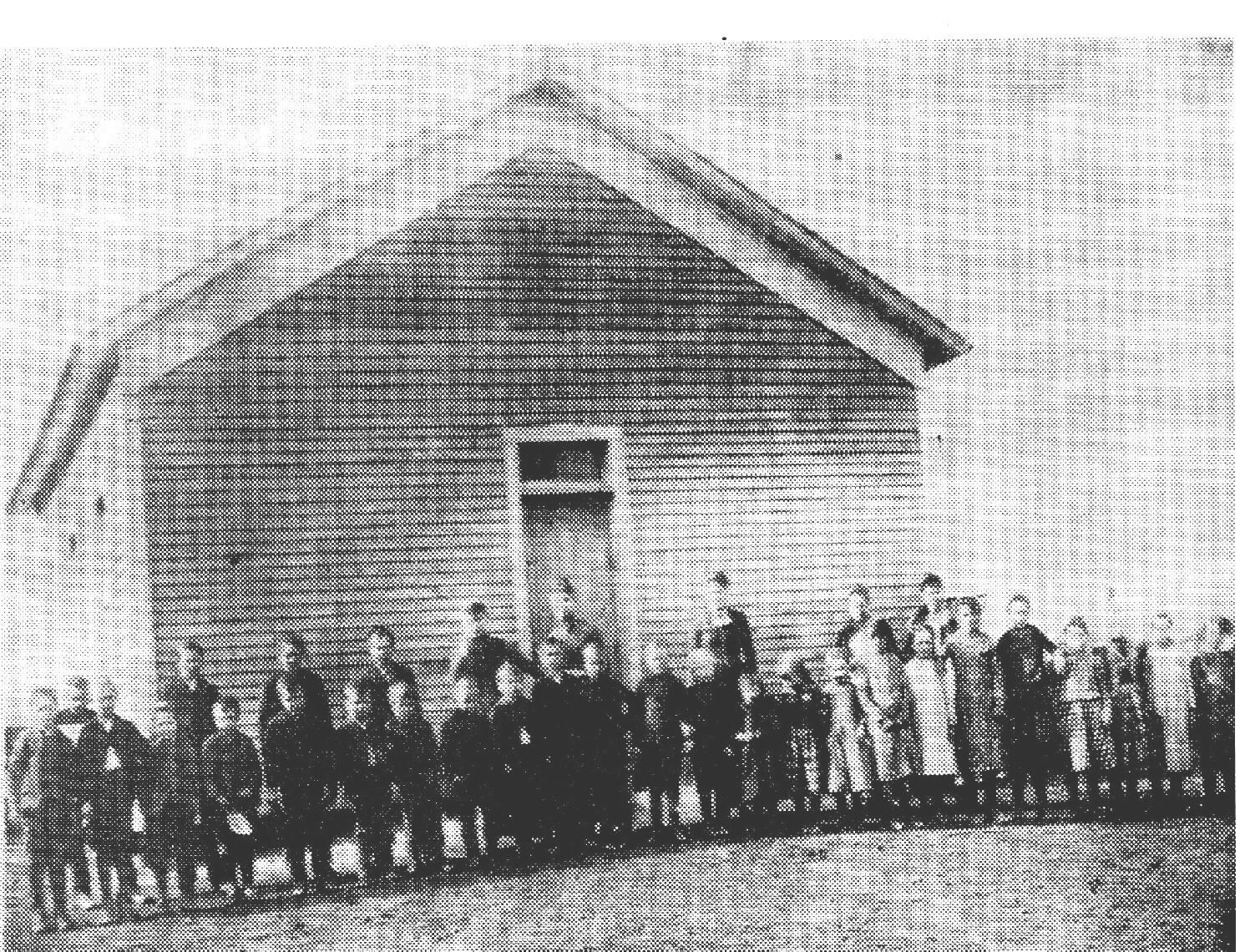 |
| JASONVILLE'S FIRST SCHOOLHOUSE AROUND 1900 Was located on the corner of south Meridian and Cooke Streets |
 |
 |
| HOME |