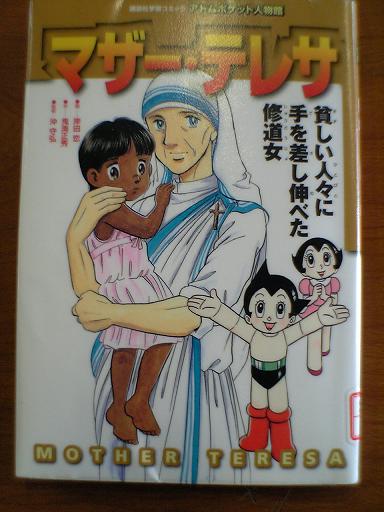
One of my students was reading this between classes: the story of how Mother Teresa met Astro-Boy.
During my recent, brief vacation at home I received questions...many questions about my life as a “teacher” at school. Folks at home have an incomplete, or hideously inaccurate, idea of what I do. So, I’ll take a minute to explain just how I spend my 9-to-5s. Those of you who’ve been passed through the Japanese education system already will find this to be pretty old material. But for the rest of you...:
My experience is a little different from the preconceptions most people have about teaching here. Perhaps because my experience is a little different from the one most people have teaching here.
First, I work in a junior high school. This is an actual school in the actual Japanese public education system. It is not a special private company, extra school for cram-studies, or language-specific school. You know the kind of junior high school you yourself went to when you were a kid? That's the environment I work in, with of course a few twists due to the local culture.
Second, I work in just one school. Day in, day out, for the length of a school year, I'm at the one location. This is great because, since I don't shuttle to several places the way many of my friends do, I get to spend lots of time with my kids. I get at least a feeble grasp on how each individual student learns; what material they can take in and at what speed they can handle it; and generally what kind of person they are. This is also bad because, although I live in Osaka, my school is in the next province and I spend 2.5 hours on the trains commuting every day.
I am the only foreigner at my school, and one of only four foreigners who work in that city (the others being people at my company assigned to nearby schools). Since the city is rural and small, we foreign teachers stand out a lot more than we do when strolling the streets of Osaka.
I teach every class alongside a Japanese teacher of English. As an assistant to the JTEs, I do not often take the leading role in class but rather support them with advice, entertainment, pronounciation and explanation of the cultural influcences that lead to the differences between our languages. The last part is hardest, as the JTE will often turn to me in mid-lesson and ask, "Suuchi sensei, why do you say 'such-and-such' in English?". "Such-and-such" is inevitably a curiosity for the Japanese, who do not use "such-and-such" and cannot easily grasp its meaning. The difficulty with this question, of course, is that I have not studied the concept of "such-and-such", nor made an in-depth sociolinguistic analysis of its use in English. Luckily I am a fast thinker and have some fading knowledge of Latin and Greek so I can usually suss out the origin of the word/phrase and explain its use.
While playing a supportive role I do occasionally act as an honest-to-god teacher, designing sections of the exams, handing out homework assignments, marking (ugh...drudgery, sprinkled with occasional hilarity when I see some students' mistakes; e.g. a student trying to ask "What was he doing when his brother came home?" had innocently written "When he came was he doing his brother?")
I love my kids.
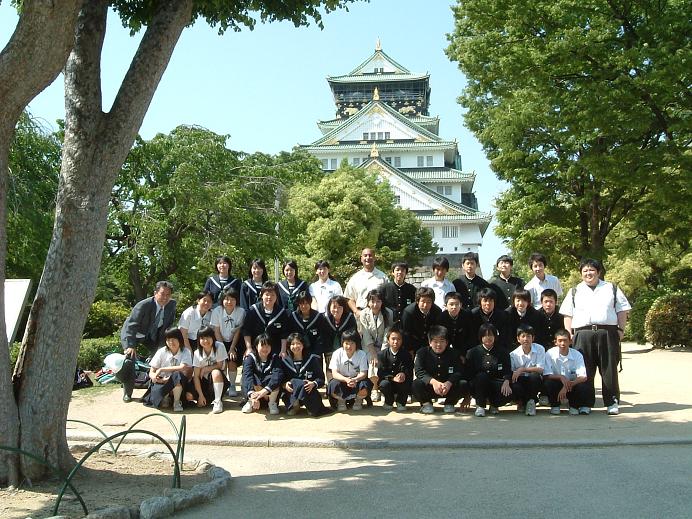
Our second-year students (equivalent of grade 8) made a day trip to Osaka. One of the best days on the job since I didn't have to commute. We toured the zoo (the same terrible zoo I'd shown you earlier) and of course the castle grounds. Here I am with my favourite second-year class (but don't tell the others I said that!)
One of my students was reading this between classes: the story of how Mother Teresa met Astro-Boy.
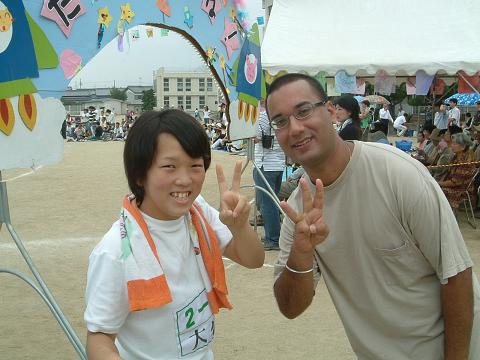
My kids volunteer at the local kindergarten about once a month and I go with them. We play with the youngsters, read to them, help them clean up, etc. One of my kids and I are enjoying the kindergarten's Sports Festival.
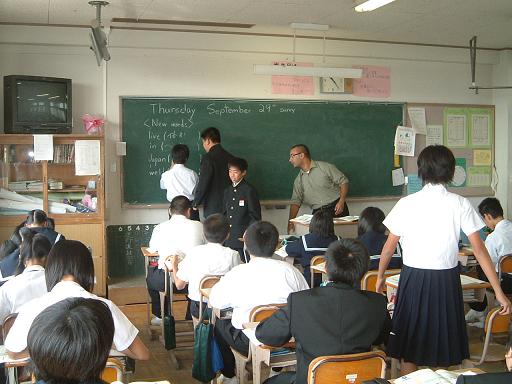
Me in action with one of my first-year (grade 7) classes.