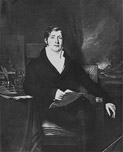
Founder of Singapore
1781-1826
Founder of Modern Singapore
Early Years
Born in 1781 on boarda merchant ship off Port Morant, Jamaica. Raffles was considered one of Britain's finest empire builders.
Little is know of his father,Captain Benjamin Raffles, and less of his mother, Ann. He was the second of the eight children.
After a brief period at Mansion House Boarding school in Hammersmith , he entered the employment
of the East India Company (EIC). He began as a temporary clerk at the East India Office, London, in 1795.He was just 14 years old. Even with his meagre salary, he was the breadwinner for his family for eight years.
The EIC, recognising his industry and exceptional ability, appointed him Assistant Secretary of the Presidency Government of Prince of Wales Island (Penang) at 1,500 pounds sterling a year.
Staring out in the East
Raffles was sent out to Penang in 1805. He had just married Olivia Fancourt, a widow 10 years his senior. In Penang , he was a licenser of the Press and Malay Translator to the government. He became scretary to the Governor in 1807 and in 1808 he was also made Clerk of the Recorder 's Court under sir Edmond Stanley . His workload and responsibities were so great that he had to recuperate twice in Malacca.There , While resting from overwork and malaria, he wrote a report to his superior in India, convincing them to retain Malacca rather handing the town over to the judge. This antagontism towards Dutch interests found a response in the paper war that ensued when raffles occupied Singapore.
It was only at the Treaty of London in 1824, that the Netherlands formerly recognised the British occupation of Singapore and agreed to exchange Malacca for british settlements in west Sumatra
.After a visit to Calcutta in 1810, Raffles was appointed Agent to the Governor General of the Malay States in the sameyear and resided in malacca. He was given the task of gathering intelligence on Java,in preparation for an invasion. He joined Lord Minto on an expediyion to Java in 1811.
Promotion and marriage
Java was taken from the Dutch and Raffles was apponited Lieutenant-Governor of the Island and its Dependencies in September 1811. In 1812, Raffles Launched a series of reforms-the most important being the land rent system. The British forces also defeated the Sultan of Yogjarkarta, opening the way more direct rule over Javanese principalities. In 1815,Java was returned to the Dutch after the Napoleonic Wars. Raffles was superseded as Lieutanent-Governor allegations of mismanagements, but he was cleared by his superiors. Raffles return to England in 1816. He started to write his History of Java. It was published in 1817, and in the same year, he was knighted by the regent,later to become george IV. He married Sophia Hull (Olivia had died in 1804) , a woman who was to show single-minded devotion to him, seen in the massive memoir she wrote of his life.
The founding of Singapore
Returning to the Far East,Raffles went to Sumatra as Lieutenant Governor of the Fort Marlborough (Bencoolen), arriving in March 1818. He held this appointment until his return to England in 1824. During this period, he set about enlarging British economic and political influence in the region. he established an EIC trading settlement in Singapore-the date of occuption being January 29, 1819. This was Britain's first free trade port in the Malay Archipelago.Raffles, on the behalfof the Governor-General of Bengal obtained permission to establish a factory in Singapore from Temenggong Daing Abdul Rahman and Sultan Hussian Mahmud Shah of Johore. By an agreement, dated 6 February 1819, Singapore was ceded to the East India Company.
Personal Tragedy
In his personal life, Raffles suffered a series of tragedies when he returned to Bencoolen - his eldest son Leopold died in 1821. Two other children died in 1822 and an infant daughter passed away in 1823. Only his Daughter, Ella Sophia, survived. During his early career. He died in his house, High Wood, near Hendon on Wednesday, 5 July, 1826.
Landmarks
In Singapore a number of landmarks have been named after him: Raffles College, Raffles Institution, Raffles Hotel, Stamford Road, Stamford House, Raffles City and Raffles Place. One of the largest flower in the world - the Rafflesia - was also named for him. Raffles was also a founder and first President of the London Zoological Society.