|
Discovering Your Direction in Life through Ignatian Discernment Methods” – Part II Focus: Why/How do I Discern? (An Introduction to Ignatian Meditation and
Contemplation Methods of Prayer and Discernment of Spirits), February 28th 2003 |
|
___________________________________________________________ How to Pray with Sacred Scriptures Method___________________________________________________________ 1.0 INTRODUCTION 1.1 Purpose of Prayer: We need to be clear that we pray because we
want to get in touch with God and encounter Him. Eventually, this
means that we want to develop a deeper relationship with Our Lord. The
setting aside of time and space for prayer is precisely for this purpose.
Accordingly, we need to have this purpose about prayer in mind and not simply
wish to go into prayer to want to “feel good” and to seek spiritual
consolations. Developing our relationship with God through
a meaningful prayer life is one of the most effective and stable ways of
keeping ourselves focused in life. Without a meaningful prayer life (i.e.
where our prayer gives meaning to our daily living) we can be easily
“distracted” by the attractions of the world or be diverted from God through
different forms of obstacles that we place in our lives especially those that
affect our emotions e.g. our hurts, pain and problems. Thus, it is essential that we stick to the time
we have decided. If we do not fix our time before we begin our prayer,
the common tendency will be to cut short our prayer when they are dry and
difficult, and to extend them when we are filled with consolations, good
insights and feelings. Such approaches to prayer are often not helpful
because our attitude in prayer would not be wholesome. To look forward to
prayer only when it gives us spiritual consolations is like having an
attitude of looking forward to meeting a friend only if he/she has something
to amuse us or if we can “benefit” from the encounter. We ought to be reminded that our commitment
to prayer is also our commitment to building our relationship with the Lord.
Without such a healthy and wholesome attitude to prayer we may even (without
knowing it) end up going into prayer with the motive of simply to hope that
God will be there to answer our doubts, wipe away our pains, solve our
problems and fill our hearts with his consolations. Such a narrow view about
prayer can turn God into “a problem solver” or an “emotions
consoler” and the like. And if such expectations are not met over some
time, many of us may find prayer a bore and even give up prayer. 1.2 Patience and Perseverance Essential There is a tendency in all of us to
want to feel good/consolation and be affirmed in prayer. Such desires are
understandable. They are normal human desires. On the contrary, we also have
a tendency of not wanting to experience emptiness, dryness and helplessness in our prayer. While such desires are to be expected, we
should go into prayer to encounter God in whatever manner
He wants us to experience Him. And this often means that we have to “stick
it out,” in our prayer with much patience even though they are dry and
difficult. Patience and our fidelity to God in our prayer are
essential. We need to pray regularly. Prayer should be part of our
daily routine regardless of how busy we may be. Very often a busy person do
not find prayer to be meaningful as they rush through prayer. The
tendency is want to “get over with it” so that he/she has done his/her spiritual
duty for the day. Ideally, we should look forward to our
prayer times. The time we have reserved for ourselves to be “alone with
God.” Just Him and me in the silence of my room or the special space I
have created for myself to “meet” God in my most personal and intimate way. I
know of some lay people who (like us priests and religious) have a “prayer
room” in their homes. In spite of such a “commitment” to our prayer life and
having such a conducive environment for prayer, our prayer life can still be
very “difficult”/ challenging. That is, our prayer experiences can still be
one that is quite dry and discouraging. We can try to pray daily or as
regularly as we can, but this does not mean that our prayer experiences will
not be dry and difficult as though nothing seems to be happening during our
prayer. Often the questions that follow are, “Am I
praying in the right way? Should I continue with my prayer?” We don’t desert
Our Lord when the going is tough. In fact, we can learn a lot about the
meaning and value of prayer through our struggles in our prayer life. Such
“struggles” can also be interpreted as positive and learning/maturing
experiences, allowed by God. 1.3 Place: choose a conducive place (i.e.
preferably one that is quiet and with minimal distractions.) Some people go
out to the garden to be with nature. Others prefer a solemn and quiet
environment. They draw the curtains, dim the lights in the room and light a
candle in front of a Crucifix or a favourite picture of Jesus or Mary. Still
there are many who choose to go to a chapel to be in front of the Blessed
Sacrament – to be in the physical presence of the Lord. 1.4 Period (Duration) of Prayer: It is important that we decide for
ourselves how long we wish to pray. This could be as long as 10 minutes,
20 minutes, 30 minutes or even an hour. For beginners, we could begin with 15
minutes and gradually increase the time. However, our prayer period should
not normally exceed one hour for each prayer session. If we are filled with spiritual consolations
(deeply moved) during the prayer and tempted to pray beyond the time we
have decided (before we started praying), then at the most pray 5 minutes
extra. On the contrary, if our prayer had been a struggle (i.e. deep
spiritual desolation or discouragement) and we are tempted to cut short our
prayer period, don’t. In fact, St Ignatius would suggest that we not only
stick to the time we decided to pray, but pray for an extra few minutes. Such
advice is to counter our tendency to develop an ulterior motive in
prayer. That is, we go into prayer to seek for spiritual consolation and not
really to encounter God in the way the Spirit chooses. ( Note 1 for details on “How much time should I devote to Prayer Daily?”) |
|
2.0 METHOD – PREPARATION 2.1 Passage: first choose a passage for your
prayer. The simplest way is to take the Gospel of the daily Masses that the
Church uses (universally) for each day of the year. The references of these
readings can be found in the “Ordo” of the Malaysia-Singapore Catholic
Directory. The simplest way is to get a “Weekday Missal” and follow the daily
readings. Alternatively, you may prefer to get a Bible and then daily look
for the passages of the Gospel. 2.2 Preview: Read the text that we have chosen reflectively (not hurriedly)
once or twice. Try to be familiar with its content. Even though we
are familiar with the text of the passage e.g. the Parable of the Sower
or the account of the Pharisee and Publican etc. it is good to read the text
again carefully and reflectively. We may have missed out some details in our
past readings. The present reading may draw our attention to some parts of
the text that may not have caught our attention before. Also, without such a
proper and serious preparation, we may fall into the tendency of making a “sloppy”
preparation for our prayer and thus be taking God for granted in
our prayer. This latter may also mean that we may be having a false
expectation that God has to come into our prayer (and give us the
spiritual consolation we are looking for) each time we go into it. Thus,
rushing into prayer, St Ignatius contends, can be one of the reasons that
cause spiritual desolations in prayer. 2.3 Posture: Sit in a comfortable upright
position (e.g. lotus position on the floor or upright on a chair. Some prefer
to kneel.) Our posture must also be reverent as we are coming before
God’s presence. Thus, we should try not to slouch or rest our chins on our
arms etc. Such positions are irreverent and improper that they can also hinder
our prayer. As such, do not take this lightly. It has more effects on our
prayers than we think. 2.4 Physical (Preparation for Prayer): To be able to pray well we need to be
relaxed. We can do this in different ways. Some people play some background music
to help them get into the mood of calming themselves. (Note that music is
to be used only if it helps us to pray better. It is not always
possible to have a cassette or CD player at our disposal each time we want to
pray. Thus, unless we find such music to be very helpful, it would seem to me
that it is more practical for us to learn how to pray without such music.) A short mental exercise here is a
more practical and effective alternative to help us focus and compose
ourselves before we enter into the prayer. This preparation will also help us
to be more sensitive to God’s presence who is within and around us. ( Note 2: “How to Prepare yourself physically and
mentally before you Pray.) |
|
3.0 PRAYER PROPER – Outline (*The “preparation” for the prayer above is
strictly speaking not prayer i.e. we have not yet
started praying.) 3.1 Graces (Begin the prayer by asking for the graces
– spiritual strength and divine favours/ help you need from God.): the
graces we need can be the graces of openness, humility, gratitude, insights
into our life etc. 3.2 a) Meditation Method: This prayer is done with our Bible opened
to the text. Read the text slowly and prayerfully, phrase by phrase.
As we do so, be conscious of God’s presence within us. He is waiting
to communicate with us. If any words or phrase or truth (e.g. God’s
love for me is unconditional) strike us and touch our hearts or catch
our attention, pause and remain still for as long as we feel it is
necessary. Relish and listen to its meaning and what it has to say to
you. Remain there until you think you should move on to the next phrase of the
text. Note that there is no need to move on in order to complete
meditating on all the verses that we intended to pray. (i.e. all the verses
that we read during the preparation of our prayer.) The purpose of the prayer
is not to gain as many insights as possible on the Scripture passage you are
praying on. The Scripture text is used as a medium/means for you to encounter
God. The primary aim of our prayer is to encounter God and to develop our
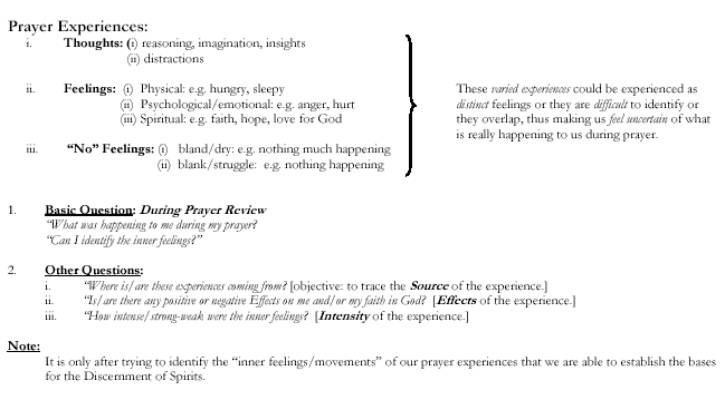
relationship with Him. We need to be attentive to ourselves, our inner feelings (movements,
emotions). Take note of what is happening to our thoughts and also to
what we are feeling at the same time. These thoughts and images or insights
are sometimes accompanied by inner feelings. During the prayer speak to the Lord if
you wish, but give the Spirit plenty of room through the silence/solitude of
your heart. 3.2 b) Contemplation Method: If the passage chosen is an event in the life
of Jesus e.g. Last Supper, Jesus walking on the water etc then this
contemplative method of prayer can be used. Of course, those us who are not
comfortable with such prayer method can also use the meditation prayer method
to pray on the life of Jesus. “Contemplative Prayer” very simply, for St
Ignatius of Loyola, is a special way of praying where we use of our
imagination and our feelings viz., our sense of sight, our
hearing, our smell, our taste and our touch. During such “Contemplative Prayer,” we reconstruct
and recreate graphically Gospel scenes of Our Lord’s life in our
imagination and participate in the scenes as though we are personally
present in the actual event itself. We could be there as an apostle, as
Jesus, as the crowd, as Pilate, as the thief crucified on the right of Jesus,
as an observer etc. We do not choose before hand which character we
wish to play before the prayer. Allow the Spirit to do the work for you. You
will just find yourself in one of the roles. Your roles may even switch during
the same prayer period. In a group retreat, one lady shared how she was
deeply moved in her contemplation on the Parable of the Prodigal Son where
she experienced herself in four roles: the role of the younger son, the
Father, the older son and also being herself (as an observer) during the one
contemplation. In “Contemplative Prayer,” we are fully and
consciously present with Jesus in a very real way. This means that
during the contemplation of being with Jesus, we would naturally want to talk
to Him, listen to Him, observe Him, or even consult and complain to Him about
any of our concerns, worries or about anything we wish. (cf. Note 3: For illustration on “Contemplative Prayer
method.”) 3.3 To Conclude the Prayer -- Thank God End with a spontaneous prayer or a
traditional prayer of the Church e.g. Our Father, Hail Mary etc. |
|
NOTES: _______ Note 1. Time for God in Prayer Daily: How long we pray depends on how serious and
important we want our prayer life to be. While the quality of our
prayer is important its quantity
is also important. What is
most important in prayer is fidelity. By this I am referring to our need to
prayer regularly and daily. We should be committed to developing a
regular prayer life regardless of how busy we are or how stressed and broken our lives
are can be. In fact, the more demanding and hectic our lives are the more
attention we should give to the quality of our prayer life. Many people wait for a crisis before
they begin to take their prayer life seriously and regularly. While such
constant begging for God to answer our needs are good and important, our
relationship with God should not be reduced to going to God only when we need
to beg for some favours/miracles. We should ideally seek God even in our
normal and happy times. Prayer for our spiritual lives (relationship with the Lord) is as important
as food and air for our bodies. Without them, sooner or later we die. If we
want to stay alive then we need to breathe in air and consume food. If we
want to live a meaningful and wholesome Christian life we need a good
prayer life. Without prayer we will eventually “starve” our relationship with
God to “death” – we will eventually lose our faith and direction in life. Some people think that as long as we do
good and live a life that the Church expects of us i.e. go to Mass on
Sunday, not harm any person, be a good parent and spouse, everything will be
fine with our relationship with God. While such Christian living is good in
itself, we may fall into the tendency of being a “minimalist” Christian.
That is, we do the “minimum” that is necessary of us as Christian . . .
nothing more and nothing less, and get on with the secular needs of our
lives. If we are only beginning to learn
how to pray and have not yet found the meaning, the rhythm and routine for
prayer in our daily life, then quantity in many ways can “make up” for
the quality of our prayer. Some people say, “As long as I pray meaningfully
one ‘Our Father’ and one ‘Hail Mary,’ every night, such prayer is better than
50 ‘Hail Marys’ of the Rosary. Such argument takes the logic of “quality”
over “quantity.” A moment of reflection on our lives would
tell us that if we want to deepen our relationship with someone,
quantity time spent with the person too is necessary. We cannot hope to have
a deep relationship with our children if we only see them and communicate
with them once a month, and for the rest of the month we have no contact with
them. Likewise, if we want to deepen our relationship with God, we need to
spend “enough time” with Him in prayer, and also outside prayer. God
must have a central role in our lives and He must play a significant
part in our daily living. Prayer can be seen as setting aside
“special time and space” in our lives to be with God. In this special encounter
with God, we often find ourselves tired (at the end of the day) from
the day’s work or activity (which often cannot be helped because of our
career, or vocation as priest/religious. Many of us fall asleep. On one hand
God understands our effort and desires to pray. That is, we are just too
tired. On the other hand, if this becomes habitual then we cannot say
that we are taking our prayer life seriously. Having said this, I still admit that to
maintain a regular prayer life daily is by no means easy. Strong discipline
and graces from God are necessary. One ‘Our Father’ and one ‘Hail Mary,’
every night is not satisfactory. We need to spend some quality time if
not telling God what happened during the day, at least try listening to Him. But, if we struggle and try our very
best every evening to pray as “meaningfully and as much as we are able
to, say 20 minutes,” then at least our relationship with our Lord is not
abandoned. If in the meantime, we are still not able to give Him quality
prayer, not to worry. This quality prayer will come in due time, if we
persist long enough. That is, if we are serious enough we will gradually find
ways to give Him quality prayer and time. But, first we must be determined
to give God, sufficient time. Better still, sufficient quality time i.e. when we are not too worn out. Ideally,
we should pray when you are most fresh and alert. Then we will be giving God
our best. Shouldn’t we give God the best and not left over time? From the above, I am not saying that we
cannot find God “outside” our formal prayer time. In the above comments, I am
referring to formal prayer set aside for God. So, we need to ask
ourselves the basic question, “How much time we wish to spend in formal
prayer with God?” Be
realistic, but most
important of all try to stick to what you have set for yourself. The secret
of gaining much from our prayer life is to have a “Regular Prayer” life. A prayer life that is “off and on” will not
“take root.” |
|
Note 2.
Preparation for Prayer: Physically Relax and compose yourself in
order to be more receptive to the Spirit.
|
|
Note 3. Contemplation: The Miracle of the Loaves
and Fishes – Jn 6,1-14 ___________________________________________________________ Imagine yourself walking with a crowd of
people in the countryside near a hillside. As you walk, feel the soft grass
beneath your feet . . . smell the fresh air of the countryside . . . feel the
cool afternoon wind on your face. As you walk, hear the people around you,
talking about this Jesus who is a great Teacher and Preacher. What do you
feel within you as you walk with these people towards Jesus? You now arrive at a close distance from
where Jesus is sitting. He begins to preach about the truth of God, “What do
you feel within you? Are you touched or disturbed or guilty about what you
hear? When Jesus finished preaching, it was
getting dark and cold. You feel hungry . . . and wished you were at home for
dinner. Just then, you see a young boy bringing his two fish and five barley
loaves to Jesus. Jesus’ disciples then asked everyone to sit on the ground. Jesus then took the fish and loaves and
blessed them. You see how Jesus prays over the fish and bread. He then passes
what He has blessed to His disciples to distribute to everyone. To your great surprise, the baskets are now
all full of fish and bread. Jesus has just performed a miracle to feed
everyone. To your surprise Jesus too got up and began
distributing the fish and bread. You see Jesus come to you and offer you the
fish and bread. You are simply dumbfounded by the care and compassion He has
for you and for everyone. He knew we were hungry and He could not abandon us
to fend for ourselves. As you ponder
on this event, . . . notice what you are feeling within you. You are
beginning to realise more and more how Our Lord has so often cared for your
needs . . . how He never failed you when you were down and needed Him most .
. .how when others seem to have turned away from you, including your own
family at times, He has constantly been there for
you. . . in fact it is His strength that you have survived the difficulties
and pain and challenges of your life. Concluding Prayer: Lord, I thank you so for accepting me as I
am . . . in spite of my imperfections and for having let you down so many
times, You have never once abandoned me . . .somehow I have always been
special to You . . . Your care and love for me is so patient, so unconditional . . . You never once judged
me harshly . . . instead Your love and compassion is always tender and
consoling. Lord, as You have blessed me so abundantly,
I now ask You to help me share all Your blessings with others. Help me to be
compassionate as You have been compassionate to me. Help me to love and
forgive the faults of others as You have always loved and forgiven me. Help
me to be more like You and today and all the days of my life. Alternatively, your concluding prayer could
be: Pray the “Our Father”, “Hail Mary,” “Glory
be.” Prepared by: Fr Philip Heng,S.J. Copyright
Reserved. |
|
|
|
|
|
|