Home
About the System
The90S2313 proves to be an inexpensive platfrom for microcontroller
development for the hobbyist, A serial programmer can be built for a few
dollars and the chips themselves can be had for a similar price
I was able to purchase the AT90S2313-10PI chip at an electroonic parts
outlet for NZ$4.15 (approx equiv US$2.90) each while the "electronics
toystore" lists the softer -10PC in their catalog for NZ$15.75
In implementing this simple polyphonic
engine I have become aware of the limitations of this device.
most notably the lack of a hardware multiply means that I had
to forego implementing direct control of the ampplitude. and the
lack of memory which left me without room for more than table with
a simple sine wave.
Note however that all waveforms can be decomposed into sine waves
by fourier analysis, and amplitude can be controlled by playing the same
frequency in two channels but with differing phases. I have not tried to
implement these features.
This code was originally developed to provide music for the doorbell
function of a driveway gate controller and as most of the 2K
rom was needed to provide all the feature I wanted for that I
used only a 64 byte table (containing 1/4 of the sine wave)
According to Nyquist's
theorem the reliably reproduced frequency is just below 1/2
of the sample rate so with the MPU runninbg at the maximum 10MHz
and the 8-bit PWM output in it's fastest (8-bit) mode that means a
rate of 1e7 / 510 = 19608KHz or so the maximum frequency is approx 9KHz
So basically you get "AM radio quality" sound.
At 510 cycles per sample the MPU can synthesise 15 fixed amplitude sine
wave channels (using my code) If fewer channels are needed and
there are spare IO pins the code cpould be modified to use an an
R-2R network (or other hardware DAC) could be used to
give a greater bandwidth, or greater resolution, or a combination
of both.
|
Initial development was done using a STK200 board that had been modified
with a pin header socket for the crystal to allow the regular 4Mhz crystal
to be replaced with a 10Mhz device. Were I to modify another STK
board I'd use half of a 6 pin DIP socket with the middle pin removed. off-the
shelf crystals will just plug straight in. with the pin header sopcket off-the
shelf crystals are a little loose and work best if soldered to a piece of
pin header strip.
|
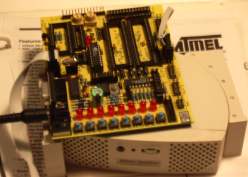
obligatory harware pic
|
The source code was developed using the free
avra assembler ,
and may contain some constructs not supported by the atmel avr assembler
To the source back to home download source code
(zip archive)