Solar System
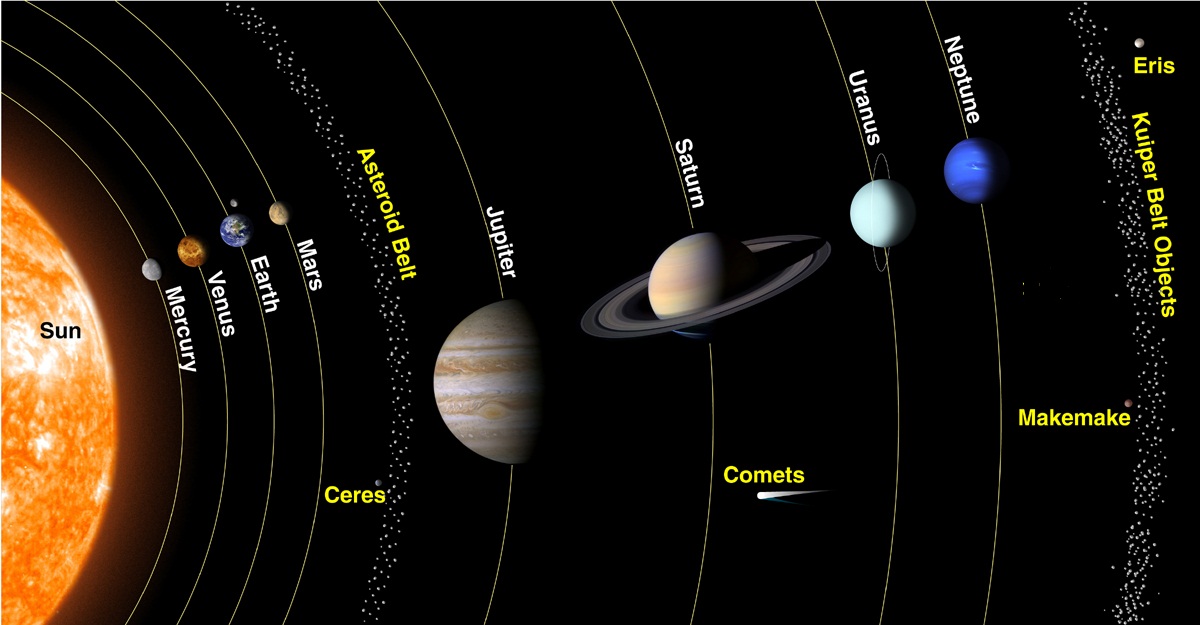
Our solar neighborhood is an exciting place. The Solar System is full of planets, moons, asteroids, comets, minor planets, and many other exciting objects. Learn about Io, the explosive moon that orbits the planet Jupiter, or explore the gigantic canyons and deserts on Mars.
The Solar System is made up of all the planets that orbit our Sun. In addition to planets, the Solar System also consists of moons, comets, asteroids, minor planets, and dust and gas.
Everything in the Solar System orbits or revolves around the Sun. The Sun contains around 98% of all the material in the Solar System. The larger an object is, the more gravity it has. Because the Sun is so large, its powerful gravity attracts all the other objects in the Solar System towards it. At the same time, these objects, which are moving very rapidly, try to fly away from the Sun, outward into the emptiness of outer space. The result of the planets trying to fly away, at the same time that the Sun is trying to pull them inward is that they become trapped half-way in between. Balanced between flying towards the Sun, and escaping into space, they spend eternity orbiting around their parent star.
Planets in The Solar System |
|
|---|---|
|
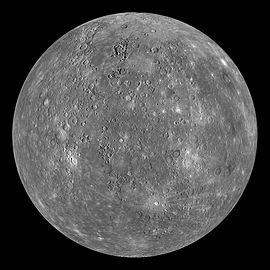
~Mercury~ The planet Mercury is the closest of the planets to the Sun. Because this planet lies so close to the Sun, and as a result somewhat near to Earth, it is visible to observers on Earth in the late evening or early morning sky. Because of this, Mercury has become a part of the mythology and legend of almost every culture throughout the history of the Earth. This planet is often called a morning star. This is because Mercury shines brightly in the early morning just before the sun rises. It has also been called an evening star for the same reason. Mercury is often visible for a brief period of time just after the Sun sets. |
 |
|
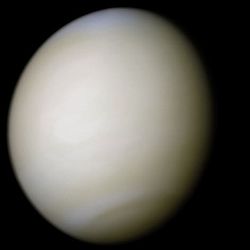
~Venus~ The planet Venus has long been one of the most misunderstood of all the inner planets. Like the Earth, Venus has an atmosphere. However, Venus' atmosphere is far thicker than that of the Earth, making it difficult for modern science to penetrate. Interestingly, scientists have recently been able to peek through the thick clouds and get a few glimpses of the surface. There are numerous volcanoes and many mountains that appear misshapen. There is much we still do not know about how this planet looks and what it is like. However, using special instruments and probes scientists have in recent years unlocked many of the secrets long hidden by this mysterious world. In the 1970s, the Soviet Union actually was able to land more than one probe on the surface of Venus. These scientific probes only lasted a few hours before they were destroyed by the intense heat of the planet. These probes were able to take several pictures and send them back to earth for scientists to study. |
 |
|
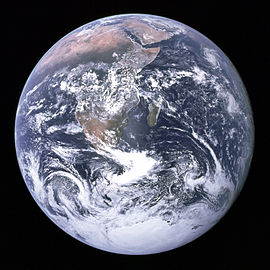
~Earth~ The Earth is the biggest of all the terrestrial planets. A terrestrial planet is a dense planet found in the inner Solar System. The diameter of Earth is 7,926 miles. The circumference measured around the equator is 24,901 miles. There are currently almost 7 billion people living on the Earth. About 30% of the Earth's surface is covered with land, while about 70% is covered by oceans. Our planet is an oasis of life in an otherwise desolate universe. The Earth's temperature, weather, atmosphere and many other factors are just right to keep us alive. |
 |
|
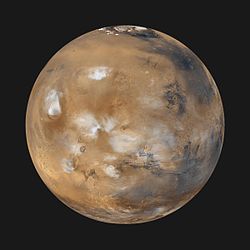
~Mars~ Mars excites scientists because its mild temperament is more like the Earth's than any of the other planets. Evidence suggests that Mars once had rivers, streams, lakes, and even an ocean. As Mars' atmosphere slowly depleted into outer space, the surface water began to permanently evaporate. Today the only water on Mars in either frozen in the polar caps or underground. You may sometimes hear Mars referred to as the "Red Planet." This is because the surface of Mars is red. If you stood on the surface of Mars, you would see red dirt and rocks everywhere. |
 |
|
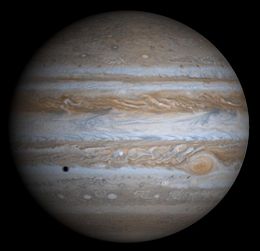
~Jupiter~ Jupiter is by far the largest planet in our Solar System. The Earth could fit inside Jupiter more than 1000 times. Jupiter is a very stormy planet. There are storms found throughout the atmosphere, and most of the storms seem to never end. The many different cloud formations and storms in the atmosphere also make Jupiter a very colorful planet. |
 |
|
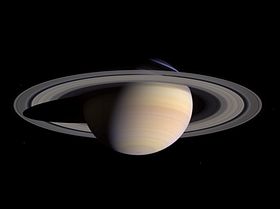
~Saturn~ Saturn is the least dense planet in our Solar System. It is made up of mostly hydrogen and helium, which are the two lightest elements in the universe and thus make Saturn the lightest planet that we know of. This is why you wouldn't weigh as much on Saturn as you think you would because of its size. And because Saturn is so light, it does not have as much gravity. Interestingly, it is believed Saturn would actually be able to float in water because the hydrogen and helium that make up the planet are so lightweight. Because Saturn is such a lightweight planet and it spins so fast, Saturn is not perfectly round like most of the other planets. Like Jupiter, Saturn is wider in the middle and more narrow near its top and bottom. |
 |
|
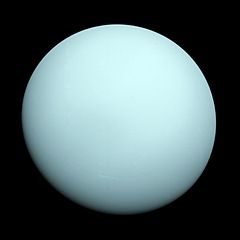
~Uranus~ Like Jupiter and Saturn, Uranus is a gas giant. But Uranus is a little different. Unlike all the other planets and most of the moons in our Solar System, Uranus spins on its side. It is believed that long ago a very large object smashed into this planet. The crash was so powerful that it completely changed the direction of Uranus' planetary rotation. However, a more recent theory is that the extreme tilt of Uranus' axis may have been caused by a large moon that was slowly pulled away from the planet by another large planet long ago when our Solar System was still new. It is thought that the gravitational pull of this moon moving away from Uranus may have caused it to tilt on its side. |
 |
|
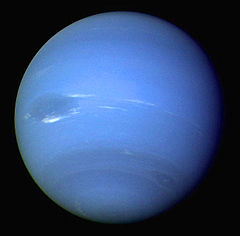
~Neptune~ For many, centuries people did not know that this planet even existed. It was discovered by Johann Galle and Heinrich D'Arrest in 1846. Neptune is the smallest of the four gas giants in our Solar System. Much like Saturn and Uranus, Neptune's atmosphere contains hydrogen, helium and methane. In Neptune's atmosphere, there is a large white cloud that moves around rather quickly. The "scooting" of this cloud around the atmosphere has led it to be named "Scooter." |
 |