
(S. arboricola)
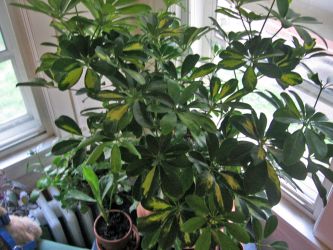
Light: Scheffleras prefer medium to bright light.
Fertilizing: Fertilize scheffleras regularly either with a water-soluble or a time-release houseplant fertilizer. Feed according to label directions. Plants growing in reduced light will need less frequent fertilization than plants growing in bright light.
Blooming: Doesn�t.
Dormancy: Repot overcrowded plants at any season and to keep plants small, prune just above a leaf. There is no need to worry about a dormancy period.
Propagation: Propagation is by seed, cuttings and air layering. I actually failed at the air layering, although it was my first attempt ever, but managed to get two new babies from cuttings over the winter.
Toxicity: Not to mildly toxic. I have seen this plant listed as both, however, I have never know of a cat or dog or other pet interested in using this as a chew toy. Even the dwarf varieties are quite large and at least softwood to semi-hardwood so they don�t try to eat it. However, stranger things have happened, so use your own discretion, you know your animals and kids and their behaviors.
Problems: In the home, plant diseases are very rarely a problem. Too much or too little water plus insects and mites are the main problems. Mealybugs, scale insects and mites are common pests of scheffleras. Root rot usually results from a soil mix that does not drain quickly or overly frequent watering. Dead areas form on leaves several days after exposure to excessive cold. Maintain temperatures above 50 � F. Do not place plants near air conditioning vents. Low light can cause leaf yellowing with spindly, weak stems. Leaf drop can be caused by excessive watering, by low humidity, or by chilling.
Back to my plants.