 |
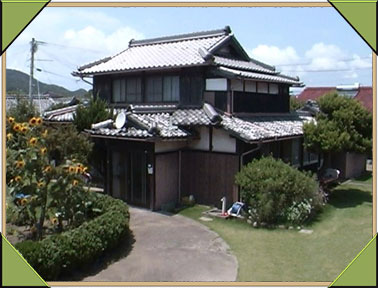
I am lucky. I mean really, really lucky to be able to live in a house like this. The reason isn't so
much that my home is modern. In fact, as Japanese homes go, this property at fifty years of age is getting distinctly
long in the tooth. The reason that I am lucky is that compared to many dwellings in the city, it is quite spacious
and has a HUGE garden. For many people in Japan, a garden is a very, very expensive luxury.
The bad news is
that I am only a tenant here and while the rent in rural areas is reasonable enough, I could never afford to buy it .
|
A traditional house like this was, and still is built almost entirely of wood. Wood and ......mud. That's right, mud.
It surprises many foreign visitors that mud remains an important building material in Japan.
It is used as an insulating layer inside the exterior walls.
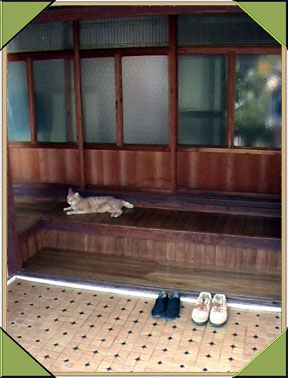
The first thing you will see when you pass through my front door is the porch, known as the 'genkan'.
Wearing outdoor shoes inside a Japanese house is a big no-no so family, friends and even the most exalted
guests all leave their shoes here.The rule doesn't seem to apply to cats.
|  |
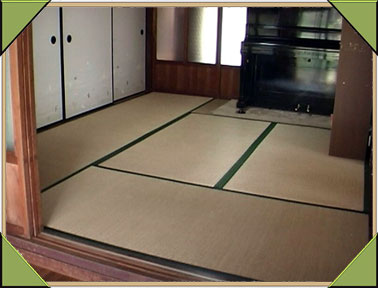 |
Once inside a traditional Japanese house, two things become immediately apparent. One thing is the
lack of interior walls (more of which later) and the other is the flooring. As with many houses, all of the floors
in my home are covered in 'tatami' mats. Tatami mats are made from rushes and come in several standard sizes.
Very approximately, they measure about 6 feet by three and have a thickness of about two inches. They are quite firm,
warm in winter and cool in summer.
|
| Unlike most western homes, the rooms in Japanese homes are generally
considered to be multi purpose and as a result, there is usually far less fixed furniture. On the first floor you are
unlikely to see a sofa or a dining table in a tatami room while upstairs the most notable absence is beds.
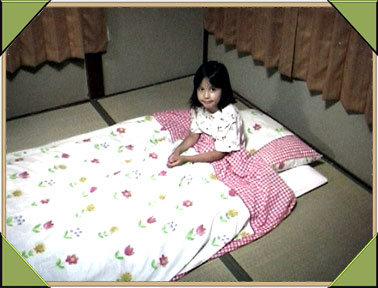
That means sleeping on the floor, which really isn't as bad as you may think and actually very good for the back.
The quilts are stashed away in cupboards during the day and laid out at bedtime.
|  |
 |
Ah yes, no interior walls. Instead of walls, all the rooms are separated by sliding doors. But why no walls?
One reason is the Japanese climate. During the very hot and humid summers, doors throughout the house are opened wide
to let the air in.....and out. Another advantage of sliding doors is that they can be removed completely, thus creating
a larger room. Handy if you are throwing a party.
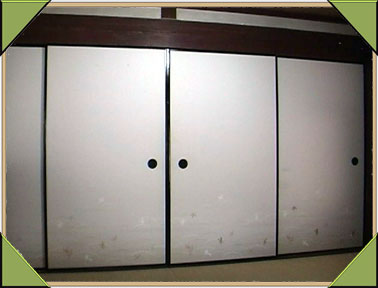
There are two basic types of sliding door. The doors on the left are called 'fusuma' and are made from lacquered wood and thick paper which usually sports some traditional design.
|
|
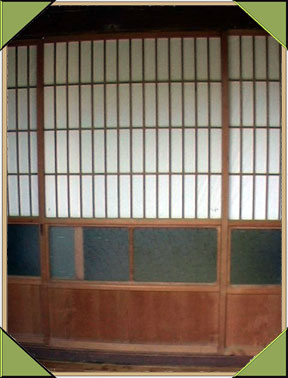
The other type of sliding door is called a 'shouji' and is designed to allow light into the room rather than to be aesthetically pleasing. It is constructed of wood, glass and paper in different measures. The glass and wooden panels in the lower half of the door are
often foregone in favour of paper from top to bottom.
|  |
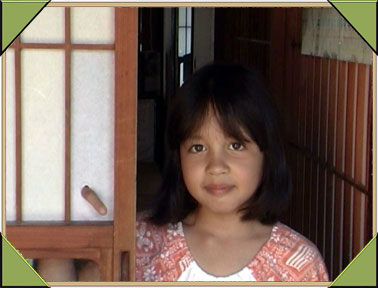 |
See, I told you the doors were made of paper. Just to prove it to you, my daughter has thoughtfully poked her finger through. Just wait till your mother gets home.
|