If you intend visiting Japan, you might be worried by the fact that everything is written in that funny squiggly stuff . Actually, that funny squiggly stuff has a name. It is called "Kanji".
Unfortunately, there's no getting around the fact that reading Kanji is darned difficult.
You could buy a dictionary, but learning to use the dictionary is almost as hard as learning the kanji themselves.
However, fear not! It's completely possible to not only visit Japan, but even to live here with only the most rudimentary knowledge of written Japanese.
The best news is that even in smaller towns all road signs and place names are bi-lingual. Both Japanese and English.
(It's a bit of a bind if you are into Arabic or Hebrew but you can't have everything). English language maps are available at bookstores in all larger cities and all of the popular tourist attractions offer guides written in English. You really don't have any excuse for getting lost!
If you are worried about reading the restaurant menus, a great many establishments - particularly the 'diner' type
family restaurants have menus containing photos of everything.
As for getting around, if you find yourself in a city with a subway system you can't go wrong. Apart from the fact that again, everything is bilingual and fairly easy to understand, Japanese subways are both clean and safe. The chances of being mugged, raped, murdered, molested,
abused and stepping in something rather unpleasant are very slim. At least, not all in the same day.
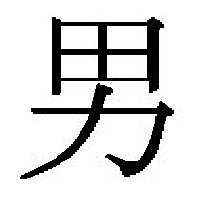
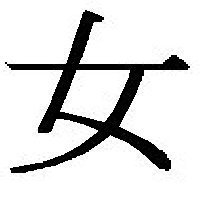
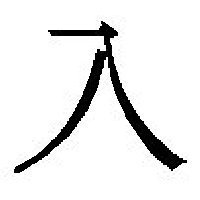
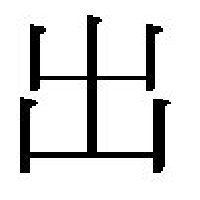
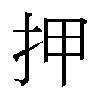
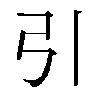
Having consulted with my fellow kanji illiterates, the consensus is that the following kanji may be useful to you. At least, they may prevent you from making a complete idiot of yourself. As the old saying goes,"Push will get you anywhere, except through a door marked pull"
Gentlemen
Ladies
Entrance
Exit
Push
Pull
~ And here endeth the lesson. ~
And if you are interested.....
Until about 1500 years ago the Japanese possessed no written language. This was most inconvenient , especially if you wanted to keep a diary. As a consequence, they popped over to the Asian mainland and "borrowed" the Chinese system. (They still haven't given it back!).
As the educated among you will already appreciate, the Chinese developed a pictographic form of writing.
Rather than each letter having a phonetic sound as in English, each written character,or "kanji",is a
pictographic representation of something or other. A bit like hieroglyphics. Well, sort of.....
No-one seems to know exactly how many kanji there are. I have read that there may have been as many as 80,000
which were known to scholars in bygone days, which is a heck of a lot. The good news is that in this
day and age about 2000 kanji will be sufficient for you to read the newspaper. Personally, I just look at the pictures. However, before you start to celebrate, you'll need to invest all your free time for the next ten years or so in order to learn all of them.
Oh, and by the way, after pinching the Chinese writing, the Japanese invented their own set of phonetic letters ( called hiragana)and mixed the two together. Just for good measure, they invented yet another set of phonetic letters (called katakana) and mixed them in too. Complicated? You don't know the half of it.
By the way......
As you know by now, all these kanji are little pictures that represent a word.
So how come they don't really look like very much at all? It's all darned inconvenient.
After all, the Egyptian hieroglyphic for a fish really does look like a fish.
Well, the answer is that they do. Or at least, a long time ago they did. It's just that with the passage of time
things got changed a bit. I guess it's called progress.
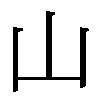
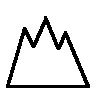
It doesn't take a rocket scientist to figure out that:-
the kanji for "yama" (mountain):
was derived from the ancientsymbol:
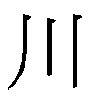
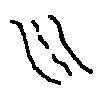
and the kanji for "kawa"(river):
was derived from the ancient symbol:
Put like that, it's simple, isn't it? The problems start when you want to express an abstract idea.For instance,
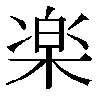
the kanji for "tanoshii" happy) :
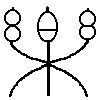
was derived from the symbol :
Clear as mud, isn't it? Well, the first time I saw it I thought it looked a bit like a guy dancing. Dancing guy.....happy guy? Turns out that the symbol actually represents three musical instruments on a table. The story goes that a couple of millennia ago, the only time that the peasants had any fun was when a band of performing artists wandered into town. Hence the instruments on a table (bet you knew that really).
And there's more....
Though each kanji has it's own meaning, two of them are often lumped together to give a third. For example,
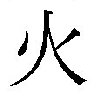
1) If the kanji for "hi" (fire) is :
and the kanji for "yama" (mountain) is :
what do you think
means?
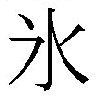
2) If the kanji for "kouri" (ice) is :
and again we have our old buddy "yama" :
what do you think
represents?
Hands up everyone who said volcanoes and icebergs. You've taken your first steps in the world of kanji. Anyone who said bonfires and ice cubes should go straight to jail. Do not pass go and do not collect 200 pounds.
And finally (as if you hadn't had enough)....
As mentioned previously, Kanji originated in China and although the Japanese and Chinese still - to a great extent - use the same characters, they don't always have the same meaning.
In either language,
means "hand"
and this kanji
means "paper"
If I lump them together like this,
Well....... what do you think? .
The answer depends very much if you are Chinese or Japanese. Give it some thought!
If you want to know the answer just click "Japanese" or "Chinese" below.