

THE PAINTER



 |
A story from Minas Gerais to Everybody: |
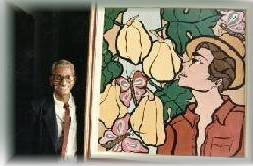
Januario's lifetime is a kind of a poem over canvas with verses wandering from soft hues to the utmost colors. He was born in a small village located in Minas Gerais, Dores de Guanhaes. There the green multiplied itself and the sky was so blue. As a boy, he worked so hard in a farm, he enjoyed exploring the soil. It would inspirate him a lot in the future. A lonely boy in close relationship with Mother Nature. Few words, no father, no mother, just a grandfather to bring him up. But... the serenity of green wouldn't last forever and the day for leaving the small village was coming. He decided to be great, to study, to go to a big city and make his life. Farwell to Grandpapa, farwell to Mother Nature, farwell to Priest Domingos, who taught him many things by the time when he served as an assistant in the old church. There he found his faith out. And this faith would inspire him too.
Then Januario left your birthplace. He was on the way to Rio de Janeiro, the big city, placed into a truck crossing the long road. Sixteen years old and lots of dreams. He was going to see the Sea. He longed for it. And finally he met the Sea. The ocean was a kind of delight into his new hard life. Life was such a hard game to play in a big city. He chose to work in the Air Force. And what had the Air Force to do with Fine Arts? Nothing. But he had to support himself. There, in the Air Force, which had nothing to do with Fine Arts, he found the start point of his career. A distinguished colonel, who would be a Minister some years later, discovered Januario. His name was Delio Jardim de Mattos. Mr. Delio and his family took the young boy as a son. With the help of this gentle family, Januario could have your work improved. They admired his talent and were fond of him. And so the young painter could go to Paris, in order to improve his work and to learn more and more. In Europe he kept in contact with some great artists, including the brazilian painters: Di Cavalcanti and Antonio Bandeira, who much praised his works.
Back to Brasil, in 60's, Januario took all his efforts to make brazilian people more acquainted to his paintings. And he got it, in a certain way. He made his name, always improving his studies, always searching for a new result, always trying to set or participate of exhibitions. Januario is an on-going art laboratory. He made many friends in the right places and in the right times and each single friend played an important role in Januario's life and art. Sometimes life was very crude to him, and as an artist, he felt these passages more deeply.
These marvelous paintings came as a consequence of every feeling, bad or good, every hope and every pain he experienced and, above all, as a consequence of his faith in man and in God. Years passed by and the colors remain vivid on Januario's paintings. It is the brazilian way for existing and painting.
By Marcia Cardoso

|
Style - A brazilian way to paint: |
Januario's style could hardly be explained by these multiple "ism's" labeling usually historical and critical comments. It woul not be correct to call him a "naïf", although many people do it. It would be incomplete and unsuitable. We may say that he is a policromatic, a strong featured painter, impregnated by the hot live colored tropical images. But it is so hard to get a specific category for him. Better not to do it and just feel the strenght of his expression.
It is easier to look to Januario's works with the soul's eyes. His paintings wander among diferent phases, they are not only ornamental composings for walls. All his themes and phases hold elements coming from sensuality, breeds mixing, brazilian fauna and flora; all of them represented in contundent traces. Folk, soil and colors. We use to find often coffee and cocoa trees at the background of his works. There are also the stylized birds that express well the pictory scenary from brazilian tropic. In some paintigs we will find the most varied and stylezed saints. This phase was influenced by Minas Gerais, a very religious city, famous by a great and well know saints sculptor named "Aleijadinho", and by his faith. The Januario's religious characters is a kind of trademark, as well as the expressive painted eyes are. It's not only a matter of beauty, it's a matter of expression in full force. The eyes from his character makes an interesting contrast: "joyfull vivid colors x pathetic eyes". It is a curious contrast, sad deep melancholic eyes combined with a color festival.
In such manner, this work really seems to escape from any classification. It is just a blessed manifest of life. Improvisation is a common trace. Januario uses to say that he is possessed by some entity at the painting time. When he takes the paintbrush he never knows what is going to happen. Possessed or not , the end result is a nice bliss and a explosion of talent. A very brazilian talent, who signs Januario, whose identity papers inform "Sebastiao Januario" and to whom I call Sebastiao Januario Brazil.
By Marcia Cardoso

|
Titles:Disciple of Master Oswaldo Teixeira, at the earlier Fine Arts Institute - IBA , Master Eduardo Sued and Master Ivan Serpa at the Modern Art Museum of Rio de Janeiro.
|