Ed. D. candidate in Education, School of
Languages and International Education, University of
Canberra, Australian Capital Territory
Prepared for DPU Conference on ELT Trends, Dhurakijpundit University, Bangkok, Thailand, May 2002
Acknowledgments
I would like to express my gratitude to the following people for making this article possible:
Marie Brennan
Andrew Lina
Ania Lian
Debbie Dolan.
I also wish to thank my sponsor Dhurakijpundit University for supporting this presentation.
************************************************************
Why
reverse genealogy?
According
to Krishnamurti, it is extremely difficult, if not impossible, for us to be free
from our past and to be able to see our present as it really is, for, as the
observers, we are unable to completely distance ourselves from our experience.
In an effort to better understand the present ELT constitution, this paper has
applied the concept of reverse genealogy as suggested by Brennan (2002) who has
used this methodology when she talked about school reform. This essentially
offers another view of looking at ELT today through what we expect to see
ourselves in the future. It examines what is represented as the future of ELT
from policy documents, research papers, textbooks, magazines and newspapers, as
a means of constructing the desired ELT at the present moment.
Future studies often share many assumptions of
logical positivism i.e. that we can manage the future in tune with modern
sciences. Facts and values are separated. The future in this view is something
that has been made into existence.
There are many types of future studies, ranging
from the less scientific ones to the more mystical ones:
- Palmistry
- Numerology
- Trends monitoring
- Think Tanks
- Forecasting
- Intention Monitoring, e.g. election polls
- Delphi Techniques for making decisions
- Scenarios Building
- Psychic reading, wild guessing, and etc.
Rather
than going back to the past and dig up the history in order to understand the
present, this paper invites its audience to take a look at the things we expect
to see in the future. It is a means to help us see our own constitution of the
present. Instead of relying on just one end, we can look at both ends. It is
therefore a way of enhancing our perception by taken into account a greater body
of information.
Let’s start by briefly looking at a
few examples of organizations whose main interest is to shape the future. There
are some in Thailand, for instance, The Institute of Future Studies for
Development. It is a good example of a research organization aiming “ to
stimulate a long-term vision for the holistic development of Thai society,
especially in the field of Human Resource Development.”
One of its beliefs is that, because it is future-oriented, it is good for
solving problems at a national level. It actually has announced that:
“ If we can anticipate what the
results of our actions will be, problems can be prevented and then we won't have
to vex ourselves trying to solve problems after they have occurred. We therefore
try to understand the past and analyze the present in order to plan for the
future.”
Source: http://www.ifd.or.th/futurestudiessiteEP/aboutusEP.htm
[5/19/2002]
Of
course, another obvious example is Thailand’s
National Economic and Social Development Board. It primarily aims to formulate
socio-economical plans for the development of Thailand. Recently, it has
announced the
Ninth National Economic and Social Development Plan (2002-2006). The plan,
seriously, intends to safeguard Thailand from the threats of rapid
globalization.
And
one of its methodologies is a brainstorming process based on the past:
“
In the brainstorming process to develop this desirable vision for Thai society,
participants took into consideration past development performance, the
management of rapid change resulting from globalization, as well as the need to
strengthen desirable values.”
Source:
http://www.nesdb.go.th/Interesting_menu/progress_plan9/index.html
5/19/2002
Malaysia
has come up with the 8 Malaysia Plan (8MP) representing the first five years of
the ten-year plan --- the Third Outline Perspective Plan (OPP3) that covers 2001
to 2010.
And
many other countries, states, or territories have their own future plan.
Source:
http://www.jaring.my/ksm/spm198.htm
5/19/2002
It
is quite obvious to note here that the most common method has been to rely on
the analysis of the data or information from the past to predict the
future. Most of us are familiar with a famous statistical analysis called
‘regression analysis’ where we return to the information from the past to
make sense of the future. It is perhaps a typical way of doing future studies.
Historically, such modus operadi may be prelinguistic.
Genealogy
Past
----------> Present
-----------> Future
Unlike
popular views mentioned above, the future in this view, according to Brennan
(Ibid), is the mind of the present or another performance of the present.
Reverse
genealogy
Past
---------------> &nbsspp; Present
<-------------- Future
This
paper looks at what is represented in the present as well as in the future In
particular, it reports the status and roles of English as a global language of
the 21st century. It addresses various relevant ELT issues e.g.
teacher-student power relationships, materials, language learning principles,
and measurement under the context of the new challenges of globalization driven
by new information and communication technologies. This reverse genealogical
view can be regarded as a means that enables us to enhance our understanding of
present ELT situations, so as to adjust ourselves in such ways that can make us relevant and meaningful both at present and in the future.
“The future is what matters, which is why I don’t
look back too often.” ---- Bill Gates
“Well see 1,000 times more technological progress in
the 21st century than we saw in the 20th." --- Ray Kurzweil
Let’s
begin by looking at the future of education in general. In the context of
public education in the state of Victoria, Brian Caldwell (2000) suggests six
core values for policy and practice in the learning century:
-
Liberty
-
Equality
-
Fraternity
-
Efficiency
-
Economic Growth
-
Harmony
Elsewhere,
he elaborates that:
“
Liberty or choice respects the right of parents and students to choose a school
that meets their needs and aspirations. Equality or equity refers to assurance
that students with similar needs and aspirations will be treated in the same
manner in the course of their education. Fraternity or access means that all
students will have access to the kind of education that matches their needs and
aspirations. Efficiency refers to the manner in which resources are deployed in
order to optimise outcomes given the resources available. Economic growth is
essential if resources are to be adequate to the task.”
(Ibid.)
Interestingly,
the first three core values: Liberty, Equality, and Fraternity are nothing new.
We all have memory of three revolutionary ideals of the French revolution of the
18th century. And here we have three values of the 20th
century: efficiency, economic growth, and harmony. As the world is full of
violence and conflicts, it is inevitable and undisputable that peace has to be
one of our most valued ideologies. His three scenarios for the 21st
century are that: (1) Public schools as safety net schools, (2) The decline of
schools, and (3) All schools can be public schools.
School
reforms are underway in many parts of the world. It seems that everybody is
calling for ‘reform.’ In Queensland, Australia, for example, many schools
are presently being involved in a four-year trial of the New Basics Project. The
New Basics consists of four clusters of practices that are essential for
survival in the worlds in which students will live and work in the year 2010.
Each
New Basics cluster is designed to help students answer a critical question:
-
Who am I and where am I going?
-
How do I make sense of and communicate with the world?
-
What are my rights and responsibilities in communities, cultures and economies?
-
How do I describe, analyse and shape the world around me?
Source:
http://education.qld.gov.au/corporate/newbasics/html/nbmenu.html
[5/8/2002].
In
the 21st century, there are many new challenges for ELT. Warschauer
(2000) has discussed three consequences of globalization in the context of ELT
profession.
-
Global
Englishes
-
Employment
patterns
-
Technology
Reich
(1991, quoted in Warschauer 2000) has grouped employees into three categories:
(1) routines-production workers e.g. factory workers, data processors, (2)
in-person service workers e.g. janitors, taxi drivers, hospital attendants, and
(3) symbolic analysts e.g. software engineers, lawyers, research scientists. If
university professors were to be put in to the third category, Warschauer
thinks, to be successful in the 21st century, these are the new work
skills for the symbolic analysts:
-
Critical
analysis
-
Evaluation
-
Experimentation
-
Collaboration
-
Communication
-
Abstraction
-
System
thinking
-
Persuasion
(Reich,
1996, quoted in Warschauer 2000)
What
will happen in the university? Where will future students learn? “ Many
universities may die or may change beyond recognition as a result of IT
revolution,” states Donald Langenberg (quoted in Dator, 1998). What is more
interesting is a scenario of the year 2020 in Seattle Times some time ago:
“
It’s the year 2020. A favorite place to vacation is the newest, hottest
attraction in Boston: “ Harvard, Class of 1925.” Just three years ago Bill
Gates rescued the shuttered campus from condo developers by turning it into a
“re-creation” of a bygone era, a theme park. Now Harvard looks as it had in
1925, with lectures of the period, too: Marxism, physics (And Einstein
relativity was the new thing), motion pictures, etc.”
(Ibid.)
Dator
himself has made a somewhat dystopic guess: “ … more campuses will become
shelters for homeless --- the vast number of unemployed teachers and professors
--- and the unemployed graduates of all ouurr academic programs too, whether
campus-based distributed or virtual. (Ibid)”
The
impact of technology on ELT will be significant. “ New information
technologies provide a powerful means to help make the 21st century the freest
ever for humanity, whether in educational, occupational, or societal
contexts,” Warschauer (2002) predicts. He adds: “ But to achieve such
freedom will take vision, commitment, and struggle in our schools, our
workplaces, and our society.”
Elsewhere
Warschauer (2000) has discussed the impacts of the changing global economy on
the future of English teaching. Future speakers of English, according to
Warschauer (Ibid.), “ will use English, together with technology, to express
their identity and make their voice heard.”
What
is the future of English in the first half of the 21st century? Will
it maintain its present status? As we move into the new millennium, deep and
complex forces are pushing the English language into its global status. At the
meantime, other languages face decline or extinction (Crystal, 2000).
Michael Krauss (quoted in Crystal, 2000, p. 18) has been quoted as saying
that 90% of mankind’s languages will disappear within the next 100 years if
the present rate of extinction is untouched. Luckily, English as an object of
our work, unlike other languages, remains important and will be even more so at
least in the next 100 years.
In
1997, David Crystal made a speculative teaser of what the future of English will
be in 500 years’ time:
“
Will it be the case that everyone will automatically, be introduced to English,
as soon as they are born? … If this is part of a rich multilingual experience
for our future newborns, this can only be a good thing. If it is by then the
only language left to be learned, it will have been the greatest intellectual
disaster the planet has ever known…”
(p.
139-140)
Based
on the 1995 survey by a British Council project English 2000, David Crystal
(Ibid) has highlighted some findings:
English
will retain its role as the dominant language in the world media and
communications (94 % agreed and strongly agreed).
English
is essential for progress, as it will provide the main means of access to
high-tech communication and information over the next 25 years. (95 % agreed and
strongly agreed)
English
will remain the world’s language for international communication for the next
25 years (96% agreed or strongly agreed).
The
global market for English language teaching & learning will increase over
the next 25 years (93 % agreed or strongly agreed).
(p.
104)
But
for how long will English continue its global status? Crystal (Ibid) thinks
English will be the global language of the 21st century unless there
is a ‘cataclysmic incident’. Not everyone agrees, however. Gillian Brown, of
the Research Centre for English and Applied Linguistics at Cambridge University,
writes: "My guess is that English will retain its currency in the world for
the next 50 years or so, but it is difficult to see it retaining it beyond
then" (cited in Tonkin, 2001). She reasons that: “ … non-English
speakers are gaining increased influence on the world scene in such parts of the
world as China (Ibid).”
Regarding
the future of English in Singapore, a group of undergraduates from the English Language
Department at the National University of Singapore has predicted that English
will be used more widely because a new
generation of English educated will inherit “ the workforce in positions of
higher and lower status alike.” They also suggest that English will still be a
means “ to mobilize any nation building values. ”
Source:
http://www.elangproject.net/elpps/
[5/19/2002]
It
is safe to assert that, unless some major turn of events happen, English will continue
to be the global language of the 21st century. But what is English as
a global language like? In particular, who owns it? And will a single world
standard for English develop?
In
the introduction to the book The Cambridge Guide to Teaching English to
Speakers of Other Languages, Carter and Nunan (2000) write that: “ In
becoming the medium for global communication, English is beginning to detach
itself from its historical roots…. It is possible to question the term
‘English’ …, and it is conceivable that the plural forms ‘Englishes’
will soon replace the singular ‘English (p. 3).”
In a similar vein, Crystal (1997) declares: “ … the English language
has already grown to be independent of any form of social control (p. 139).”
So how about the standards? The simple answer would be there are many
standards, depending on the context and circumstances. Chaotic? For pedagogical
purposes, it would be less problematic, and thus manageable, to view English as
having two broad categories: Native speakers varieties of English e.g. American,
Australian and non-native speakers varieties of English e.g. Pakistani English,
Singaporean English (Carter and Nunan, 2000). Recently, regarding the question
of who owns English, Paul Roberts (2002) has provocatively put it that: “ At
the extreme end of this liberal wing, a handful of native speakers writing on
the subject have declared that ownership of, and therefore authority over,
English has passed from them and out into the world of all English users; one
has even declared that the native speaker is dead (Guardian Unlimited, 2002).”
Some
of the questions remain, however.
Which
languages may rival English as a world lingua franca in the 21st century?
Chinese? Thai? French? Japanese? Hindi? Arabic?
Can
anything be done to influence the future of English (es)?
Will
English continue to give Australia, Britain, America, or New Zealand some
special economic and political advantages?
And
what impact will the Internet have on the global use of English?
But
the future of English also lies in its use and usage online. As it has been used
extensively on the Internet, it has evolved into a 'language' of its own. The kind
of language or English being referred to is often said to be somewhere along the
continuum of speech and writing. Undoubtedly, it has made the distinction
between speech and writing blurred. McCarthy (2001), on the context of discourse
analysis, reports that some linguists have actually abandon the traditional
categorization of speech and writing as a model for pedagogy. A better approach,
according to Carter and McCarthy (1994, cited in McCarthy, 2001, p. 95) is to
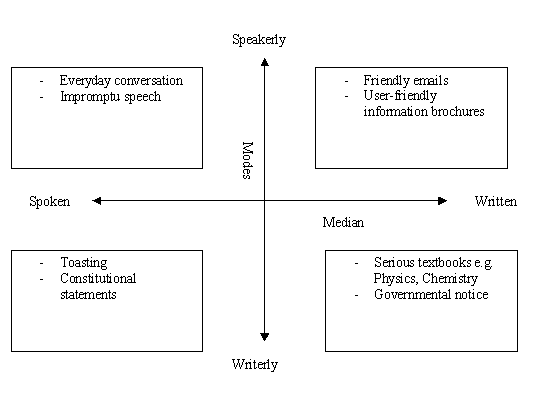
talk of modes of communication (more or less writerly or speakerly) and medium
of communication (spoken or written). It is quite a useful analysis.
As
the distinction between speech and writing has become more problematic,
Widdowson (1984, quoted in McCarthy, 2001, p. 95) has repositioned his stance on
the dichotomy of reading/writing versus speaking/listening in the four skills
paradigm. Instead, his focus is now on ‘being a reader ’ or ‘being a
speaker. (Ibid)’
Despite
the fact that English is regarded as the language of the Internet, some are not
too happy with the ways in which it has been abused. There is a real concern
that such English is a runaway thing. Naomi Baron (2000) writes in Alphabet
to Email that:
“
These issues spill beyond the classroom as students become adults, whose writing
goes largely unmonitored. No one edits what gets sent out on the Net (and
sometimes, even what get published in hard copy). As our notions of writing
begin merging with informal speech, we find ourselves getting into trouble ...
Speech that’s directly written down… can produce texts that are verbose,
sloppy, and even irresponsible.” (p. 268)
Maybe
she is referring to this kind of message:
freem@n,
im
glad tat u managed to c things in a different light
 i
fully understand wat u mean cos i've been thru it..... its really tough
initially but time will heal all wounds.... its juz a matter of time, how slow
or how fast u snap out of it..... im still recovering but definitely doing much
better now
i
fully understand wat u mean cos i've been thru it..... its really tough
initially but time will heal all wounds.... its juz a matter of time, how slow
or how fast u snap out of it..... im still recovering but definitely doing much
better now
 i believe
he really din mean to hurt me & being the 1 initiating the breakup, im sure
he feel worse
i believe
he really din mean to hurt me & being the 1 initiating the breakup, im sure
he feel worse
 probably
much worse than i do? i made him worried for awhile but i noe now he's relieved
tat i pick myself up. im relieved too
anyway
i hope he is happier now! even though i cant be with him, i still wish
he'll always stay happy!
probably
much worse than i do? i made him worried for awhile but i noe now he's relieved
tat i pick myself up. im relieved too
anyway
i hope he is happier now! even though i cant be with him, i still wish
he'll always stay happy!
U
feel the same rite?
Well,
hope everything goes well for u! God bless u & her!
[5/17/2002]
Or the discourse of the chat room:
shynotsoshy : hi monkey MONKEYBUD1 : HELLO SHY Joyx3 : hey mrpro what kind of consult are u
Joyx3 :
lol8
kychick_8 has left the conversation.8
RelcusiveMe1 has left the conversation.8
MONKEYBUD1 has joined the conversation.
8
SassyPoppy has left the conversation.8
whiteowl30 has joined the conversation. shynotsoshy : hi white8
fireman70 has left the conversation.8
hottstuff535 has joined the conversation. whiteowl30 : hello shynotsoshy : hi hot whiteowl30 : hello shy MrProactiveguyinTexas : in the off shore construction industry Joyx3 : i c whiteowl30 : how r u? Joyx3 : do u work on the oil rigs? shynotsoshy : i am great ty and you whiteowl30 : im fine shynotsoshy : r u a snowy owlshynotsoshy : lol
Source: http://chat.msn.com/chatroom.msnw?rm=30s&cat=PR [09/09/2003 ]
Not
necessarily so, argues Crystal (2001) in his book Language and the Internet.
He has pointed to the bright side of the story, saying that the kind of English
being used online can be perceived as creativity. The discourse of the Internet
English is neither threatening nor replacing existing varieties of English, but
extending and enriching them.
One solution ELT specialists can deal with is to exclude it. Such English should better be classified as having its own register. Warschauer (2001) has put it explicitly that: “ It is increasingly clear that online-communication represents for the field of TESOL much more than a pedagogical tool. Rather, online-communication is a major new medium of English language communication and literacy in its own right, and one that is likely to affect the development of TESOL in important ways that we cannot yet predict.” (p. 212)
But for how long can we leave it as it is and will be? Crystal (2001) has predicted that in the future our communication will be largely computer-mediated: “ Where as, at the moment, face-to-face communication ranks as primary, in any account of the linguistic potentialities of humankind, in the future it may not be so. In a statistical sense, we may one day communicate with each other far more via computer mediation than in direct interactions (p. 241).”
Technology
does significantly influence the ways we communicate. On the
future of CALL, Hanson-Smith (2001) predicts:
“
The move from wire to wireless communications and the consolidation of
telecommunications into combined telephone-internet-television access will not
drive pedagogy in quite the same way as the move to personal computers has
done…. Eventually, as miniaturization progresses, audio, and monitor may be
embedded in eyeglasses and a voiced-controlled computer strapped into a backpack
for communication, anywhere, anytime.” (p. 112)
If
that what we think the future will be, in many parts of the world, we may expect
to see learners with their computer-integrated glasses, who can learn anytime
and anywhere, similar to the picture below.
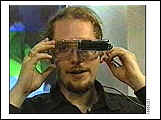
Photo
taken from:
http://www.cnn.com/TECH/science/9807/23/t_t/digital.gadgets/#video
Will
students in 2020 wear tiny computers, and will images of presentations be beamed
directly onto their retinas, will the ‘computer’ talk to them? Considering
Moore’s Law: “ The amount of information that can be stored on a computer
chip doubles every 18-24 months,” it is quite likely to be the case.
Two
IT public figures offer some interesting scenarios. Bill Gates opines:
“ I don’t think there’s anything unique about human intelligence. All the
neurons in the brain that make up perceptions and emotions operate in a binary
fashion (p. 214).” He predicts: “ Eventually we’ll be able to sequence the
human genome and replicate how nature did intelligence in a carbon-based system
(p. 215).”
In
a more radical, albeit optimistic view of the future, Ray Kurzweil has been
quoted as saying that:
“
Ultimately, computers will become so powerful that they will dwarf the mental
capabilities of mankind and even begin to take on human characteristics such as
spontanteity and impulsive discoveries. These same computers will create
communication systems between people that are far more complex than voice or
written transmissions, where massive amounts of knowledge in the form of neural
network patterns can be transferred from one wired human brain to another.
Source:
http://www.businessweek.com/bwdaily/dnflash/june2000/nf00629i.htm
[5/22/2002]
In
the field of artificial intelligence, Ian Peason, a futurologist at Btexact,
mentioned in New Scientist (Vol
174, p. 46) : “ I have a prototype design for something that might be 50, 000
million times smarter than the human brain. Target date is 2010. ”
It
is very likely that the future of ELT, like other fields, is bounded to be
dictated by the advancement of computer technologies
One
major stumbling block for all of the methodological business lies in its
strongest persuasion: repetitiveness, as Krishnamurti has put it in The Book
of Life: “ Methods mean repetition.” And we may recall what Emerson has
urged us to be aware of our tendency to follow certain conventions without
proper examination: “ Foolish consistency is the hobgoblins of little mind.”
Several
prominent TESOL scholars tend to abandon their once-beloved methods. Rodgers
(1999) has gathered some opinions as follows:
“
Methods don’t matter because they don’t exist” (Long 1989).
“
Nunan (1991) supported criticism of the profession and its preoccupation with
methods.”
“
The era of methods is over (Brown, 1994a).”
“
The profession is now in a period of ‘post-method’ thinking (Woodward,
1996).”
What’s
next? Rodgers (Ibid) has come up with ten scenarios that will shape the field of
TESOL in the next decades of the 21st century. New vocabulary has
been invented:
In terms of research directions, Ellis (1998) has concluded in his
review of theoretical approaches to language acquisition that the connectionist
models of language learning will be widely scrutinized in the future.
“
Emergentists believe that simple learning mechanisms, operating in and across
the human systems for perception, motoraction, and cognition as they are exposed
to language data as part of a communicatively-rich human social environment by
an organism eager to exploit the functionality of language, suffice to drive the
emergence of complex language representations…”
What
he claims to be emergent is “ Some new kind of relation.”
In
a nutshell, McCathy (2001) has put it that:
“
It is the idea that important information about language can be extracted from
‘probabilistic patterns of grammatical and morphological regularities.’ The
mind makes connections among multiple nodes of processed information: the more
connections, the stronger the trace in acquisition.”
(p.
83)
And
Ellis’s prediction:
“I
look to the next 50 years of language learning research for the details of these
processes. The research must
involve the interdisciplinary collaboration of the aforementioned –ists
[e.g. Generative linguistics, Cognitive linguistics, Corpus linguistics,
Psycholinguistics, Sociolinguistics] and the ever new –istics that will
emerge from their mutual influences. It needs to understand the constraints on
human cognition that arise from the affordances and the proscription in each of
these domains, and how these constraints interact…”
However,
Upshur (1999), in his response to Ellis, has doubted the future of the
connectionist models which, as he has put it:
“ the subject is language learning; the orientation is emergence and
connectionism, the methodology is simulation.”
He criticizes that connectionism is nothing new but “ the old notion of
habit dressed up in fancy new dress.” Towards the end of his response, Upshur
(Ibid.) sarcastically wishes Ellis et al. best of luck in pursuing such new
daunting enterprises. He writes:
“
…Ellis makes no claims that connectionist models for emergent language
knowledge will be important 40 years from now. The research agenda is so full,
however, that I cannot believe it will be exhausted in less time. If Ellis, his
colleagues, and their followers remain true to their beginning, I can well
imagine Language Learning publishing new connectionist studies in 2038. I
envy those who will read them.”
Undoubtedly,
we are moving towards interdisciplinary study. And connectionism as posited by Ellis,
in some sense, is in line with the notion of language as a socio-historical
phenomenon (Vygotsky, 1935; Bourdieu, 1991). In the wider context, it seems to
be consonant with the cosmological perspective of education
(O’Sullivan, 1999), for in Ellis’ words, “ Language representations
emerge from interactions at all levels from brain to society (Ibid.).” Though
not explicitly spelt out, those connectionist models can be seen as another
attempt to overcome the traditional mind-body problem. This big move seems, in
many respects, to be in tuned with the new trend. In his article “ The Future
of Philosophy”, Searle (1999) has written that the Cartesian dualism needs to
be rethought: “ The notions of both mental
and physical as they are traditionally defined need to be abandoned as we
reconcile ourselves to the fact that we live in one world, and all the features
of the world from quarks and electrons to nation states and balance of payments
problems are, in their different ways, part of that one world.” And one of the
new trends in the 21st century, adds Searle (Ibid.), lies in the
progress of cognitive science as a “ paradigm shift away from computational
model of the mind and toward a much more neurobiologically based conception of
the mind.” But, as Upshur
(1999) has criticized, connectionism “ appears, in many ways, to be the old
notion of habit dressed up in new fancy dress.” The notion that learning
depends essentially on making connections is nothing new. Years ago, under the
context of behaviorism, Thorndike believed that learning is nothing but
connecting, and Pavlov’s conditional reflexes are nothing but temporary
connections (Stones, 1966).
Source:
http://socrates.berkeley.edu/~jsearle/rtf/future_of_philosophy.rtf
[5/18/2002].
In
the wider sense, the notion of connectionism is in some aspects compatible with
the relativist view of language learning (Lian, 2000). In particular, the
meaning making mechanism (3Ms) that enables learners to confront, contrast, and
compare what they think they understand and those of the real world (Lian,
2000). In many respects, theoretically, connecting is also contrasting.
To
contrast, according to Hume (Ibid), also means to make a connection between
ideas or objects. And to Hume, there are only three principles of connection
among ideas: (1) Resemblance, (2) Contiguity in time or place and (3) Cause or
Effect. He noted that: " Contrast is also a connexion among Ideas: but it
may, perhaps, be considered as a mixture of Causation and Resemblance
(p.24)." He added, " Where two objects are contrary, the one destroys
the other; that is, the cause of its annihilation, and the idea of the
annihilation of an object, implies the idea of its former existence
(Ibid.)."
There
seems to be a rush to put everything online where many believe that is where our
future will be. In terms of materials development, Tomlinson (2001) predicts
many scenarios of the future, some of which are that:
More
materials will be available on the Internet and many will make use of Internet
texts as sources.
Materials
will become more international, presenting English as a world language rather
than a language of a particular nation and culture.
Materials
will stop catering predominantly for the ‘good language learners’ and will
start to cater more for the many learners who are experientially inclined.
Materials
will move away from spoken practice of written grammar, taking more account of
the grammar of speech (McCarthy and Carter 1995; Carter and McCarthy 1995, 1997;
Carter et al. 1998, quoted in Tomlison 2001)
(p.
70-71)
In
the future, although measurement will still be there, the advancement of
technology and new perception of language will influence how we assess the
learners.
What
will the future of English language assessment look like?
Proponents
of IT-strong would not hesitate to come up with scenarios where tests will be
administered individually over the Internet. Computers will response directly to
students in tests using virtual reality simulations. And testing merged with
instruction through the use of electronic learning tools.
Source:
http://www.ets.org/news/story.html
We are heading into the notion that
some kinds of technologies will lead us the ways to better assess the learners,
which is that the business of assessment is going to be faster, better, and
cheaper. According to the former president of Educational Testing Service (ETS),
Nancy Cole (1999), “ language assessment will undergo revolutionary change in
the next decade. The richer theoretical understanding of language use provides
one basis for the change. The new possibilities with modern electronic
technologies provide the other. Together the time is ripe for radical change in
the assessment of language.”
Elsewhere
she opines: "The value of technology to improve learning and assessment is
undisputed." Source: http://www.bibl.u-szeged.hu/oseas/papcomp.html
At
JLTA Annual Conference and LTRC 99, Alan Davies has made some prediction on the
principal basis that:
“Views
of language and the practice of language testing will no doubt change over the
next 50 years but it seems likely that the underlying tension will remain
[between formal and functional views of language or UG context-free theories and
interactive context-full theories e.g. the connectionist models].
When
it comes to technology, his opinion: “ How far communication technology
will facilitate our ability to take account of these divergent views remains to
be seen.”
Source:
http://www.surrey.ac.uk/ELI/ilta/ilta.html
[5/10/2002].
As
ELT is another field within the broader educational context, it is worth
spending a few moments looking at the big picture. In general, the present has
been mapped as dysfunctional and rigid schooling. For example, in Thai context,
the Foundation for Children (FFC) has attacked the mainstream education as
having fatal flaws:
“
The rote learning, the use of authority, the dominant and overpowering role of
the teachers and the harsh punishment used commonly in schools suffocates the
potential of children. This system, which mechanically gears towards vocational
training and equipping the population with occupational skills to serve the
government and the private sector, deeply affects the Thai society. Learning
only to memorize and regurgitate information, to sit still and not express
thoughts, creates 'non-thinkers'. “
Source:
http://www.ffc.or.th/htmleng/edupage/page.htm
In many Asian countries, as Mok (1997) has rhetorically
described, students have been rigidly controlled:
“ The school administration, including the
principal and the teachers, is the boss. They have absolute power to determine
the formal and informal curriculum, to set the learning objectives, to establish
standards, and to decide on the pace of learning process. Student input in
deciding what to learn and how to acquire their learning is extremely low if not
non-existent. Students are told to do what is required by the school. If they
perform differently, the use of coercion or punishment is almost certain.
Students are powerless to choose or decide what they want in learning.” (p.
305)
In
the context of ELT, based on Wongsothorn’s report (1999) of The Ministry of
Education’s Foreign Language Education Policy, it is not difficult to feel how
centralized language education policies in Thailand have been. Let’s look at a
couple of the policy statements at the elementary and secondary levels:
“
Students will start learning English as a foreign language from Grade 1 onwards
using curriculum, syllabus and guidelines provided by the Ministry of
Education.”
“
Any educational institutions interested in offering foreign language programs
which are not in accordance with the Ministry’s guidelines can ask for
permission from the Ministry.”
(Ministry
of Education. 1996. The Ministry of Education’s Foreign Language Education
Policy, quoted in Wongsothorn, 1999)
In general, the present educational system has been criticized as:
- Being dysfunctional
- Having rigid forms of schooling
- Having problems, but not being problematic
- Having technological potential, but full of risks
Everybody
is calling for some kinds of reform. Ingram (2002), in the Australian context,
has called for teaching reform. He writes: “ Despite the social and global
context, the societal and individual needs that arise from them, and the
language education policies, one has to conclude that the language education
system is not working.”
“ Tell me love, will you be staying long enough for me to try to remember your name?” ---- An elderly history teacher asked a young English teacher from Budapest (Medgyes and Matei, 2001)
At present, who are we?
Naisbitt (1984) has predicted that we will see the shift from institutional help to self-help: learning at home. Computer, coupled with democratic/ humanistic movements and social problems, is undeniably, one salient factor effecting teachers’ role and status. In general, teacher prestige and status have been reported to be lower than any period in history (McCreary Juhasz, 1990, cited in Robinson, 1994, p. 1). Based on a small-scale research project, Medgyes and Matei (2001) have reported that generally TESOL teachers are those with 'low esteem'. Some findings are actually interesting.
On the positive
side:
- Citizens of the world
- Streetwise, flexible, easy-going, and open to innovative ideas
- In many places, enjoy higher status for their scarcity value, and in certain places they are regarded as a status symbol.
On the negative
side:
- The necessary evil among staff: fluctuate, part-timers, and not faithful to the classical educational teacherly roles
- Outsiders, non-conformists --- weird
- Temporary labor rather than as professional
- In some countries saying that you are a native speaker teacher is synonymous with a tourist who didn’t want to leave.
- Not as clever as teachers of math. (Thank you!)
What the above report has revealed is not so much of the content, which one can always argue about its methodology and etc., as it is rather a mirror reflecting how we perceive ourselves. At present it seems we need more confidence and some kind of professional standards.
Nowadays, it is quite obvious that many educational institutions and business organizations are moving along with the digital age. Bill Gates has written in his 1999 book Business @ The Speed of Thought: “ The PCs and the Internet fundamentally change one thing: They provide every student in every school and community with access to information and collaboration that before now was not available even to students in the best schools (p. 403).” Some of the common problems in using PCs with the Internet access, based on a special report by The Wall Street Journal, have been reported in the same book:
(p. 402)
Much research has been carried out to find out
the effects of computers on learning and teaching. Research conducted by the Pew
Internet & American Life Project (2000) shows that teenagers use the
Internet as an essential study aid outside the classroom and that the Internet
increasingly has a place inside the classroom. The research has also reported
that:
- 94 % of youths age 12-17 who have Internet Access say
they use it for school research and 78% say they believe the Internet helps them
with schoolwork.
- 71% of online teens say they use the Internet as the
major source for their most recent major school project or report.
- 41% of online teens say they use email and
instant messaging to contact teachers or classmates about schoolwork.
It
seems that much of what we expect to see in the future is to a large extent
based on six movements as outlined by Brennan (2002).
-
Speculation
-
Fantasy
-
Imagineering i.e. using our imagination to actually create the imagined
reality.
-
Normative critique i.e. making a choice on what to do or not to do
-
Reform Legitimation i.e. states have been legitimized to reform.
I
should like to focus on the legitimized reform. Paradoxically, many calls for
school reform come at the very time many nation states, the main sponsor of
public education, are in the process of disintegrating or reintegrating into new
forms. Indeed, globalization has already greatly impacted nation states as
Habermas has written in the context of globalization:
“
The globalization of commerce and communication, of economic production and
finance, of the spread of technology and weapons, and above all of ecological
and military risks, poses problems that can no longer be solved within the
framework of nation-states or by the traditional method of agreements between
sovereign states. If current trends continue, the progressive undermining of
national sovereignty will necessitate the founding and expansion of political
institutions on the supranational level, a process whose beginnings can already
be observed.”
(Habermas,
1998)
Elsewhere
he sates:
"
Undoubtedly, the impacts of globalization coupled with new technologies are
paramount as Ketudat (1996, quoted in Wongsothorn, 1999) has put it: “ The
effect of telecommunications and computer technology) upon human civilization
are far beyond imagination.” And Wongsothron herself has said (1999), “
Truly, the era of globalization has arrived with many implications for national
stability.” Similarly, “ For
higher education”, Suwanwela (2002) says, “ The rapid changes and expanded
uses of information and communication technologies pose both threats and
opportunities.”
Another
interesting point is that much of what we expect to see in the future (all of these
things) embodies our fears of:
-
Irrelevance of schooling (teachers’ roles and status). Many things are being
setup because if we are to be relevant in the future, it must mean we are
relevant now. In short, the ELT profession is seen as a runaway thing.
-
Globalization as threats to local cultures, national security, and etc.
-
Technological determinism (The real fear of man being as a utility, rather than
as a person)
-
‘English’ as a runaway thing.
-
Environmental degradation (Can’t stay the way it is)
-
Community disintegration (Schools are going to be communities e.g. David
Ingram’s call for community involvement in language learning.) (Family
breakdown, drugs, etc)
-
Measurement (Schools are about writing, grading, and examination. --- Control)
-
Youth revolt and other social problems
Based
on reverse genealogy, it is worth noting here that when we look into the future
we tend to be universal: whether we are conservative or liberal, from the
leftwing or the rightwing. This is indeed an interesting phenomenon. In
Brennan’s term: “ We tend to be less fragmented” when we see ourselves in
the future.
Some
commonalities are that:
-
IT will be strong, (and the magic of science will actually lead the way).
-
Progress will continue, (and is always better).
-
Schooling remains relevant, and is essential for nation building business
whereby the teaching profession plays an important role in the intervention.
-
The main goal of education is to produce desirable global & local citizens,
and also the somewhat undeniable assumption that more education will make a
country more prosperous.
Methodologically,
the reverse genealogy enhances our perspectives. It invites us to have a look at
another end, not just from the past. We will understand our own constitutions
much better if we use the information from both ends. In a nutshell, it is a way
of accessing the more. It is a paradoxical thing that while we are currently living among very large amounts of data or information, the data is,
chronologically, insufficient, considering our brief existence in this universe.
Cosmologically, human beings are but a small spot along the time line (A.
B. Lian, 2002, personal communication).
Past
------- > Present <
------------ Future
Reflexively,
it helps to raise our awareness at the profound level, especially with regard to
our roles as
teachers of English, our goals and the means available of carrying out our
teaching business. We need to ask ourselves
more often of our relevance. Where is our place in the future? How long can we
continue to act and think in the same ways?
Reverse
genealogy also enables us to be critical when reading literature of the field.
For example, despite the movement towards interdisciplinary studies, there still exists
the call for autonomy. Recently, Richards (2001) has written a short postscript
reflecting his own current ideology of TESOL.
Among other issues, he would like to see TESOL as an autonomous
discipline. He argues that: “ …increasingly TESOL seeks to establish its own
theoretical foundation and research agenda rather than being seen as an
opportunity to test out theories developed elsewhere and for different purposes
(p. 216).” Such statement should
be regarded as simply a political one that needs to be carefully addressed.
As English as we used to know and teach is running from us, and the distinction between speech and writing has become blurred, reverse genealogy helps us to reconsider our perceptions of English as the subject of our profession. Among others, the view on language as an object needs to be rethought. And the newer notion, as proposed by Lian (2000), that the object of linguistic study is not language per se, but actually a representation of language, may be quite a useful perspective. It is a runaway thing simply because it never really exists in the first place. Language is just our construction. According to Lian (2002, personal conversation):
" The DETAIL of the linguistic and scientific discourse MASKS what we really trying to do and those factors which we are unable to define but which really matter. So… We focus on what we have categorized, elevate it to a high place and ignore the things that we have not been able to (or wished to) categorize in the belief that what we have categorized is in fact what really matters and is a complete description or as complete description as you would want (and therefore the basis for explanation) of the objects or phenomena which we are seeking to describe. While in fact the categories we have established are not the complete object of study, or for that matter, any part of the object of study they become (magically) the object of study because they seem so real, so solid, so true. We are acculturated into these belief systems and live our lives as though we were surrounded by a world of solidity. It is that very solidity which is misleading and actually quite damaging.”
Reverse
genealogy can stimulate us to rethink our roles as educational researchers.
Conventionally, it is probably research that legitimizes us, and, therefore,
gives us a continuing life. As the future can be viewed as nothing but the mind
of the present, what we should be focusing on, rather than speculating, is to
try to distance ourselves from our own socio-historical perceptions, which is
not an easy task because when all else fails we always revert to more primitive
states and this will be our acculturated experiences. To avoid
making more tautological statements, perhaps the best we should do is to
deconstruct and reconstruct the constitution of our present.
Brennan,
Marie 'Disinterring the Present in the Future: a 'Reverse Genealogy' of School
Reform' [Online: http://www.slie.canberra.edu.au/broadcast/Interdisciplinary/index.html
Retrieved May 4, 2002]
Bourdieu,
Pierre (1991). Language and symbolic power. Cornwall:
Polity Press.
Crystal,
David. (1997) English as a Global
Language. Cambridge: Cambridge UP.
Crystal, David.
(2001) Language and the Internet Cambridge Cambridge University
Press.
Dator, Jim (1998). “ The Futures of
Universities: Ivied Halls, Virtual Malls, or Theme Parks?” in FUTURES,
Vol. 30, No. 7 Deptember 1998: 615-623.
Gates, Bill (1999). Business @ the
Speed of Thought. New York: Warner Books.
Habermas,
J. (1998) "The European
Nation-State: On the Past and Future of Sovereignty and Citizenship" Winter
1998, Volume 10, Number 2, Translated by Ciaran Cronin [ Online: http://www.uchicago.edu/research/jnl-pub-cult/backissues/pc25/habermas.html
Hume,
David. Enquiries concerning human understanding and concerning the principles
of morals (3rd ed.) Oxford: Clarendon Press.
Ingram, D. (2002). “ Methodology to enhance
proficiency and foster positive attitudes” Paper to the Post-RELC Seminar,
Chulalongkorn University, Bangkok, Thailand, 29 to 30 April, 2002.
Lian,
Andrew (2000) “ From First Principles: Constructing Language-Learning and
Teaching Environment.” In Selected
Papers from the Ninth International Symposium on English Teaching, Taipei,
Crane Publishing Co., Ltd., November 2000, pp. 49-62.
Medgyes, Peter and Matei, Gabriela (August, 2001). What
unites us? Low esteem. The Guardian Weekly.
Mok, Angela (1997). Student Empowerment in an English
language Enrichment Programme: An action research project in Hongkong. Educational
Action Research . 5(2), 305-320).
Naisbitt, J.
(1984). Megatrends: Ten New Directions Transforming Our Lives. New York:
Futura.
Robinson, A. H. (1994) The Ethnography of
Empowerment: The Transformative Power of Classroom Interaction. London: The
Falmer press.
Rogers, Ted (1999). “ LT Technologies and Methodology
in the New Millennium” in PASAA Vol. 29 December 1999: 33-53.
Stones, E. (1966). An Introduction to Educational
Psychology. London: Methuen & Co Ltd.
Tonkin,
Humphrey (2001) “ Language Learning, Globalism, and the Role of English.” ADFL
Bulletin 32 (2): 5-9. [Online: http://www.adfl.org/ADFL/bulletin/v32n2/322005.htm
Vygotsky, L. (1935). Mind in Society.
Massachusetts: Harvard University press.
Warschauer, M. (2000). “ The
Changing Global Economy and the Future of English Teaching.” TESOL Quarterly.
Wongsothorn, Achara (1999). “ Reflection and Projection
on Thailand’s Language Education Policy for the New Millennium” in PASAA
Vol. 29 December 1999: 54-66.
