 |
|
|
|
|
|
|
|
|
|
|
|
|
|
|
|
|
|
|
|
|
|
|
|
|
|
|
|
|
|
|
|
|
|
|
|
|
|
|
|
|
|
|
|
|
|
|
|
|
|
| FLYING A KITE |
|
|
|
BACK TO HOMEPAGE |
|
|
|
 |
|
|
|
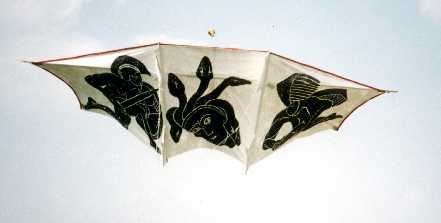
I love to spend my time doing absolutely nothing, but being Dutch, I need an excuse for doing nothing. Flying a kite is the perfect excuse. This is one of my oldest kites, a 'Genki' made from tyvec (Genki is the name of this model, and tyvex is a 'textile' made of pressed plastic fibres). The Genki is a model that needs only the mildest of breezes. I love to keep it in the air in the evening, when the wind is dying away, and everything quiets down. |
|
|
|
 |
|
|
|
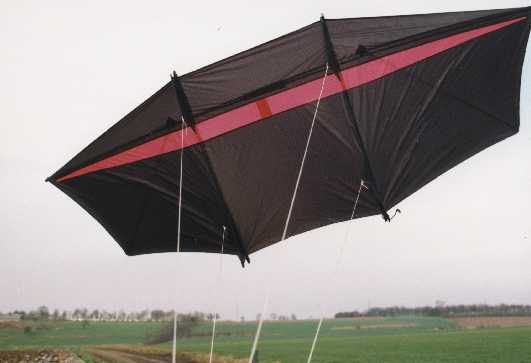
Here's another Genki, this time made with carbon-fiber spars and a nylon sail. I've been riding a bike for the last couple of years, and last year I decided a new set of kites was needed. The 150 centimetres long wooden spars I used to have were a bit long, and I was beginning to feel fed up with all those kites in white tyvec anyway. I chose black and red as 'my' colours, and I have built several kites in this new colour-scheme. Since I like to fly a kite in still weather, the Genki had to be the first new kite. |
|
|
|
 |
|
|
|
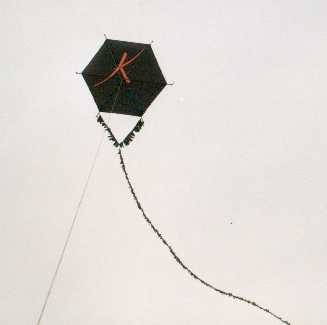
6-cornered kite with a tail.
Modern kite-designs usually don't need tails anymore, keels, fins and shape stabilise kites without adding the weight of a tail. People passing me by while I am flying a kite tell me over and over again that 'yonder kite won't fly because the tail is missing'. The kite they are talking about meanwhile looks like it is nailed into the blue sky, lifting 300 metres of line without any trouble. To get rid of these buggers I builded a kite that needed a tail. The red symbol in the sail is made up from a J and a K, my initials. It happens to looks Japanese, always a good thing on a kite. |
|
|
|
 |
|
|
|
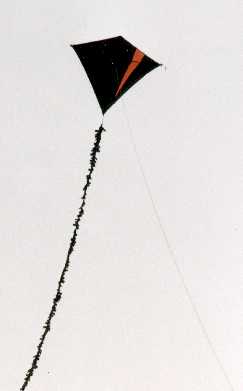
This is the most traditional Dutch kite I know. When I built the previously mentioned kite with the tail, people still kept nagging me; now the tail was allright, but the kites they used to fly had a different shape and they flew miles high and weeks on end and... (sigh)
I have given in again. I made a traditional kite. It isn't the best kite I have. It also isn't the prettiest kite I have. But no Dutch kiter should leave home without one.
(Deep sigh) |
|
|
|
 |
|
|
|
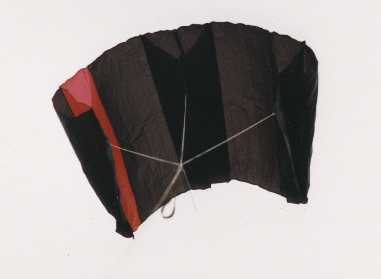
This is the kite I use most. Not because it is spectacularly beautiful, but because its total simplicity in use. It is a 3-tube double-sled kite. There are no sticks in this kite, the wind blows it into shape. It needs no assembling or disassembling, it can simply be folded into a small package. And despite all this simplicity, this kite is very reliable. It needs a bit of wind, but when that minimum is reached, it will fly. Always! I have used this kite on night-flights, when one can only see the line going up, disappearing into the darkness (I had some glow-sticks in the line, but no lights on the kite). I have used this kite in the mountains of Norway, where wind seemed to come from every direction. I flew it in a gale at the coast. This is a no problem kite, once you have built it... |
|
|
|
 |
|
|
|
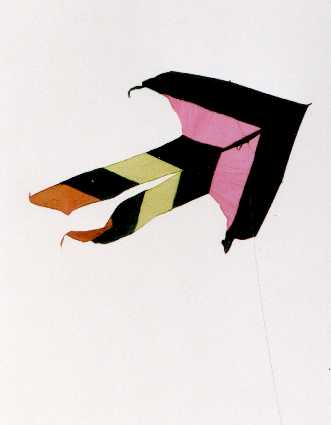
Now I have to do a bit of head-down-feet-shuffling in shame. This kite is not built by me, it was bought.
I never liked Delta's (that's the name of this shape). The ones I have built all gave major headaches one way or the other: bigger then intended or as big as intended but still too big (one day I'll add the story of that one). And I still believe a well built Genki outflies a well-built Delta. But all of a sudden a friend of mine, usually tinkering with 2, 3 and 4-line stuntkites, showed up at our favourite hill with a Delta. A BOUGHT delta, to make matters worse! I was ready to start laughing: those damned stuntflying guy's don't know a good kite from a brick wall. But before I could shift into cynical gear, he had the bloody thing airborne. The blasted thing flew, and it kept flying all afternoon, tied to a pole in the ground, without him looking again at it once. To make things even worth, he told me what the price of this contraption was: far less than it would cost me to build such a thing myself.
A couple of weeks later I went camping with a couple of friends. A second bastard had bought the same kite, and now I was taunted by two of them critters. Shortly afterward a third of my companions gave in. VILLANS! SCOUNDRELS!! MANAGERS!!! What can a man do, when all of his friends desert him? Join them, of course... |
|
|
|
 |
|
|
|
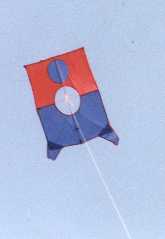
Korean fighter-kite: controlled by one line only...
Nowadays, kiting has become sport. Flash guys, flying big kites at high speeds, the 'been-there done-that' kind of experience. Those kites need 2, 3 or even 4 lines for control. Neon-coloured high-tech kites scream their way through the sky steered by howling lines, dragging kiters behind them across the beaches or fields. ACTION, POWER KITING, SPORT!!!
And it has nothing whatsoever in common with my way of kiting, the calm, one-with-the-wind experience. This kite is the opposite of modern kiting. This is a controllable kite, but not like a car 'turn the steeringwheel and the car will follow'. By giving or taking line at the right moment, the kite can be destabilised or stabilised, and with enough 'feel' for what the kite and wind are doing, the kite can be controlled perfectly. But it takes time and practice. These type of kites are my play-objects, kites I use whenever I feel like active kiting. |
|
|
|
 |
|
|
|
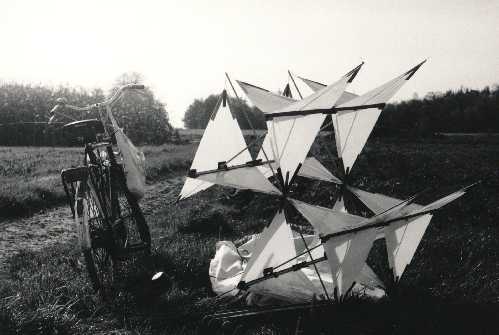
For a long time, to me, kiting was the ultimate simplicity. And it was a cheap hobby. I made kites from tyec or plastic garbagebags and wooden dowels, and for a very long time, my line of 500 metres of woven nylon was the most expensive piece of equipment I used. Alas, those day's are over, even I have given in. Now I use nylon sails and carbon fibre rods, and one kite costs more than my entire bag-o-kites used to cost. This is one of those kites from way back when. It is called a Pely-box, and this one actually is made from two of those kites stacked on each other. |
|
|
|
 |
|
|
|
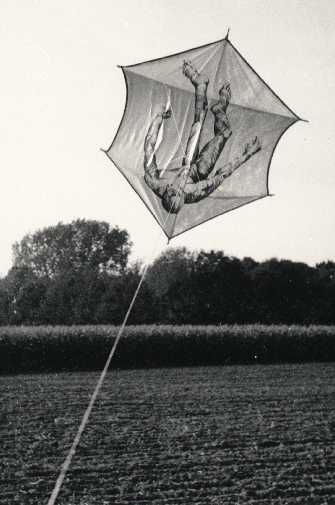
Here's another one from way back when, this is a Sanyo Rokkaku, made from tyvec. No, neither kite nor man are up-side down; the man is Icarus, falling from the sky after trying to be a high-achiever... |
|
|
|
 |
|
|
|
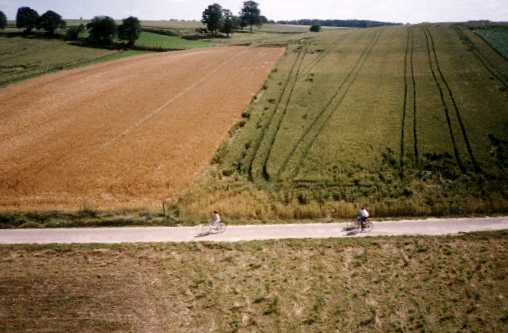
Kites are reliable enough to send up a camera. This is an aereal vieuw of one of my kite-locations: the 'Kolleberg' in Sittard. |
|
|
|
 |
|
|
|
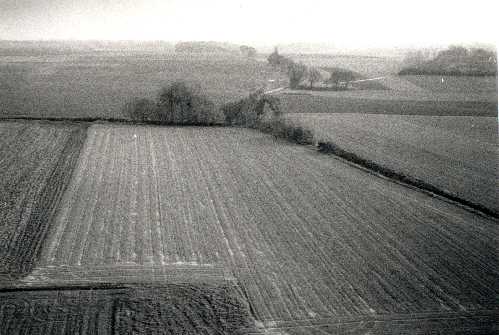
And another picture from the sky, another side from my favourite kite-ground. |
|
|
|
 |
|
|
|
I used to visit a lot of kite-meetings. Over the years, these meetings grew from little intimate get-togethers into huge, crowded meetings. The flashy guy's that hardly knew how to handle their new bough neon kites needed more and more space, in the air as well as on the ground. The old, experienced kiters faded away, and I faded with them. I never stopped flying kites totally, I went out every once in a while, alone on a hill. But my big time flying day's were over.
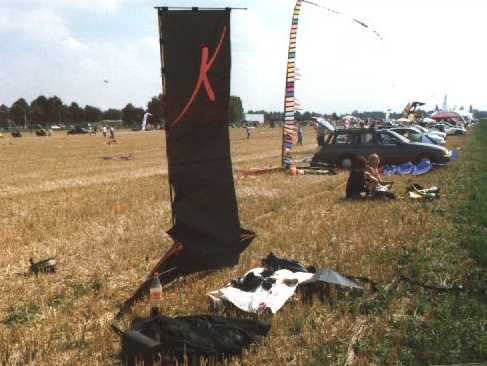
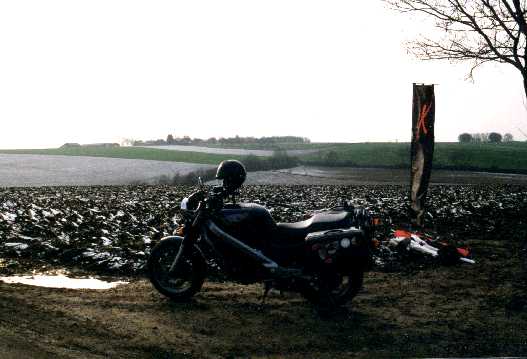
And then, all of a sudden, some of my friends turned onto kiting. They turned to me for information, and before I knew what hit me, I was dragged into a kite-meeting again. Much to my surprise, it turned out to be fun again. A lot of the flashy guy's had turned into knowledgeable old hands, there were some new rules like separate fields for different kites, and it was not as crowded as I remembered. Here's one of those meetings, in Oirsbeek. I now try to frequent 2 meetings a year: Oirsbeek and Weustenrade. On this picture I also show my new banner, black and red with my initials again. |
|
|
|
 |
|
|
|
But even with my new found joy in meetings and kiting with friends, to me the ultimate kiting experience remains tranquillity in solitude. Alone, crisp winter air, the low hills surrounding me, my silent companion high in the sky on a minimal breeze. Silence... |
|
|
|
BACK TO HOMEPAGE |
|
|
|
|
|
|
|

|
|
|
|