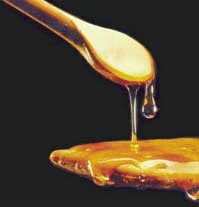
Honey is one of nature's oldest and most treasured sweeteners (even if it does take a little nerve to gather) and has occupied a prominent place in traditional medicines throughout world history. It is known that the ancient Egyptians, Assyrians, Chinese, Greeks and Romans employed honey for wounds and diseases.
Honey is as old as written history, dating back to 2100 B.C. where it was mentioned in Sumerian and Babylonian cuneiform writings, the Hittite code, and the sacred writings of India and Egypt. It is presumably even older than that.
In ancient time, honey was seen as a symbol of wealth and happiness. It was associated with strength, beauty and longevity. Its name comes from the English hunig, and it was the first and most widespread sweetener used by man. Legend has it that Cupid dipped his love arrows in honey before aiming at unsuspecting lovers.
In the Old Testament of the Bible, Israel was often referred to as "the land of milk and honey." and is also mentioned in the Noble Quran "And the lord inspired the bee, saying: Take your habitations in the mountains and in the trees ad in what they erect. Then, eat of all fruits and follow the ways of your Lord made easy (for you)'.There comes forth from their bellies a drink of varying color wherein is healing for men. Verily in this is indeed a sign for people who think." [16:68-69]
Honey was valued highly and often used as a form of currency, tribute, or offering. In the 11th century A.D., German peasants paid their feudal lords in honey and beeswax.
Although experts argue whether the honeybee is native to the Americas, conquering Spaniards in 1600 A.D. found native Mexicans and Central Americans had already developed beekeeping methods to produce honey.
In days of old, honey has been used not only in food and beverages, but also to make cement, in furniture polishes and varnishes, and for medicinal purposes. Today, honey is widely available in most communities but its medical potential remains grossly underutilized.
Darker honeys have more nutrients than light ones. Vitamin and mineral content depend on the floral source of the honey. Honey has less than 2% sodium, and as such can be labeled as a sodium-free product by Food and Drug Administration standards. Nutritionally, honey is a healthy, easily digestible, natural and energy rich food. It contains carbohydrates, proteins, lipids, enzymes and vitamins. One tablespoon of honey provides 60 calories and contains 11g of carbohydrates, 1mg of calcium, 0.2mg of iron, 0.lmg of vitamin B and 1mg of vitamin C. Honey also contains glucose, fructose and saccharine (70%). Besides the above, copper, iodine, and zinc exist in it in small quantities.
Honey has been used in many medical applications over the years, but recent studies are now able to prove its beneficial nature in some applications, including as antibacterial topical treatment for burns and ulcers. The reason is because honey has osmotic properties; that is, it tends to withdraw water. Water molecules strongly react with the sugars in honey, leaving little water available for microorganisms. Thus, infection-causing bacteria is literally dehydrated to death by honey.
Warning! Honey is not for babies!
Although honey is a natural, healthy food that normally cannot support bacterial life, it's important to note that it can carry C. botulinum spores which may be harmful to the undeveloped immune systems of infants. The old practice of dipping pacifiers into honey to soothe crying babies should be aborted.
Yet, it is an avoidable risk, and honey should not be fed to infants under the age of twelve months. Don't play the odds