• We collided head-on with hurricane Joann and she won.
We had left Los Angeles two weeks before and had thus far a pleasant sail with our sloop "Pandora" (Coronado-25) down the West Coast
of Baja California without too many problems.
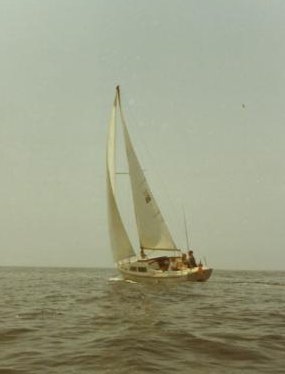
October 1st we had arrived at Turtle Bay which we left again two days later for Bahia Asuncion, a distance of 35 miles. The Port Captain had assured us there were no Chubascos (storms) along the Baja coast.
On our way to Bahia Asuncion we made a night-stop at Punta San Pablo. We spent an uneasy night here being rocked by Southern swells. Because of lack of any wind near the shore, and since no chubascos were reported, we decided to make the long run (180 mi.) to Cabo San Lazaro by going further offshore to pick up some wind.
After a few hours of motoring
we were delighted to find that bit of
wind and we "sped" along at 4½ knots,
which for our boat is just about top
speed.
Then it started to rain with big drops. The
winds were growing stronger. Tremendous swells were coming towards us.
We took down the jib, reefed the main and later took all sails down and let out a sea-anchor. This did not slow us down at all; we were sailing under bare-poles. It became harder and harder to control the boat. We were in a very confused sea.
Next day, in the afternoon, all went quiet. I went into the cockpit to check the damage on deck. It didn't look too bad. No longer was the wind howling instead it was eerie quiet; the sky had a strange bright color. We didn’t realize it at the time, but we were in the eye of a hurricane. Then all of a sudden all hell broke loose again. At one time the boat rolled over and when she rightened herself again, the mast was sheared off the deck. Everything went flying through the cockpit, drawers emptied their contents, water everywhere. We believed this was it: the end. The mast, still attached to some wires, started to pound against the hull under the waterline.
Lying on deck while Frieda was holding my legs, I tied as well as I could, the mast parallel to the boat. I almost lost two fingers when the mast was violently pulled away by waves and my fingers got caught. I had instant blue fingertips and nails. But the pounding of the mast against the hull stopped.
That night we sent out a "Mayday." It was picked up by an oil-tanker who confirmed we were in a hurricane. This was our first and only message for another big wave ripped off the antenna. Altogether we were now in this weather for 36 hours; we were wet, hungry, tired and constantly being thrown around in every direction. We died many times. All the wires attached to the mast snapped like strings. Without any cutting done by me, we lost the mast, boom and sails. On the morning of October 6 we were out of the hurricane. The sea was still mountainous and confused, but the wind was gone and the sun was shining. The boat looked more like a powerboat than a sailboat; nothing was standing on the deck anymore. Some stanchions were even flattened. The twisted cover of the outboard well had been standing on its side during the ordeal; waves and rain had inundated the outboard from all sides. However, a squeeze in the rubber ball and one pull on the cord and the engine started. A miracle! Now we could make headway. But where were we? We started to move on a 35° course. After five hours we saw an island coming up, Isla de Asuncion, about 35 miles southeast of Turtle Bay and our intended stop out of Turtle Bay three days before. Two days after we anchored at Asuncion Bay we were home again. We learned later that this hurricane had sustained winds from 80 to 100 miles an hour.
Now the prospect of recovering the boat was looming, but that is another story.
Jan Fokkema
Gardena, California
This article was published in Sea and Motor Boat Magazine
January 1973.
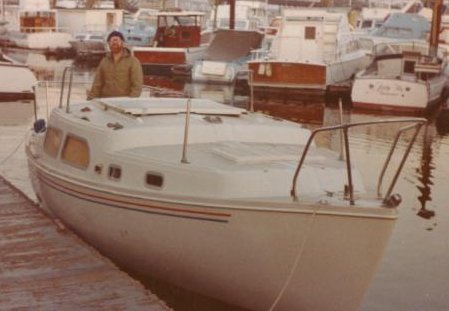
"Pandora" back in Los Angeles
repaired and waiting for a new mast, sails and lifelines
