Chapter VI












DETERMINANTS OF STAKEHOLDERS’ EDI SATISFACTION
This chapter reports the results of the analysis of EDI satisfaction causal model. The causal model is a path analysis which involves a number of submodels to be analyzed separately. The analysis can be divided into three parts which are the evaluation of domain satisfactions as predictors of overall EDI satisfaction; the analysis of the determinants of the domain satisfactions and the analysis of factors directly affecting the stakeholders’ overall EDI satisfaction; and the estimation of the factors’ direct, indirect and total causal effects on stakeholders’ EDI satisfaction.
The analysis is conducted on Transportation, retailer, and supplier subsamples as well as on the total sample. The analysis of each subsample is expected to provide more conclusions concerning the effects of various factors. They can reveal if each group has different relationship patterns. The analysis on the total sample is able to strengthen conclusion about the true significance of the variable.
Multiple regression analysis technique is applied as well. The results will be presented on the analysis procedure. The employment of path analysis technique in the analysis of EDI effectiveness causal model makes it possible to measure the direct influence along each separate path in the model and thus to find the degree to which variations of each domain perceived by stakeholders. Multiple regression analysis technique will be employed in the path model as well.
Model
of Analysis
The relationships between EDI effectiveness and other independent variables in the outcome and impact evaluation model are conceptualized as follows:
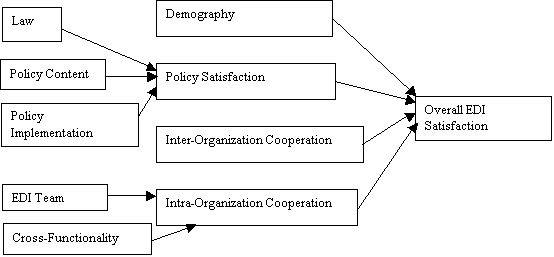
Figure 6.1 Conceptual Model of
Outcome and Impact Evaluation
Where in:
SEDI = Overall EDI Satisfaction (SAT129),
SAT121 = Policy Satisfaction (SAT121),
INTER = Inter-Organization Cooperation (SAT124)
INTRA = Intra-Organization Cooperation (INTRA FACTOR)
SAT122 = Law (LAW FACTOR),
POLICY = Policy Content (POLICY FACTOR),
PI = Policy Implementation (PI FACTOR),
EDITEAM = EDI Team (EDITEAM FACTOR),
CROSSFUNC = Cross Functionality (V54), and
RESBUD = Resource and Budget (RESBUD FACTOR).
Policy Satisfaction (SAT121) is likely changed due to Law Satisfaction (SAT122), Policy Content (POLICY FACTOR), and Policy Implementation (PI FACTOR) such that
SAT121 = a1 + b1SAT122 + b2POLICY FACTOR + b3PI FACTOR.
Intra-Organization Cooperation (INTRA FACTOR) is likely changed due to EDI Team (EDITEAM FACTOR) and Cross Functionality (V54) such that
INTRA FACTOR = a2 + b4EDITEAM FACTOR + b5V54
Overall EDI Satisfaction (SAT129) is likely influenced by all independent variables e.g. Policy Satisfaction Index (SAT121), Inter-Organization Cooperation Index (SAT124), INTRA FACTOR etc. such that
SAT129 = a3 – b9DEMOGRAPHY + b10SAT121 + b11SAT124 + b12INTRA FACTOR
The relationships among these variables are tested; that is, any variable is affected by what variables included in the model.
Domain Satisfactions as Predictors of EDI Satisfaction
SEDI (SAT129) = b0 +b1Policy Satisfaction Index (SAT121) + b2Management Satisfaction Index (SAT1211) + b3Intra-Organizaiton Support (SAT1214) + b4Law Satisfaction Index (SAT122) + b5Inter-Organization cooperation (SAT124) + b6Software Satisfaction Index (SAT125) + b7VAN Provider Satisfaction Index (SAT126) + b8VAN Satisfaction Index (SAT127) + b9EDI Team Satisfaction Index (SAT128)
To analyze multiple regression, multicollinearity problem, in which an independent variable is almost a linear combination of other independent variables, must not exist. Thus the relationships between independent variables must be examined first in order to prevent the mentioned problem.
Table 6.1 The Correlations between Overall EDI Satisfaction and Its Predictors.
|
|
SAT121 |
SAT122 |
SAT124 |
SAT125 |
SAT126 |
SAT127 |
SAT128 |
SAT129 |
SAT1211 |
SAT1214 |
|
SAT121 |
1.000 |
.373** |
.509*** |
.576*** |
.520*** |
.525*** |
.512*** |
.567*** |
.419*** |
.435*** |
|
SAT122 |
|
1.000 |
.673*** |
.493*** |
.289*** |
.373** |
.538*** |
.440*** |
.374** |
.026 |
|
SAT124 |
|
|
1.000 |
.677*** |
.646*** |
.421*** |
.518*** |
.447*** |
.388*** |
.285** |
|
SAT125 |
|
|
|
1.000 |
.790*** |
.589*** |
.623*** |
.462*** |
.459*** |
.438*** |
|
SAT126 |
|
|
|
|
1.000 |
.741*** |
.556*** |
.410*** |
.290* |
.397*** |
|
SAT127 |
|
|
|
|
|
1.000 |
.589*** |
.505*** |
.442*** |
.273* |
|
SAT128 |
|
|
|
|
|
|
1.000 |
.652*** |
.438*** |
.415*** |
|
SAT129 |
|
|
|
|
|
|
|
1.000 |
.613*** |
.345*** |
|
SAT1211 |
|
|
|
|
|
|
|
|
1.000 |
.434*** |
|
SAT1214 |
|
|
|
|
|
|
|
|
|
1.000 |
Table 6.1 shows that the independent variables are highly correlated. Therefore, new variables should be created by combining those highly related independent variables.
EDI Team Satisfaction, Management Satisfaction and Organization Support form a new variable called INTRA-ORG such that
INTRA-ORG = EDI Team Satisfaction (SAT128) + Management Satisfaction (SAT1211) + Organization Support (SAT1214)
VAN Satisfaction and VAN Provider Satisfaction form a new variable called VAN such that
VAN = VAN Provider Satisfaction (SAT126) + VAN Satisfaction (SAT127)
The model can be re-expressed as follows:
SEDI (SAT129) = b0 +b1Policy Satisfaction (SAT121) + b2Law Satisfaction (SAT122) + b3Software Satisfaction (SAT125) + b4VAN + b5INTRA-ORG + b6Inter-organization cooperation (SAT124)
Table 6.2 Prediction of Overall EDI Satisfaction by Domain Satisfactions, Total Sample, Transportation, Retailer, Supplier, VAN, and State Agency Subgroups (Standardized Regression Coefficients)
|
|
Predictor |
Total
Sample |
Transportation |
Retailer |
Supplier |
VAN |
State
Agency |
|
SAT121 |
Policy
Satisfaction Index |
.292** |
.267 |
.363 |
-.011 |
- |
- |
|
SAT122 |
Law
Satisfaction Index |
-.016 |
-.014 |
-.017 |
.729 |
- |
-.397*** |
|
SAT125 |
Software
Satisfaction Index |
-.178 |
-.272 |
.123 |
-1.690** |
- |
- |
|
VAN |
VAN&VAN
Provider Satisfaction |
.117 |
.087 |
-.261 |
1.051* |
.964*** |
-.523*** |
|
INTRA-ORG |
Intra-organization
Support |
.415*** |
.298* |
-.323 |
.336 |
.198*** |
-.316*** |
|
SAT124 |
Inter-organization
Cooperation Satisfaction Index |
.338* |
.735** |
.995 |
.074 |
- |
- |
|
|
R2 |
.633 |
.728 |
.933 |
.959 |
1.000 |
1.000 |
|
|
R2
adj |
.592 |
.660 |
.800 |
.898 |
1.000 |
1.000 |
|
|
F |
15.242*** |
10.705*** |
6.993 |
15.684** |
*** |
*** |
*
P-value < .05, **
P-value < .01, ***
P-value < .001
The set of six domains is entered into the structural equation. For Total Sample, three domain satisfactions, which are Policy Satisfaction (SAT121), Intra-Organization Support (INTRA-ORG), and Inter-Organization Cooperation Satisfaction (SAT124) can explain 63 percent of the variance in the overall EDI satisfaction score. This is considered to be encouraging.
For Transportation subsample, the change in policy satisfaction does not significantly affect EDI satisfaction score. The independent variables which can explain 73 percent of the variance in the overall EDI Satisfaction are Intra-Organization Support (INTRA-ORG) and Inter-Organization Cooperation satisfaction (SAT124).
For Retailer subsample, none of domain satisfactions affects overall EDI satisfaction. But for Supplier subsample, Software Satisfaction (SAT1225) and VAN & VAN Service Provider Satisfaction (VAN) play the important role on EDI satisfaction. These two variables can explain 96 percent of the variance in the overall EDI Satisfaction.
For VAN subsample, VAN & VAN Service Provider Satisfaction and Intra-Organization Support (INTRA-ORG) affect overall EDI satisfaction scores.
For State Agency subsample, the result is similar to VAN subsample; that is, VAN & VAN Service Provider Satisfaction (VAN) and Intra-Organization Support (INTRA-ORG) affect EDI satisfaction. Besides, there is one more factor affecting EDI satisfaction scores which is Law Satisfaction (SAT122). This is slightly strange comparing to other subsamples where Law Satisfaction never involves overall EDI satisfaction. This is possible that this subgroup is State Agencies where law matter affects the overall EDI satisfaction. They must follow the law more strictly than other types of organization. Therefore, changes in law contents cause the EDI process communicating with trading partners easier or harder.
Factors Directly Affecting Overall EDI Satisfaction
Besides the six domain satisfactions, personal characteristics which govern every judgement a person makes are independent variables in a predictive model as follows:
SEDI = b0 + b1SEX + b2AGE + b3EDU1 + b4EDU2 + b5EDU3 + b6EDU4 + b7EDU5 + b8POSDUMMY + b9SAL + b10INVNUM1 + b11INVNUM2 + b12INVNUM3 + b13INVNUM4 + b14INVNUM5 + b15INVNUM6 + b16INVNUM7 + b17INVNUM8 + b18EXPALL + b19EXPFN + b20HR
As mentioned before, to analyze multiple regression, multicollinearity problem must not exist. To detect multicollinearity, correlation coefficients between independent variables must be examined first.
Table 6.3 The Correlations between EDI Satisfaction and Personal Characteristics as its prediction.
|
Variable |
Description |
Total Sample |
Transportation |
Retailer |
Supplier |
VAN |
State Agency |
||
|
SEX |
Sex |
.021 |
.087 |
-.046 |
.235 |
-.730 |
-.185 |
||
|
AGE |
Age |
.003 |
.253 |
-.250 |
-.378 |
.521 |
-.507 |
||
|
EDU1 |
Less than high school |
-.301** |
-.270* |
- |
- |
- |
- |
||
|
EDU2 |
High school |
-.005 |
.034 |
- |
- |
- |
- |
||
|
EDU3 |
Bachelor |
.214* |
.235 |
-.022 |
.161 |
.316 |
- |
||
|
EDU4 |
Master |
-.195 |
-.102 |
-.066 |
.265 |
-.316 |
- |
||
|
EDU5 |
Doctorate |
- |
- |
- |
- |
- |
- |
||
|
POSDUMMY |
Division manager and up |
-.155 |
-.212* |
-.109 |
-.251 |
.316 |
-.050 |
||
|
SAL |
Income |
-.149 |
-.190 |
-.233 |
-.195 |
-.189 |
.553 |
||
|
|
EDI Developer |
-.034 |
-.068 |
-.066 |
.183 |
-.316 |
.123 |
||
|
INVNUM2 |
EDI User |
.037 |
-.114 |
.252 |
.224 |
- |
.704 |
||
|
INVNUM3 |
EDI Project Leader |
-.017 |
-.237 |
.015 |
.358 |
-.730 |
.123 |
||
|
INVNUM4 |
Management |
-.112 |
-.110 |
.095 |
-.314 |
- |
- |
||
|
INVNUM5 |
Coordinator |
-.071 |
.026 |
-.038 |
-.278 |
.730 |
-.452 |
||
|
INVNUM6 |
Operator |
-.027 |
-.276 |
- |
.205 |
- |
.201 |
||
|
INVNUM7 |
System Monitor |
-.103 |
.151 |
-.359 |
-.067 |
- |
-.050 |
||
|
INVNUM8 |
Others |
.136 |
- |
- |
- |
-.316 |
- |
||
|
EXPALL |
All Experience (years) |
.057 |
.282 |
.007 |
-.056 |
.527 |
.596 |
||
|
EXPFN |
Experience in current function (years) |
.047 |
.318 |
-.158 |
-.021 |
.527 |
.050 |
||
|
HRS |
Number of hours working a day |
.037 |
-.078 |
-.068 |
.009 |
.748 |
.046 |
*
P-value < 0.05, ** P-value < 0.01, *** P-value < 0.001
The independent variables are not highly related but only few personal characteristics are related to over EDI satisfaction.
Table 6.4 Standardized Regression Coefficients of Predictors of Overall EDI Satisfaction, Total Samples, Transportation, Retailer, Supplier, VAN, and State Agency Subsamples
|
Variable |
Description |
Total
Sample |
Transportation |
Retailer |
Supplier |
VAN |
State
Agency |
|
|
Personal
Characteristics |
|
|
|
|
|
|
|
SEX |
Sex |
- |
- |
- |
- |
- |
|
|
AGE |
Age |
- |
- |
- |
- |
- |
|
|
EDU1 |
Less than high school |
-.378*** |
-.620*** |
- |
- |
- |
|
|
EDU2 |
High school |
- |
- |
- |
- |
- |
|
|
EDU3 |
Bachelor |
- |
- |
- |
- |
- |
|
|
EDU4 |
Master |
- |
- |
- |
- |
- |
|
|
EDU5 |
Doctorate |
- |
- |
- |
- |
- |
|
|
POSDUMMY |
Division manager and up |
- |
- |
- |
- |
- |
|
|
SAL |
Income |
- |
- |
- |
- |
- |
|
|
INVNUM1 |
EDI Developer |
- |
- |
- |
- |
- |
|
|
INVNUM2 |
EDI User |
- |
- |
- |
- |
- |
|
|
INVNUM3 |
EDI Project Leader |
- |
- |
- |
- |
- |
|
|
INVNUM4 |
Management |
- |
- |
- |
- |
- |
|
|
INVNUM5 |
Coordinator |
- |
- |
- |
- |
- |
|
|
INVNUM6 |
Operator |
- |
- |
- |
- |
- |
|
|
INVNUM7 |
System Monitor |
- |
- |
- |
- |
- |
|
|
INVNUM8 |
Others |
- |
- |
- |
- |
- |
|
|
EXPALL |
All Experience (years)
|
- |
- |
- |
- |
- |
|
|
EXPFN |
Experience in current function (years) |
- |
- |
- |
- |
- |
|
|
HRS |
Number of hours working a day |
- |
- |
- |
- |
- |
|
|
|
Domain
Satisfaction |
|
|
|
|
|
|
|
SAT121 |
Policy
Satisfaction Index |
.274** |
- |
- |
- |
- |
- |
|
SAT122 |
Law
Satisfaction Index |
|
- |
- |
- |
- |
.397*** |
|
SAT125 |
Software
Satisfaction Index |
|
- |
- |
1.690** |
- |
- |
|
VAN |
VAN&VAN
Provider Satisfaction Index |
|
- |
- |
1.051* |
.964*** |
.523*** |
|
INTRA-ORG |
Intra-organization
Support |
.448*** |
.352** |
- |
- |
.198*** |
.316*** |
|
SAT124 |
Inter-organization
Cooperation Satisfaction Index |
- |
.483*** |
- |
- |
- |
- |
|
|
R2 |
.667 |
.751 |
- |
- |
1.000 |
1.000 |
|
|
R2
adj |
.642 |
.714 |
- |
- |
1.000 |
1.000 |
|
|
F |
26.818*** |
20.353*** |
- |
- |
*** |
*** |
* P-value < 0.05, ** P-value < 0.01, *** P-value < 0.001
Results of the analyses conducted on the total sample and subsamples are presented in Table 6.4. For Total Sample, the computed F statistics indicate that the model significantly fits the sets of data. The model can explain a substantial portion of the variance in overall EDI satisfaction. Sex and age are not found to affect EDI satisfaction in either direction. Only one of personal characteristics which is education level, “less than high school”, negatively affects overall EDI satisfaction.
Determinants of Policy Satisfaction: Total Sample
It is predicted that policy satisfaction index may be affected by EDI policy itself and the way it has been implemented. Therefore, the analysis involves sub-model as follows:
SAT121 = b0 + b1Policy Content (POLICY) + b2Policy Implementation (PI)
The result of the analysis on the Total Sample is summarized in Table 6.5. Personal Characteristics are not found to affect the dependent variable.
Table 6.5 Standardized Regression Coefficients of Predictors of Policy Satisfaction for Total Sample
|
Variable |
Description |
Standardized Regression Coefficients |
|
POLICY |
Policy Content |
.580*** |
|
PI |
Policy Implementation |
-.049 |
|
|
R2 |
.323 |
|
|
R2 adj |
.294 |
|
|
F |
11.220*** |
* P-value < 0.05, ** P-value < 0.01, *** P-value < 0.001
Only Policy Content is found to affect Policy Satisfaction (SAT121) for Total Sample. It can explain 32 percent of the variance in the Policy Satisfaction.
Determinants
of Intra-Organization Cooperation
It is predicted that intra-organization cooperation (INTRA FACTOR) may be affected by EDI team (EDITEAM FACTOR) and cross functionality (CROSSFN, V54). Therefore, the analysis involves a sub-model of which its structural equation is as follows:
INTRA FACTOR = b0 + b1EDITEAM FACTOR + b2CROSSFN
The result of the analysis on the total sample is summarized in Table 6.6. Personal characteristics are not found to affect the dependent variable. Only EDITEAM FACTOR can explain 22 percent of variance in Intra-Organzation Cooperation (INTRA).
Table 6.6 Standardized Regression Coefficients of Predictors of Intra-organization Cooperation for Total Sample
|
Variable |
Description |
Standardized Regression Coefficients |
|
EDITEAM FACTOR |
EDI Team |
.458*** |
|
CROSSFN FACTOR |
Cross Functionality |
-.167 |
|
|
R2 |
.218 |
|
|
R2 adj |
.191 |
|
|
F |
8.095*** |
* P-value < 0.05, ** P-value < 0.01, *** P-value < 0.001
Estimation of Total Causal Effects
The estimation of total causal effects of overall EDI Satisfaction for Total Sample and Transportation subgroup were accomplished according to three major steps:
1. The estimation of path coefficients,
2. The computation of indirect causal effects, and
3. The calculation of total causal effects.
Total
Causal Effects of Factors Affecting Overall EDI Satisfaction For Total Sample
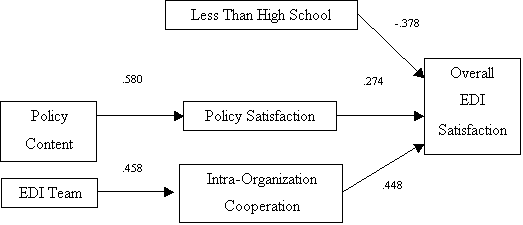 |
Figure 6.2 Estimation of Total Causal Effects for Total Sample
Total causal effects of factors affecting overall EDI satisfaction for total sample is shown in Figure 6.2 with path coefficients of independent variables shown in Table 6.7.
The most important factor determining the level of EDI satisfaction is Intra-Organization Cooperation (INTRA FACTOR) as shown in Table 6.8. Support from each other within the organization e.g. EDI developers, users, coordinators, and management is the key for EDI satisfaction. Other important factors being found to have considerable influences are educational attainment less than high school, policy satisfaction. Its substantial indirect effect goes through EDI team and policy contents.
Table 6.7 Path Coefficients of Independent Variables (Standardized Regression Coefficients-Beta) in the Path Analysis, Total Samples
|
|
Dependent Variable in the Structural Equation |
||
|
Independent Variable |
Policy Satisfaction |
Intra-Organization Cooperation |
Overall EDI Satisfaction |
|
Less than high school |
- |
- |
-.378 |
|
EDI Team |
- |
.458 |
- |
|
Policy |
.580 |
- |
- |
|
Policy Satisfaction |
- |
- |
.274 |
|
Intra-Organization Cooperation |
- |
- |
.448 |
|
R Square |
.323 |
.218 |
.667 |
|
Adjusted R Square |
.294 |
.191 |
.642 |
|
F |
11.220*** |
8.095*** |
26.818** |
* P-value < 0.05, ** P-value < 0.01, *** P-value < 0.001
Table 6.8 Direct, Indirect and Total Causal Effects of Overall EDI Satisfaction Determinant, Total Sample
|
|
Dependent
Variable |
||
|
Determinant |
Overall
EDI Satisfaction |
||
|
|
Direct |
Indirect |
Total |
|
Less
than high school |
-.378 |
- |
-.378 |
|
Policy
Satisfaction |
.274 |
- |
.274 |
|
Intra-Organization
Cooperation |
.448 |
|
.448 |
|
EDI
Team |
- |
.205 |
.205 |
|
Policy
Contents |
- |
.159 |
.159 |
Total Causal Effects of Factors Affecting Overall EDI
Satisfaction For Transportation Subgroup
Prior describing total causal effects of factors affecting overall EDI satisfaction for Transportation subgroup, It is predicted for inter-organization cooperation (INTER) that it may be affected by good cooperation among organizations (COOR FACTOR), Resource and Budget (RESBUD FACTOR), Van and EDI Software (VANSOFT FACTOR), Private Sector Adjust and Support (PRISUP FACTOR), and Lack of Confidence with Partners (LCON FACTOR). Therefore, the analysis involves a sub-model as follows:
INTER = b0 + b1COOR FACTOR + b2RESBUD FACTOR + b3VANSOFT + b4PRISUP + b5LCON FACTOR
Table 6.9 Standardized Regression Coefficients of Predictors of Inter-Organization Cooperation for Transportation
|
Variable |
Description |
Standardized Regression coefficients |
|
COOR |
Good Cooperation Among Organizations |
.650** |
|
|
R2 |
.422 |
|
|
R2 adj |
.390 |
|
|
F |
13.136** |
* P-value < 0.05, ** P-value < 0.01, *** P-value < 0.001
After testing this hypothesis, only Good Cooperation Among Organizations (COOR FACTOR) affects Inter-Organization Cooperation (INTRA) as shown in Table 6.9. COOR FACTOR consists of
1. Public sector strongly supports EDI,
2. Good cooperation between private organizations and public agencies,
3. Your contacted government agency strongly supports EDI,
4. Your VAN provider strongly supports EDI, and
5. EDI software vendor strongly helps about EDI.
These composite variables explain 42 percent of variance in Inter-Organization Cooperation (INTRA)
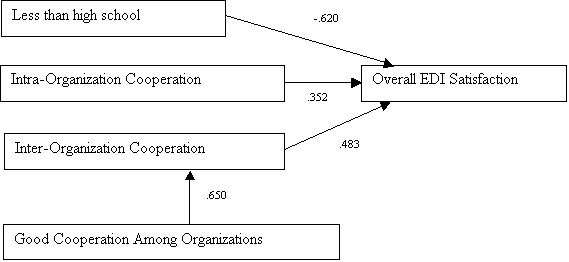
Figure 6.3 Estimation of Total Causal Effects for Transportation Subgroup
Total causal effects of factors affecting overall EDI satisfaction for transportation subgroup is shown in Figure 6.3 with path coefficients of independent variables shown in Table 6.10.
Direct, indirect and total causal effects of overall EDI satisfaction determinant for Transportation subgroup are shown in Table 6.11. There are four determinants affecting EDI satisfaction.
Table 6.10 Path Coefficients of Independent Variables (Standardized Regression Coefficients-Beta) in the Path Analysis, Transportation Subgroup
|
|
Dependent Variable in the Structural Equation |
|
|
Independent Variable |
Inter-Organization Cooperation |
Overall EDI Satisfaction |
|
Less than high school |
- |
-.620** |
|
Intra-Organization Cooperation |
- |
.352* |
|
Inter-Organization Cooperation |
- |
.483* |
|
Good Cooperation Among Organization |
.650** |
- |
|
R Square |
.422 |
.751 |
|
Adjusted R Square |
.390 |
.714 |
|
F |
13.136** |
20.353*** |
* P-value < 0.05, ** P-value < 0.01, *** P-value < 0.001
Table 6.11 Direct, Indirect and Total Causal Effects of Overall EDI Satisfaction Determinant, Transportation Subgroup
|
|
Dependent
Variable |
||
|
Determinant |
Overall
EDI Satisfaction |
||
|
|
Direct |
Indirect |
Total |
|
Less
than high school |
-.620 |
- |
-.620 |
|
Intra-Organization
Cooperation |
.352 |
- |
.352 |
|
Inter-Organization
Cooperation |
.483 |
- |
.483 |
|
Good
Cooperation among Organizations |
- |
.314 |
.314 |
The most important factor determining the level of EDI satisfaction is education attainment less than high school as shown in Table 6.11. Other important factors being found to have considerable influences are intra-Organization cooperation and inter-organization cooperation. Its substantial indirect effect goes through good cooperation among organizations.