
Chapter III












EDI LAWS AND ACTS
In Thailand, use of electronic communications is expanding rapidly both in commercial and non-commercial sectors. The Customs Department is preparing to adopt EDI for international commercial transactions by revising all legislation concerned and is seeking parliamentary approval for the amendment of those legislation. Digitalization and telecommunications technology pose a challenge to traditional Thai law.
In Thailand, as in all developing countries, the law governing on-line transactions is still in the embryonic stage. The fact is that this area of law remains undeveloped nationally and internationally. The fundamental legal issues need to be addressed at an international as well as national level to develop principles of contract that will fit the modern digital world.
On-Line Contract Law
Thai legal system is mostly influenced by Continental European civil law traditions although some specific law origin has been adopted and blended in Thai jurisprudence. The main statutory basis for governing private transactions is the Civil & Commercial Code (CCC) which is amended from time to time to cope with social and economic changes. The CCC retains the principle of freedom of contract. This means parties have autonomy in concluding an agreement, so long as the purpose of the agreement is not prohibited by law or contrary to good morals, or against public policy.
At present there is neither concrete legislation drafted to govern on-line contracts nor has there been any case raised before a Thai court on issues relating to offer and acceptance made over the Internet or EDI.
Under Thai law, an agreement to sell or to buy any property, or a promise of sale of such property is accepted only by written evidence signed by the liable party or
unless a deposit is given, or part performance is undertaken. For this discussion, it is assumed that the other formulations necessary to form a on-line contract (i.e. intention of the parties, contractual capacity and purpose of entering into a contract) are complete and legal.
Similar to the common law approach on the issue of contract terms/liability, Thai law also recognizes the principle of freedom of contract.
Digital
authentication and Enforceability
Authentication is a major factor of legal enforceability both substantively and procedurally. On the substantive law notion, authentication is an element of formation of a contract whereas in the procedural law respect it concerns the law of evidence and the issue of admissibility in the court. Under the Thai legal system, formalities are required in some special types of contracts. The formalities of a contract can be indicated as in writing and with signature.
Where a writing is required by law, it automatically means that a signature is essential. To facilitate international trade via on-line contract, the reliability and security for electronic commerce have been developed. Digital signature is a widespread practice in on-line transactions. As a technology importing country, public key encryption is practically accepted in on-line transactions in Thailand.
The existing laws which may be applicable to electronic commerce are the Telegraph & Telephone Act 1934 (B.E. 2477), the Radio & Television Broadcasting Act 1955, the Consumer Protection Act 1979 and the Civil & Commercial Code (CCC).
The Telegraph & Telephone Act 1934 (B.E. 2477)
The purpose of the Telegraph & Telephone Act 1934 is to regulate the provision of telegraphic and telephonic services. The rationale underlining this provision is to protect the integrity of telegraph and telephone service as a reliable system which will contribute benefit to the public as a whole. Certainly, this provision would well be applicable to on-line transactions.
The Radio & Television Broadcasting Act 1955
Data communications of which an on-line commercial transaction is a type can be transmitted by means of leased lines or radio wave. Under technical criteria, data communications is categorized as telecommunications service and it has never been legally classified as broadcasting. Moreover, the Radio & Broadcasting Act is aimed to regulate a broadcasting station set up domestically. The Act has no extra-territorial enforcement to any broadcasting station outside its jurisdiction.
The issue which is defendable is that electronic commerce does not fall within the definition of “broadcasting” under the Radio & Television Broadcasting Act. Moreover, the Radio & Broadcasting Act is aimed at regulating a broadcasting station set up domestically. The Act has no extra-territorial enforcement to any broadcasting station outside its jurisdiction.
The Consumer Protection Act 1977
The Consumer Protection Act applies to all kinds of commercial advertisement. Under section 22 of the Consumer Protection Act, advertisements must not contain any statement taking unjust advantage of the consumer, or any statement which may cause harmful effect to the society as a whole, regardless whether such statement is on the origin, condition, quality, or appearance of the goods or services through the delivery, procuring or application of the goods or service.
The Civil & Commercial Code (CCC)
Similar to the common law principle of tort, the liability for wrongful acts under the CCC is a remedy for non contract-based relationship.
The National Electronics and Computer Technology Center (NECTEC) announced in early January 1998 that it would appoint committees to study and draft the following laws:
 |
Data Protection, |
|
Computer Crime, |
|
Electronic Data Interchange Law, |
|
Digital Signature Law, |
|
Electronic Fund Transfer Law, and |
|
Telecommunication Law. |
Organizations Responsible for Policy Implementation
NITC supports use of IT policy in public and private sectors to develop our country to catch up with other modernized countries. Its main duty is to make IT policies.
The committee further appointed 7 sub-committees to be responsible for different duties; and one of these would take care of EDI. The 7 sub-committees are as follows:
|
Planning, |
|
Human resource development, |
|
Research and development, |
|
Law, |
|
Public awareness, |
|
Government computerization, and |
|
EDI for intertional trade. |
Subcommittee on EDI for International Trade
Its main duty is to be responsible for EDI development. It is chaired by the Director General of the Customs Department. The representative members are from various public and private agencies as follows:
|
Ministry of Commerce, |
|
Office of the Board of Investment, |
|
Thai Industrial Standards Institute, Ministry of Industry, |
|
The Port Authority of Thailand, |
|
The Airport Authority of Thailand, |
|
Communications Authority of Thailand, |
|
Thai Airways International, |
|
Federation of Thai Industries, |
|
Federation of Thai Chamber of Commerce, |
|
Thai Banking Association, |
|
Thai Air Freight Forwarders Association, |
|
Experts, and |
|
National Electronics and Computer Technology Center. |
The subcommittee has done some steps towards the development of EDI in Thailand. Accomplishments consist of:
|
Assessment of current practice and procedures involved in international trading cycle, and |
|
Defining scope of activities that would be involved in EDI development in international trade project. |
An EDI project proposal was developed and presented to the National IT Committee (NITC) in December 1992. The committee approved the project in principle. Further, it recommended that a more detailed study be conducted before any decision has been made regarding EDI implementing. To respond to the recommendation, NECTEC as a committee’s secretariat coordinating with the subcommittee proposed five alternatives for review. Subsequently, Andersen Consulting was chosen to conduct the feasibility study for a period of six months.
The study has completed and been forwarded for approval from the NITC and subsequently to the Cabinet. It included:
1. A private, for profit, national EDI service for international trade in Thailand should be established. This service will use public data networks rather than establishing its own. The name for this service is TradeSiam.
2. TradeSiam should start with A Regulatory System for communication with government bodies involved in international trade; and an Air Cargo Community System (ACCS).
3. International trade organizations that will be pivotal in the effectiveness of EDI in Thailand should choose TradeSiam as a sole domestic supplier of EDI services. The examples of international trade organizations are Customs, Thai Airways International, Port Authority of Thailand, and the Ministry of Commerce.
4. Funding for TradeSiam should come from a consortium of public and private business partners who could either benefit directly from EDI or have a vested interest in international trade in Thailand.
5. TradeSiam should be a private company with no more than 49 percent government ownership. No single party, either government or private, should own more than 25 percent.
6. Establish a Thailand EDI Council (TEDIC). This would also represent Thailand on the Asian EDIFACT Board. TEDIC should endorse EDIFACT as the sole standard for domestic EDI messages. TradeSiam would have a close relationship with TEDIC.
7. Initially, TradeSiam should keep its EDI service charges below cost, as an incentive for organizations to use it. Over a period of time the charges should be increased until they are in line with those of other EDI providers in Thailand.
For technology concern, there must have privacy which is there is no eavesdropping on communications, authentication which is there is no impersonate of network computers, and integrity which is there is no tampering with data as it was transmitted by the sender.
Elements of a security scheme comprise of:
|
An encryption algorithm – transforms plain text into encrypted message, |
|
An authentication algorithm – ensures integrity (the message has not been tampered with), and |
|
A key management protocol – generates and exchanges keys. |
Besides, the messages to be sent and received must be standardized. There will be a neutral organization to manage EDI for business. It is “TradeSiam”. This will be responsible for EDI Value-Added Network (VAN) and will operate EDI to serve the users’ needs. It acts like the public switching between trading partners and the international trade organizations.
To respond to the study, the establishment of TEDIC has been proposed, by the former subcommittee on international trade EDI, and got approval from NITC in December 1993.
Thailand EDI Council (TEDIC)
TEDIC includes a number of new committee members representing strategic operations such as chairman of each affiliated working group, managing director of the national EDI service provider, and representatives from public agencies. Under the chairmanship of the Customs Director General, TEDIC composes of representatives from:
|
Ministry of Commerce, |
|
Ministry of Transport and Communications, |
|
Board of Investment (BOI), |
|
Customs Department, |
|
Comptrollier-General’s Department, |
|
Revenue Department, |
|
Department of Foreign Trade, |
|
Department of Export Promotion (THAIPRO), |
|
Insurance Department, |
|
Department of Economic Affairs, |
|
Thai Airways International (THAI), |
|
Port Authority of Thailand (PAT), |
|
Telephone Organization of Thailand (TOT), |
|
Communications Authority of Thailand (CAT), |
|
Federation of Thai Industries (FTI), |
|
Federation of Thai Chamber of Commerce, |
|
Thai Banking Association, and |
|
NECTEC (as secretariat). |
TEDIC has the following mandates:
1. Establish policies and objectives on EDI for the country,
2. Set up working groups to develop EDI, support EDI utilization, develop message
standards study and recommend EDI-related legal framework,3. Facilitate and monitor the operations of the working groups and other relevant
agencies on EDI to follow the government policy and objectives,4. Manage the establishment of the national EDI service provider according to the
government’s direction,5. Represent Thailand in coordinating and consulting with other nations in international
EDI development,6. Carry out other EDI-related activities, and
7. Carry on work, study result and development plan from the former subcommittee on
EDI.
Under TEDIC, there are 3 functional groups of people working together, namely,
1. Service & Support group (SSG),
2. Messages Development Group (MDG), and
3. Legal working group (LWG).
SSG is a working group responsible for promoting awareness and education both in public and user communities, as well as preparing all necessary standards and materials for them.
MDG has to look after its industrial sector’s electronic messages development. It will work jointly with Thai Industrial Standard Institute (TISI) technical committee and Ministry of Transport and Communications (MOTC) EDI Subcommittee on Multi-modal Transport.
It has a mission to help matured users to cope with legal problems. That is to seek for interim solutions while related laws have to be reformed e.g. to prepare a standard agreement for trading partner, etc. The LWG is expected to work closely with the NITC subcommittee on IT Legal Infrastructure.
Agencies involved with EDI in Thailand
The Customs Department
The Customs Department is one of public agencies that deals with trading. The clearance process here is said to be important since import and export do affect the country’s economics. The government has been trying to reduce the bureaucratic processes by introducing EDI.
The Customs Department realized that the appropriate technology was essential to support international trading at this moment (Tax & Business Law Magazine 21, November 1999). This is not only responsive to the government policy to plan for economic growth and international trade but also to increase Customs Department’s management efficiency. The agency spent more than 1,000,000,000 Baht. for this issue including purchasing high efficient computers ranging from PCs to mainframe.
The Customs Department uses only one database for import-export oriented e.g. VAT refund, compensation to contact with Ministry of Industry, Ministry of Commerce, Bank of Thailand, etc. For The Customs Department, they aim for themselves that this should be used for quick information services concerning import-export value. The trading partners should gain the benefits as follows:
1. The clearance process should be fast,
2. The errors should be reduced,
3. The inventory management cost should be reduced,
4. The paper cost should be reduced,
5. The time should be more saved,
6. The information should be up-to-date, and
7. Entrepreneurs using EDI will be more advantageous than outside system entrepreneurs.
The agency tries to most facilitate EDI users resulting that the process for Non-EDI users would be slower. The outside system users must spend more money for the clearance process. There may be data mistakes while in customs clearance process. Moreover, The process steps will not be reduced.
EDI has been fully implemented on November 1, 1999 mainly aiming to ease custom clearance for international trade entrepreneurs. All custom brokers must unavoidably enter an EDI system. The Customs Department would not facilitate the private sector if they are using a non-EDI system for clearance process. Besides, the central part of Customs Department would cancel a manual system within November 1999. EDI is expected to reduce people involved around 80 percent. In order to use EDI system with the Customs Department, trading partners must have resources, equipment, and time as follows:
-
PC, printers, modem
-
Computer programs according to Customs Department standard
-
Data entry program according to Customs Department standard
-
EDI software package according to UN/EDIFACT
-
EDI Van Service Provider
-
Registration (Free of charge)
-
Testing (Free of charge)
-
Implementing (Customs Department will not charge their users for this)
The Port Authority of Thailand (PAT)
The overview of inward container EDI system can be described as follows:
1. Marine agent sends the manifest via EDI system six hours in advance of the custom clearance. The examples of EDI data are shown in Figure 3.1 and 3.2.
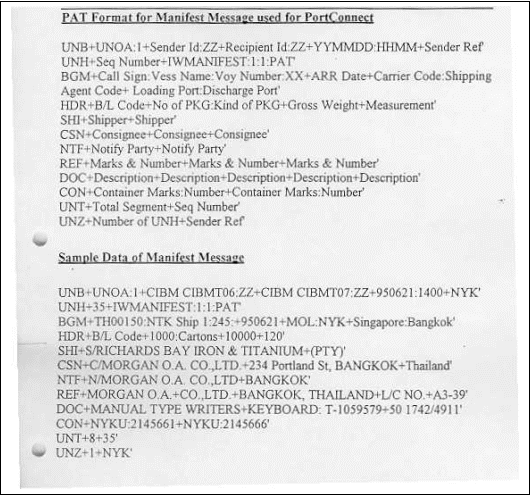 |
Figure 3.1 PAT format for Manifest Message and Sample Data of Manifest Message.
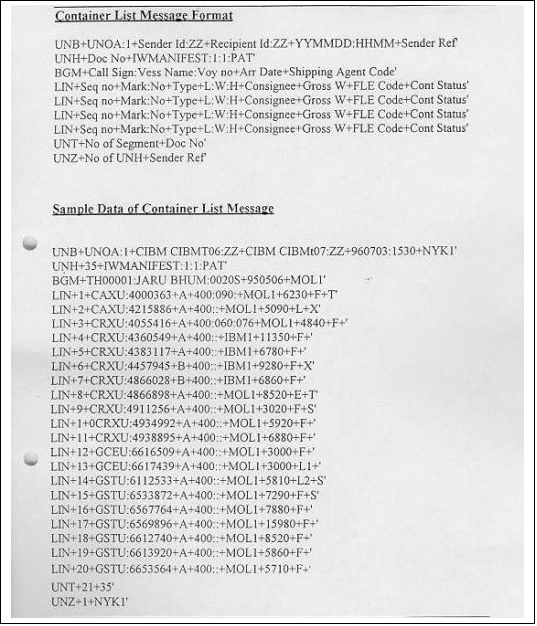 |
Figure 3.2 Container List Message Format and Sample Data of Container List Message.
The diagram of EDI data transfer between PAT and trading
partners is shown in Figure 3.3.
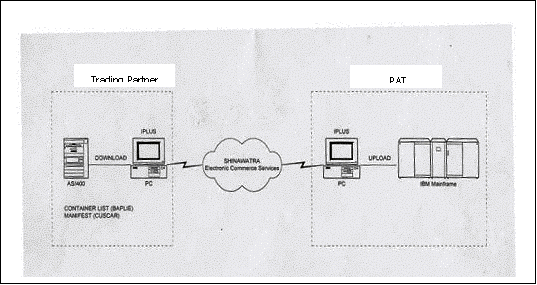 |
Figure 3.3 EDI Data Transfer between PAT and Trading Partners
2.
Terminal 1 and 2 retrieve and check the data for correctness. The
diagram of translation from text file of to EDI file of trading partner in
order to send to PAT is shown in Figure 3.4.
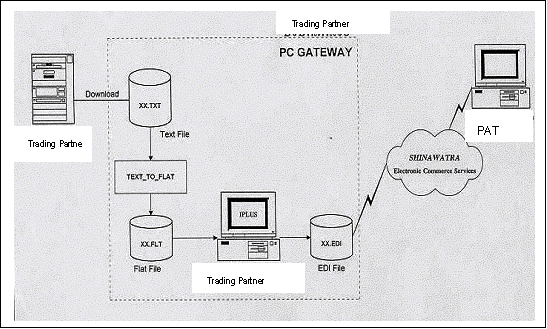 |
Figure 3.4 Translation from Text File to EDI File
The diagram of translation from EDI to text file at PAT
is shown in Figure 3.5.
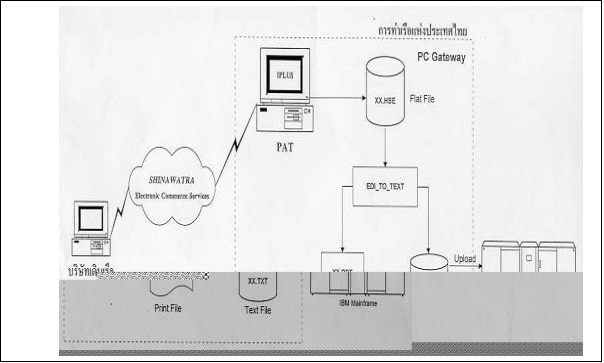
Figure 3.5 Translation from EDI
to Text File
3. If there are no errors, the data will be uploaded to mainframe and every concerned function can access the data. Otherwise, the computer will inform the exporter to retransmit the correct data.
4. Inspectors check the merchandise.
In order to implement an EDI, PAT trading partners must prepare
1. Personnel computer (CPU 386 onward) with 4 MB RAM, HD at least 50 MB, DOS
version 3.0 up.2. Asynchronous data modem and serial cable
3. Expedite/PC or Expedite/Base programs
4. Standard translation program
5. Telephone line
6. CAT/IIN (IBM Information Network) membership fee
The estimated cost is as follows:
1. Computer 30,000 Baht.
2. Asynchronous modem 6,000 Baht.
3. Expedite program 6,320 Baht.
4. Standard translation program 20,000-50,000 Baht.
The estimated CAT/IIN network cost is as follows:
1. Yearly
1.1 Membership 15,630 Baht.
1.2 Mail Box 7,383 Baht.
1.3 Minimum usage 7,200 Baht.
2. One payment
2.1 Registration, installation, linkage, test 50,800 Baht.
Transaction Cost is as follows:
|
7,200 Baht. = 10 units |
|
1,000 characters ~ 3.1 Baht. |
|
7,200 Baht. can be used to transmit 2.3 million characters |
PAT inward manifest data transmission is diagramed as shown in Figure 3.6.
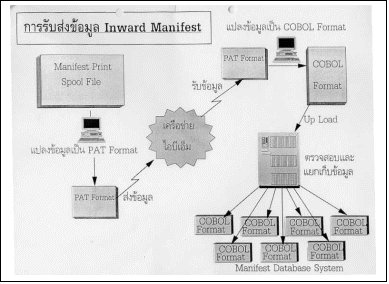 |
Figure 3.6 PAT Inward Manifest Data Transmission
Thai Airways International Plc. (THAI)
The EDI first phase has been targeted to implement about freight. THAI involves in EDI project because it has air transportation to carry cargo. TradeSiam will play the important role in connecting to every partner and being the interface among these partners to Customs.
THAI has two kinds of cargo customers. The first kind of customer is freight forwarders which are cargo agents and the other kind is airline partners.
Freight forwarders will contact Customs concerning customs declaration and contact THAI to send the cargo. The customs declaration is aimed to send by EDI CUSDEC, the standard name of customs declaration EDI. This is implementing. Message Implementation Guideline for General Customs Declaration Message on Export (GDEX) is shown in Appendix.
For other airlines, normally, among airlines, they send and receive document via EDI but with the different standard called CARGO-IMP. This standard has been using for more than 20 years. However, to contact with the Customs Department via TradeSiam, THAI has to use UN/EDIFACT standard. In other countries, there must be a conversion software to convert these standards back and forth. The organization who does the conversion is the interface organization and it is TradeSiam in this case.
Before setting up TradeSiam, there were several partners who are interested in being shareholders including IATA and GE (Thailand). IATA is the expert organization about airline affairs since it is the International Aviation Organization and it knows well about EDI standard conversion. Finally, GE is the shareholder but they cannot implement the EDI standard conversion. They have asked the consultant from India and in the stage of implementing. Therefore, THAI is unable to participate in the EDI with Customs via TradeSiam for Export so far and still wait for TradeSiam to complete the conversion.