 |
 |
 |
 |
 |
|
|
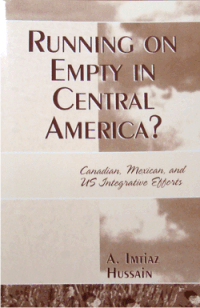
RUNNING ON EMPTY IN CENTRAL AMERICA? CANADIAN, MEXICAN, AND US INTEGRATIVE EFFORTS
Abstract: What led Canada, Mexico, and the US to deepen Central American (CA) economic ties? All belong to NAFTA and FTAA, but only one succeeded, another failed, and a third still struggles. Why? Could how they negotiated explain the results? A structured focused analysis (George 1979) of Canada’s Central American Four Free Trade Agreement (CA4FTA), Mexico’s Plan Puebla-Panama (PPP), and the US Central American Free Trade Agreement (CAFTA) reveals common Washington Consensus thrusts, diverging domestic interests, and disparate outcomes: (a) Canada’s trigger was development, Mexico’s restructuration, and US’s strategic imperatives; (b) relative economic size and deeper trading history bred US success, Canadian failure, and Mexico’s sputtering; (c) lesser developed CA countries embrace was matched by corporatist reactions in developed Costa Rica; and (d) negotiations paradigms accenting asymmetry (Habeeb 1988), explained more than others (Feinberg 1997). Among implications: (a) Canada and Mexico may be better free-riding US initiatives; (b) irreversibly liberalizing CA widens societal and environmental gaps; and (c) anticipated CAFTA ratification strengthens FTAA momentum at Brazil’s expense. Meant for students/scholars of international political economy, North, Central, and Latin America, as well as comparativists and negotiation theorists, the book also appeals to political scientists and transnationalists in this hemisphere and elsewhere.
|
|