E) The Quran on Seas and
Rivers |
|
Modern Science has discovered that in the
places where two different seas meet, there is a barrier between
them. This barrier divides the two seas so that each sea has
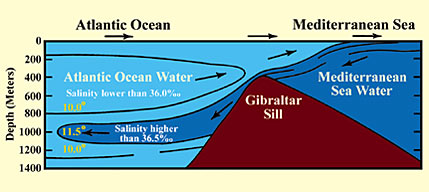
its own temperature, salinity, and density.1 For example, Mediterranean sea water is
warm, saline, and less dense, compared to Atlantic ocean
water. When Mediterranean sea water enters the Atlantic over
the Gibraltar sill, it moves several hundred kilometers into the
Atlantic at a depth of about 1000 meters with its own warm, saline,
and less dense characteristics. The Mediterranean water
stabilizes at this depth2
(see figure 13).
|
|
|
|
Figure 13: The Mediterranean sea
water as it enters the Atlantic over the Gibraltar sill with its own
warm, saline, and less dense characteristics, because of the barrier
that distinguishes between them. Temperatures are in degrees
Celsius (C°). (Marine Geology, Kuenen, p. 43, with a slight
enhancement.) |
Although there are large waves, strong currents,
and tides in these seas, they do not mix or transgress this
barrier.
The Holy Quran mentioned that there is a barrier
between two seas that meet and that they do not transgress. God has
said:
 He has set free the two
seas meeting together. There is a barrier between them. They
do not transgress.
He has set free the two
seas meeting together. There is a barrier between them. They
do not transgress.  (Quran, 55:19-20)
But when the Quran speaks about the divider
between fresh and salt water, it mentions the existence of “a forbidding
partition” with the barrier. God has said in the Quran:
He is the one who has set
free the two kinds of water, one sweet and palatable, and the other salty
and bitter. And He has made between them a barrier and a forbidding
partition. (Quran, 25:53)
One may ask, why did the Quran mention the
partition when speaking about the divider between fresh and salt water,
but did not mention it when speaking about the divider between the two
seas?
Modern science has discovered that in estuaries,
where fresh (sweet) and salt water meet, the situation is somewhat
different from what is found in places where two seas meet. It has
been discovered that what distinguishes fresh water from salt water in
estuaries is a “pycnocline zone with a marked density discontinuity
separating the two layers.”3
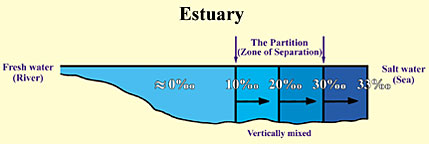
This partition (zone of separation) has a different salinity from the
fresh water and from the salt water4 (see
figure 14).
|
|
|
Figure 14: Longitudinal section
showing salinity (parts per thousand ‰) in an estuary. We can
see here the partition (zone of separation) between the fresh and
the salt water. (Introductory Oceanography, Thurman, p. 301,
with a slight enhancement.) |
This information has been discovered only
recently, using advanced equipment to measure temperature, salinity,
density, oxygen dissolubility, etc. The human eye cannot see the
difference between the two seas that meet, rather the two seas appear to
us as one homogeneous sea. Likewise, the human eye cannot see the
division of water in estuaries into the three kinds: fresh water, salt
water, and the partition (zone of separation).
_____________________________
Footnotes:
(1) Principles of
Oceanography, Davis, pp. 92-93. 
(2) Principles of
Oceanography, Davis, p. 93.
(3) Oceanography,
Gross, p. 242. Also see Introductory Oceanography, Thurman,
pp. 300-301.
(4) Oceanography,
Gross, p. 244, and Introductory Oceanography, Thurman, pp. 300-301.
_____________________________