A) The Quran on Human
Embryonic Development
In the Holy Quran, God speaks about the
stages of man’s embryonic development:
 We created man from an
extract of clay. Then We made him as a drop in a place of
settlement, firmly fixed. Then We made the drop into an
alaqah (leech, suspended thing, and blood clot), then We made the
alaqah into a mudghah (chewed-like substance)...
We created man from an
extract of clay. Then We made him as a drop in a place of
settlement, firmly fixed. Then We made the drop into an
alaqah (leech, suspended thing, and blood clot), then We made the
alaqah into a mudghah (chewed-like substance)...  1 (Quran, 23:12-14)
Literally, the Arabic word alaqah has
three meanings: (1) leech, (2) suspended thing, and (3) blood clot.
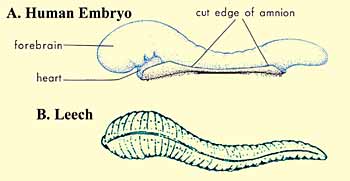
In comparing a leech to an embryo in the
alaqah stage, we find similarity between the two2 as we can
see in figure 1. Also, the embryo at this stage
obtains nourishment from the blood of the mother, similar to the leech,
which feeds on the blood of others.3
|
|
|
Figure 1: Drawings illustrating the
similarities in appearance between a leech and a human embryo at the
alaqah stage. (Leech drawing from Human Development as
Described in the Quran and Sunnah, Moore and others, p. 37,
modified from Integrated Principles of Zoology, Hickman and
others. Embryo drawing from The Developing Human, Moore
and Persaud, 5th ed., p. 73.) |
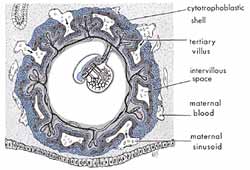
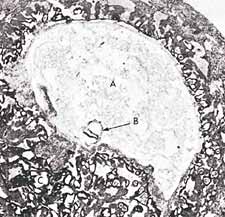
The second meaning of the word alaqah is
“suspended thing.” This is what we can see in figures 2 and 3, the
suspension of the embryo, during the alaqah stage, in the womb of
the mother.
|
Figure 2: We can see in this diagram
the suspension of an embryo during the alaqah stage in the
womb (uterus) of the mother. (The Developing Human, Moore and
Persaud, 5th ed., p. 66.) |
|
|
Figure 3: In this photomicrograph,
we can see the suspension of an embryo (marked B) during the
alaqah stage (about 15 days old) in the womb of the
mother. The actual size of the embryo is about 0.6 mm. (The
Developing Human, Moore, 3rd ed., p. 66, from Histology,
Leeson and Leeson.) |
|
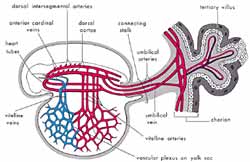
The third meaning of the word alaqah is
“blood clot.” We find that the external appearance of the embryo and
its sacs during the alaqah stage is similar to that of a blood
clot. This is due to the presence of relatively large amounts of
blood present in the embryo during this stage4 (see
figure 4). Also during this stage, the blood in the embryo does not
circulate until the end of the third week.5
Thus, the embryo at this stage is like a clot of blood.
|
Figure 4: Diagram of the primitive
cardiovascular system in an embryo during the alaqah
stage. The external appearance of the embryo and its sacs is
similar to that of a blood clot, due to the presence of relatively
large amounts of blood present in the embryo. (The Developing
Human, Moore, 5th ed., p. 65.) |
 |
So the three meanings of the word alaqah
correspond accurately to the descriptions of the embryo at the
alaqah stage.
The next stage mentioned in the verse is the
mudghah stage. The Arabic word mudghah means
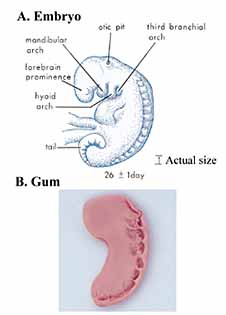
“chewed-like substance.” If one were to take a piece of gum and chew
it in his or her mouth and then compare it with an embryo at the
mudghah stage, we would conclude that the embryo at the mudghah
stage acquires the appearance of a chewed-like substance. This
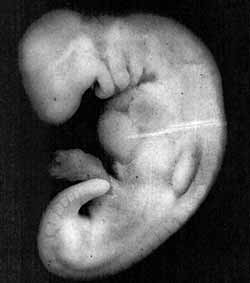
is because of the somites at the back of the embryo that “somewhat
resemble teethmarks in a chewed substance.”6 (see
figures 5 and 6).
|
Figure 5: Photograph of an embryo at
the mudghah stage (28 days old). The embryo at this
stage acquires the appearance of a chewed-like substance, because
the somites at the back of the embryo somewhat resemble teeth marks
in a chewed substance. The actual size of the embryo is 4 mm.
(The Developing Human, Moore and Persaud, 5th ed., p. 82,
from Professor Hideo Nishimura, Kyoto University, Kyoto,
Japan.) |
|
|
Figure 6: When comparing the
appearance of an embryo at the mudghah stage with a piece of
gum that has been chewed, we find similarity between the
two.
A) Drawing of an embryo at the mudghah
stage. We can see here the somites at the back of the embryo
that look like teeth marks. (The Developing Human, Moore and
Persaud, 5th ed., p. 79.)
B) Photograph of a piece of gum
that has been chewed. |
|
How could Muhammad(SAW) have possibly
known all this 1400 years ago, when scientists have only recently
discovered this using advanced equipment and powerful microscopes which
did not exist at that time? Hamm and Leeuwenhoek were the first
scientists to observe human sperm cells (spermatozoa) using an improved
microscope in 1677 (more than 1000 years after Muhammad(SAW). They mistakenly thought that the sperm cell contained a
miniature preformed human being that grew when it was deposited in the
female genital tract.7
Professor Emeritus Keith L. Moore8 is one of
the world’s most prominent scientists in the fields of anatomy and
embryology and is the author of the book entitled The Developing
Human, which has been translated into eight languages. This book
is a scientific reference work and was chosen by a special committee in
the United States as the best book authored by one person. Dr. Keith
Moore is Professor Emeritus of Anatomy and Cell Biology at the University
of Toronto, Toronto, Canada. There, he was Associate Dean of Basic
Sciences at the Faculty of Medicine and for 8 years was the Chairman of
the Department of Anatomy. In 1984, he received the most
distinguished award presented in the field of anatomy in Canada, the
J.C.B. Grant Award from the Canadian Association of Anatomists. He
has directed many international associations, such as the Canadian and
American Association of Anatomists and the Council of the Union of
Biological Sciences.
In 1981, during the Seventh Medical Conference
in Dammam, Saudi Arabia, Professor Moore said, “It has been a great
pleasure for me to help clarify statements in the Quran about human
development. It is clear to me that these statements must have come
to Muhammad from God, because almost all of this knowledge was not
discovered until many centuries later. This proves to me that
Muhammad(SAW) must have been a messenger of God.”9
Consequently, Professor Moore was asked the
following question, “Does this mean that you believe that the Quran is the
word of God?” He replied, “I find no difficulty in accepting
this.”10
During one conference,
Professor Moore stated, “....Because the staging of human embryos is
complex, owing to the continuous process of change during development, it
is proposed that a new system of classification could be developed using
the terms mentioned in the Quran and Sunnah (what
Muhammad(saw) said, did, or approved
of). The proposed system is simple, comprehensive, and conforms with
present embryological knowledge. The intensive studies of the Quran
and hadeeth (reliably transmitted reports by the Prophet
Muhammad’s (SAW) companions
of what he said, did, or approved of) in the last four years have revealed
a system for classifying human embryos that is amazing since it was
recorded in the seventh century A.D. Although Aristotle, the founder
of the science of embryology, realized that chick embryos developed in
stages from his studies of hen’s eggs in the fourth century B.C., he did
not give any details about these stages. As far as it is known from
the history of embryology, little was known about the staging and
classification of human embryos until the twentieth century. For
this reason, the descriptions of the human embryo in the Quran cannot be
based on scientific knowledge in the seventh century. The only
reasonable conclusion is: these descriptions were revealed to Muhammad
from God. He could not have known such details because he was an
illiterate man with absolutely no scientific training.”11
_____________________________
Footnotes:
(1) Please note that what
is between these special brackets ... in this web site is only a translation of the meaning of the
Quran. It is not the Quran itself, which is in Arabic. 
(2) The Developing
Human, Moore and Persaud, 5th ed., p. 8.
(3) Human Development
as Described in the Quran and Sunnah, Moore and others, p. 36.
(4) Human Development
as Described in the Quran and Sunnah, Moore and others, pp. 37-38.
(5) The Developing
Human, Moore and Persaud, 5th ed., p. 65.
(6) The Developing
Human, Moore and Persaud, 5th ed., p. 8.
(7) The Developing
Human, Moore and Persaud, 5th ed., p. 9.
(8) Note: The occupations
of all the scientists mentioned in this web site were last updated in
1997.
(9) The reference for this
saying is This is the Truth (video tape). For a copy of this
video tape please contact one of the organizations listed on this
page.
(10) This is the Truth
(video tape).
(11) This is the Truth
(video tape). For a copy, see footnote no. 9.
_____________________________