| Baxter :
The Brighton Coastal World |
 |

|
|
| Styles of 120 Camera
There is also wide variety of camera types that take this size film (120) and camera types within each format, and perhaps the most familiar is the old box brownie type camera. These can often be found still working in junk sales and there is no reason why they can not be used today with interesting results if the photographer is aware of the specific characteristics created by the poor quality lenses. If you are buying one of these, be aware that there are also 620 cameras around that have the some film width but have a different hole size on the spool and will not connect with the 120 film spool. Usually these cameras have very limited exposure controls if any. Although the lenses tend to be rather poor, the larger film size, 6 x 9 produces quite good results if the images are not enlarged up too much, or perhaps this may add a special quality to your work? There are also older type folding cameras that take this size film and they can also be fun to use. These generally have a wider variety of shutter speeds and aperture settings and if you are buying one, as with any camera it is usually the slower shutter speeds that stop working first. With both these cameras the viewing systems are usually direct vision although some folding cameras will often have a coupled range finder that allows the photographer to focus more accurately. The Diana camera takes 120 film and the low qualityplastic lenses produce
images with a umique sense of beauty. There has been a cult grow around
this camera and many sites can be found on the web that outline this.
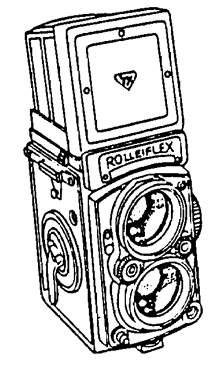
Twin Lens Reflex
The image however, is laterally reversed in the ground glass screen and while some photographers find this a better way of composing the image as it fits in with the left right brain theory other photographers find it awkward and clumsy. They are very quiet to use, having a synchro-confur shutter and no mirror flapping about. Some photographers who take images of people find an affinity with these cameras as it can appear that the photographer is engaged somewhere else, which helps to relax the person sitting in front of the camera. They tend to have a good range of shutter speed and aperture settings, and most use the square 6x6 format; although some can be converted to take 35mm film as well as 120. A few of these cameras allow interchangeable lenses, but this has to be done by a plate that contains both the upper viewing and the lower taking lens and because of the twin lenses can be expensive.
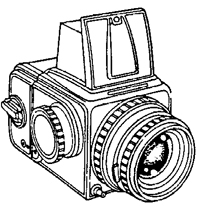
The viewing system can be a simple folding type which produces a laterally reversed image on a ground glass screen, or a larger and heavier prism that corrects the image and is also easier to use if the camera body is used at an angle other than level. The Ground glass screen that the image is focused onto can often be changed as well to suit the particular lens being used at the time. The other inter-changeable part is the film back, and depending upon the camera unit, not only can the back be changed with different types of film, it can also be changed for different formats. An example is 6x6, 6x4.5, two different size backs to take 35mm film, one 1.5 times longer than the normal size, and even a polaroid back for instant film use. The polaroid back can be useful when there is something very important that is being photographed and it will allow the photographer to shoot several images with the instant film to arrange the image between shots. Once the image is right, the other film back can be clipped on and the photograph taken on the desired film stock. Polariod film has its own characteristics and can also be used for this alone on a system that allows interchangeable lenses and a wide range of exposure options. As with the 4x5 film holders, each film back has a dark slide that can
be slid across to protect the film from light and allow the back to be
removed. Nearly all these types of camera will not operate without the
dark slide pulled out, but there can be a trap in that some cameras allow
the film back to come off without the dark slide in place which would ruin
the film.
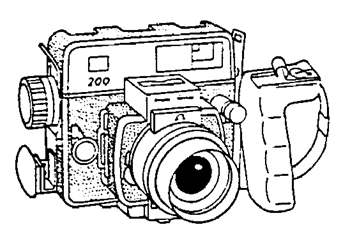
It is useful to note that while there are some cameras that fit the visual look of these types, they do not have the versatility of the interchangeable back and will often only take 6x4.5cm format images. An addition to some of these cameras is the motor winder that winds on the film automatically. The Hasselblad 500el has this built in as standard or couples on the side of the camera body. While some of these cameras have focal plane shutters and go off with a real bang compared to the twin lens reflex cameras, even the ones with synchro-confur shutters make quite a noise. This is also due to the large viewing mirror swinging up out of the way to let the image project back to the film for the taking of the photograph. It also means that the photographer must have a good sturdy tripod that will not flex or move with the weight of the camera and this movement of the mirror during the exposure. While the leaf shutters may have the advantage of quietness etc, they are built into the lens, not the camera, and the shutter speeds may vary between lenses, where as the focal plane shutter is built into the camera body and will generally produce more consistent results when a wide variety of lenses are use. These cameras can be VERY EXPENSIVE compared to most 35mm cameras,
and a body alone can be as much as $5,000 with the lenses because of the
size of the glass costing much more than 35mm camera lenses.
|