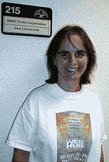
by Ann Lynnworth
CEO - HREF
Tools Corp.
July 12, 1999
|
An
Article on Programming, Delphi and Life
by Ann Lynnworth
|
| After many interviews on our web site with male programmers, I wanted
to get an article from a female programmer, and the name that stands out
is Ann Lynnworth.
And I have to say, after reading her article below, I am impressed. --James Sandbrook |
|
|
|
| It's not often that someone asks me to write
about the personal motivations behind my business life - why did I do it,
how was it, should anyone else take the same path? But James Sandbrook
did, and here I am, several weeks later, looking at a mostly blank file
with all these ideas running around in my mind. How do I give you
a glimpse that somehow still contains the whole...
I will start by telling you *what* I've done, as it relates to programming. I first worked with computers in 1979, when I learned Word Perfect on a DataGeneral system at an engineering firm. A couple of summers later, I designed and wrote a small book called WordStar at your Fingertips. It never sold more than 50 copies because no one in my circle of helpers had any marketing experience. However, a couple of years later it was personally valuable to me because I was able to show it to someone who proved to be extremely influential in my attitude toward programming. There was a man named Michael Spier who lived in Cambridge, Massachusetts in the early 80s. He was working on a windowing and text presentation system that ran on DOS 2.1. It was called WinDos. He was using WinDos to store hyper-linked, highly compressed documents. He could fit an encyclopedia on a floppy disk. He had experience in writing Unix and he had written his own file compression software. When I think back, now, on the concepts and techniques he was working on already then, I really have to pause out of respect. My most vivid memory is of standing by his side while he made me a diskette to take home with the authoring software I was to use. Of course I had seen people put files on disk before. But I had never seen anyone make subdirectories with such a deep understanding of a file system, or make a BAT file with such a love of simplicity and reusability. It was perhaps akin to watching a yogi walk across a street - an action that one sees every day, executed with a grace and presence of mind that is electrifying. I remember "waking up" to the programming goal of balanced elegance and efficiency, to the inner beauty within really good code that expresses really clear thinking. I had seen it once, and after that, always strove to recreate that myself and to treasure it in others. I created three software packages myself in the years following: Situation Analyst in Basic, then Ronstadt's Financials in C and a chemical calculator in C. Then I took a rest for a while, and worked part-time as a Paradox consultant through a firm in the Boston area, X/L Proteus, which I am very glad to have been associated with. I built a number of database-driven systems there, and learned what little I know of SQL there. I got to work on a lot of different companies' systems, which was good because it gave me an understanding of the commonalties across business systems. I built an in-house tool together with the other programmers. I named it "Sit Back 'n Relax." It was a system that would generate entire Paradox (for DOS) database applications, complete with data entry and reporting. You could literally give it a few inputs, wait a few minutes, and have a system that in the past had taken us days to create. I remember the first on-site installation I had to do for a client. I had only been with the company for a week or so, and I had finished a deliverable that had to go to a big cable company in downtown Boston. I was very exited, and prepared by disk and everything so I could give them the system I had put together. Well I got there and realized that I had brought my ZIP file, but no one had pkunzip. Oh! It hadn't occurred to me that there were people who could live without that vital utility. But here I was, face to face with a whole department that could live without it. So I had to make another appointment for the installation. You can believe I haven't forgotten that lesson. Back then, I worked from home fairly often. Certainly when I was writing the software packages, I worked entirely out of a home office. When I was working on Situation Analyst, I shared a small cottage on a lake in Holliston, Mass. with a friend and her family. I bought a raft, and when I had to brainstorm some new way of doing something, I'd paddle my raft upstream and then float to the other end of the lake. Usually about half way there I'd have a pretty good idea of the next step, but I'd go the rest of the way just in case. That was probably the best environment I ever had for programming - a completely relaxing, fun rest was always just a few minutes away. I moved around a lot during those years, and built up various offices for myself. I always built my desk out of two file cabinets with a board across - that was the best setup for me because I'd have my filing space and a huge work area. I like to have a lot of room to put out papers when I'm working on a complicated system. Usually as I get further into it, I move more and more of the information into my head and off the desk and walls. But certainly when I start projects, I start with data structure drawings and data dictionary printouts. When I worked with the consulting firm, I often drove to their office, but not always. They had PC Anywhere and any of us could work from home when we wanted. I remember that was when I learned how their system could call me back at home, so that I wouldn't have to pay the phone charges. I always thought that was a great benefit! It's funny how the little details come back. Then around 1988 my life changed. I sold my house in Arlington, Massachusetts, moved into a motor home with my then significant other, and went "on the road" for two and a half years, doing Paradox training classes in every major city around the U.S. and just generally gallivanting around. We went 80,000 miles, more or less making figure 8's around the country. It was fascinating, adventuresome, eye-opening and exhausting. James Sandbrook asked me whether anything funny happened while we were on the road. You know, I suppose a lot of it is funny, now, looking back. At the time, we were always trying to do something, so the unexpected mishaps just felt like annoying obstacles to overcome. Sometimes they were very annoying. The thing about a motor home is that it includes a lot of interlocked systems - not just the driving engine, but heating, cooking, refrigeration, and plumbing, plus we had solar panels and two computers on board. So there were lots of things that could break from all the rattling along the highway, not to mention the temperature changes. If we were in a northern city and the heating didn't work, we really couldn't proceed until that was fixed. The worst accident of all was one that ironically we brought upon ourselves. My friend was driving the motor home, and I was following in the same lane, driving a rental car along one of the highways south of Chicago. Suddenly the right rear hubcap flew off the motor home, and came whizzing straight toward me. It was like one of those Oriental fighting disks, thrown in the heat of battle - it was aimed right at me. I swerved to miss it, which I did, but I failed to take into consideration a vehicle that was parked in the emergency lane. There was a pickup truck, with a young boy standing to one side and a man lying underneath the carriage of the car, looking to fix something. The boy saw me coming and yelled to the man to get out from under the truck, which was good. the man did move. Moments later I crashed into the back of the truck. I could sort of see it about to happen, and my mind flashed on the utter unfairness of how drunk drivers do not get harmed in accidents. Flash! I pretended to be as drunk as I ever had been. Crash! My car hit, the front area crumpled up, my head hit the windshield. A short while later an emergency medical guy was holding my head and neck and asking me questions like what day it was. I thought that was really unfair because I never wear a watch and I always have to really concentrate to figure out what calendar day it is. I said something and they knew I was regaining consciousness. They took me to the hospital and checked me out, couldn't find much wrong and released me. I saw rainbows whenever I read for the next two days, and I had a sprained ankle for a while, that was all. During all that time, there was so much going on that this was just one event in a very long stream of loud events. After two and a half years, it was time to do something else. We settled down in a tiny town (population 200) in the redwoods north of San Francisco, and basically retreated for a year. I kept working with a few clients that I had met while working on the road, and telecommuted with my 28.8 modem to Washington DC and San Francisco on a regular basis. That was my last important modem. It had a sticker of the earth-from-space on it. That was my reminder that all this dialing around was really all about was making a world with new lines of communication. |
Ok, let's fast forward to late 1994 when Delphi
1 was pre-announced by Borland. I was invited to attend a pre-release training
at Borland to find out about Delphi. I was very interested, even
though at that time I didn't know any Pascal. I just felt that Paradox
for Windows was a step backwards from Paradox for DOS in terms of being
a development platform, and I was open to see what they had cooked up.
So I went to this early training. I think there must have been about 200 people there, including maybe 5 women of which I obviously was 1. This might be a good moment to detour into the topic of being a woman in such a male profession. I have to say, that aspect of things never bothered me. I was always raised to believe that women have brains (and I have to dispute Terry Pratchett's view that they overheat from too much reading). The men of my generation, so to speak, have always been completely fine to work with. Once in a while I get an email from overseas where the writer assumes that I am male ("Dear Sir..."), but those just make me laugh. The other day I had sort of a sexist run-in with someone new in the office building here, and it stuck out as being so unusual. It made me very grateful that I don't have to fend off such things on a daily basis, as I'm sure earlier generations of female scientists had to. ... But it's an important question, what makes me want to be in this profession, and would, or should, that apply to other women as well? I like building things, and writing software is a way of building things. I also love that I can try things, and keep changing pieces until it's right. When I try to build things in the physical world, like wiring electrical outlets with my brother to build a house, the lack of the Undo key is quite evident to me. Probably at the deepest level, I am fascinated by creation, by the process of mind influencing tiny bits, then organized bytes, then recognizable shapes, then building up systems that span the globe and let hearts meet. ... There's also the autonomy; I have never found any other type of work where I could make as many decisions myself and have as much control over my life. ... None of this is to say that programming is an easy career. It's not. Nine days out of ten it is entirely thankless. I'm the type of person who craves 'thanks' so I have engineered things so that people know what I do and can say thanks. But most programmers are so far removed from their users that there is no direct connection. For some, that's a plus! For me, I could never be buried in cube #43922 inside a giant programming group. I need the interaction with people. End, digression! So I went to this early Delphi training at Borland in Scotts Valley. I immediately loved Delphi because I could see that it would let me build software that I could sell. I saw product potential, from the very beginning, because I could create standalone EXEs that did not require something like "runtime Paradox" in order to run for people. That felt like such freedom. And of course I was intrigued by the component idea, to be able to just drop little pictures onto a form and have them turn into an application, that was just too smart to be overlooked. I started using Delphi right away to rewrite my own contact database system, and several other little systems. It was difficult for me, at first, because I didn't know any Pascal. I knew C, so I knew the ideas, but I didn't know any of the syntax. I remember sitting in the early code clinic, being completely confused between a string and a stringlist. I just wanted to make a variable that was as stringlist, and I didn't understand that I had to allocate memory for it, and I didn't know where to look to figure out the syntax. I was getting pretty frustrated, and then David Intersimone came by and showed me how to say .Create and get a pointer that way. Sigh of relief! Of course I had many other moments of feeling entirely frustrated, like there was no way out, and then usually finding some answer somehow. The training is also where I met Michael Ax, the co-founder of HREF Tools Corp. Michael stood out, for me, as someone whose inner lights were burning with a certain type of ferocity, and that just grabbed my attention! We started talking about all sorts of things, and then drifted apart for about six months. During that time, we both stayed very active with Delphi although in very different ways. He wrote tPack and I started checking on the web and figuring out how to do cgi programming on the Windows (not Unix) platform. I taught a class called the InfoBahn Construction Workshop at the Santa Rosa Junior College in the spring of 1995, and the more I saw, the more I was sure that the initial burst of static sites would have to be short-lived, and that dynamic database-driven sites would have to take over. I saw a lot of opportunity for Delphi to make a stand on the Internet, just because it was such a great development platform. Around June of that year, I ended up meeting with Michael again in New York where he lived, and that's when WebHub was born. We initially tried to sell it to Borland, but the timing was not right for them, and that's why HREF Tools Corp. was born in September 1995. We had to create, support and market WebHub on our own. We never took any VC funding. We did do every creative marketing stunt we could think of, including of course our web site but also articles, and early on, some important book chapters. Charlie Calvert knew about WebHub all along and invited me to write about it for his Delphi Unleashed series. Just shortly thereafter, I wrote four chapters for the Delphi In-Depth book that Cary Jensen edited. All that was a tremendous amount of work, because at the same time I was trying to get initial documentation done for the product itself, not to mention build up a team of people within the company. After all that, I really didn't want to accept any more writing assignments for quite a while! Through all this HREF history time, I personally went through the transition from programmer/consultant/trainer to Internet-venture-creator. At first it was not at all easy to let go of my prior self-image, because I really enjoyed programming, especially in Delphi. But there was no doubt that between the two of us, Michael had to be the software author because he was just so much better at it. So we drew some friendly lines in the sand and I took over the bulk of the public, outer perimeter work of running the company. That has been extremely rewarding for me. I absolutely love working with our customers. My whole goal is to get good ideas out into the world. I really love it when people "get WebHub" and realize how it can help them catapult their career or their business into a new level. I love knowing what's going on with people as they are building sites, and seeing them go through the stages all the way from initial overwhelm up to a completed, award-winning site. We've now been doing this for so long that completed sites are really starting to "pop." That's just incredibly rewarding to see. Was it worth it? Yes, absolutely. I have never had more fun or felt more involved in the world than I do now. It's an incredible amount of work, but the work feels connected to the larger issues of how people find their power and freedom in the world. Ok, so what is missing from this picture? You're probably wondering where I learned to program. Well I did go to college, to Simon's Rock in Great Barrington, Massachusetts (which is a fabulous place), and Wellesley College in, of course, Wellesley, Mass (which is a famous place and did have a positive effect on my view of women in academics and the workplace). I took one programming course at Wellesley, and I learned to program in the little Logo turtle language, with IF and FOR and WHILE. What I really remember about that class was the teacher's inner qualities; she was so calm and centered and clear in her thinking. That class did give me the confidence to go on and read books and computer manuals and to figure things out. Back then I was charging $6.00 an hour, so my employers did not mind if I spend some time learning! Ever since, I've learned everything on the job. I really think that's best, at least for me. I like to learn things in context of a real world problem. Should anyone else take the same path? I'm not sure anyone could! But as far as venturing out into the world of programming, Delphi, the Internet, being in business for yourself, I can highly recommend it as a path of self-discovery and growth. But the best advice is that of Joseph Campbell, "follow your bliss." |
|
Well, thanks for reading along here. If you've been moved by anything you've read here and would like to reach me, send an email to [email protected]. CEO, HREF Tools Corp. http://www.href.com |
|
| More Interviews |